
AI demand forecasting uses machine learning models to predict future demand from historical sales, pricing, promotions, and external signals like weather and market indices, updating in near real time as new data arrives. The immediate payoff is fewer stockouts, less excess inventory, and lower carrying costs across the network. Vendor research points to error reductions compared to traditional statistical methods, though the exact amount varies widely by category, data quality, and demand volatility, so treat any specific number as directional, not a guarantee.
What changes on the ground:
- Forecast error (MAPE, MAE) drops, which tightens safety stock requirements
- Service levels rise without a proportional increase in inventory investment
- Planners spend less time firefighting and more time managing exceptions
Pro Tip: Don’t chase the headline accuracy number from a vendor demo. Ask what MAPE they measured on your product category specifically, since IBM’s overview of AI demand forecasting notes accuracy gains vary widely by data richness and demand pattern.
Key Takeaways
AI demand forecasting improves forecast accuracy most reliably when post-training corrections, ensembling, and hybrid predictive-prescriptive systems are layered on top of a well-chosen base model.
| Point | Details |
|---|---|
| Data readiness comes first | Clean SKU hierarchies and flagged stockout periods matter more than model choice at pilot stage. |
| Post-training corrections are low-risk | They can lift accuracy up to 30% without the cost or delay of a full retrain. |
| Probabilistic forecasts beat point forecasts | Prediction intervals, not single numbers, should drive safety stock decisions. |
| Hybrid systems convert accuracy into savings | Coupling forecasting with optimization cut forecast error and stockouts significantly in tested data. |
| Planner trust determines real-world value | A forecast that gets manually overridden constantly delivers none of its benchmark accuracy. |
Table of Contents
- Why AI Demand Forecasting Matters for Business KPIs
- How AI Forecasting Works: Models, Inputs, and Probability
- Techniques That Push Forecast Accuracy Higher
- What Does an AI Forecasting Rollout Actually Cost and Take?
- What Does This Look Like Across Retail, Manufacturing, and 3PL?
- What Actually Happens When You Try This On the Warehouse Floor
- Ready to Pilot AI Forecasting Without the Guesswork?
- Where to Read Further on This
- Where the Real Leverage Sits in This Technology
- Frequently Asked Questions
- Sources
Why AI Demand Forecasting Matters for Business KPIs
Forecast accuracy is not the goal. It is the lever. A 10-point drop in forecast error only matters if it shows up in inventory days, working capital, or stockout rate, and that translation is where most pilots get evaluated wrong.
The metrics that matter to a CFO differ slightly from the ones a data scientist optimizes. Mean Absolute Error (MAE) and Root Mean Squared Error (RMSE) tell you how far off the model runs on average. Mean Absolute Percentage Error (MAPE) normalizes that across SKUs of different volume, which is useful when comparing a fast-moving apparel line to a slow-moving spare part. None of those numbers, by themselves, tell a warehouse director anything actionable.
That’s why forecast value add (FVA), service level, and inventory days on hand matter more operationally. FVA answers a blunt question: is this model actually better than a naive forecast, or just more complicated? A comprehensive review of forecasting literature spanning 119 papers found consistent accuracy gains from machine learning and deep learning methods over traditional statistical baselines, but the size of that gain varies by demand pattern and industry. Track these metrics:
- MAPE and MAE for model-level accuracy tracking
- Service level as the customer-facing outcome
- Inventory days on hand as the working-capital outcome
- Forecast value add to justify the model’s existence over a moving average
How AI Forecasting Works: Models, Inputs, and Probability
Different model families solve different problems, and picking the wrong one for your SKU mix wastes both compute and planner trust. Statistical baselines like exponential smoothing still work fine for stable, low-volume items. Tree-based models such as gradient boosting handle promotions and pricing interactions well because they capture nonlinear effects without much tuning. LSTM and DeepAR architectures shine on high-frequency, seasonal data with long historical runs. Transformer-based models extend that further across multiple related series at once.
Graph neural networks are the newest addition, useful specifically when products interact, think bundles, substitutes, or cannibalization inside an assortment. They come at a cost: one benchmark found a GNN-augmented DeepAR model ran 159% slower in training and 34% slower at inference than the standard version, for accuracy gains that only justified themselves when item relationships genuinely drove demand.
The models are only half the story. Feed them well and they perform; starve them and even a Transformer degrades to guesswork. Useful inputs, roughly in order of impact:
- Historical POS and ERP sales history, cleaned of stockout-distorted periods
- Promotion calendars and pricing history
- Lead times and supplier variability
- Weather, holidays, and local events
- Web traffic or social signals for newer, trend-sensitive products
Point forecasts give you one number. Probabilistic forecasts give you a range, and that range is what actually drives safety stock decisions, because a planner setting reorder points off a single number has no idea how wrong that number might be.
Pro Tip: If your current system spits out one forecast number per SKU per week, you’re planning safety stock blind. Ask any vendor to show you the prediction interval, not just the point estimate.
Techniques That Push Forecast Accuracy Higher
Model selection gets most of the attention, but the biggest accuracy gains often come after the model is already built. Three techniques matter here.
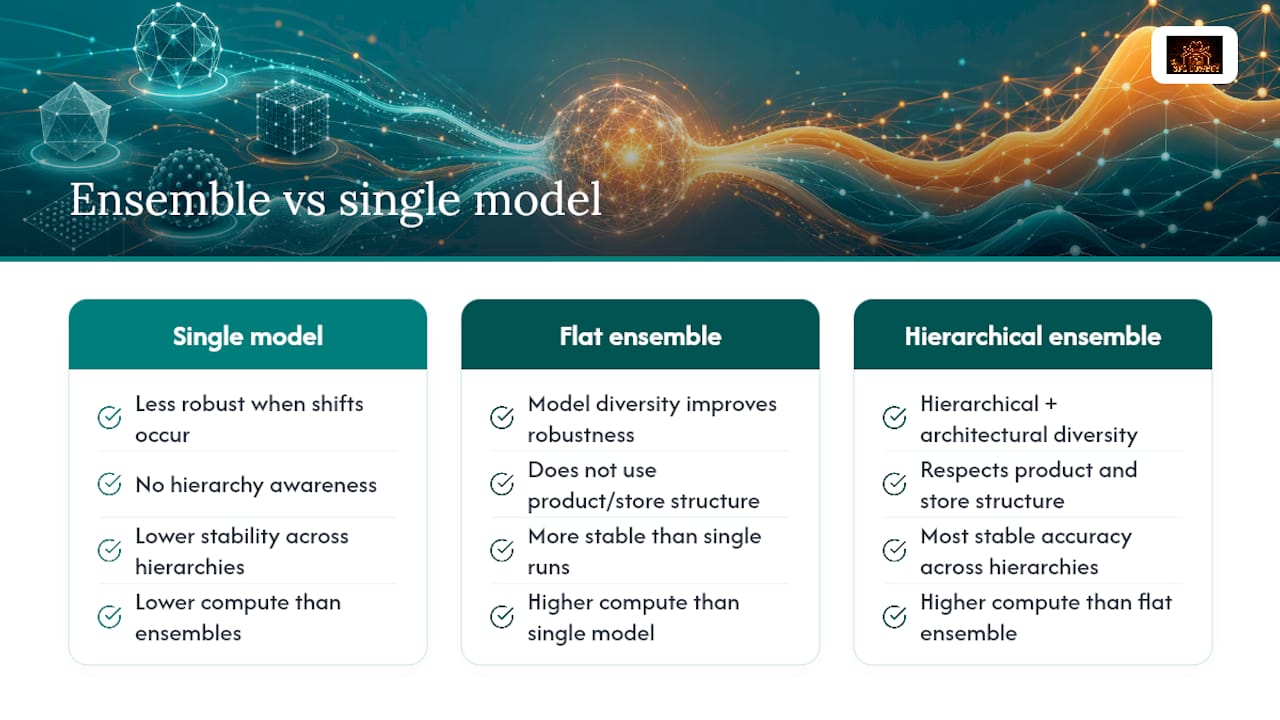
Ensembling multiple models, and specifically hierarchical ensembles that respect product and store structure, improves robustness when demand patterns shift unexpectedly. Research on unified ensemble frameworks shows this combination of hierarchical and architectural diversity produces more stable accuracy across product and store hierarchies than any single model run alone.
Post-training corrections are the sleeper technique. Instead of retraining an entire model every time drift appears, a model-agnostic correction layer adjusts outputs after the fact. One benchmark study reported accuracy improvements up to 30% using this approach, with far less compute than a full retrain cycle, and the corrections stay auditable, which matters when a planner asks why a forecast moved.
Then there’s the hybrid predictive-prescriptive approach: coupling the forecasting model directly with the optimization engine that decides order quantities.
When forecasting and inventory optimization are trained end-to-end rather than in sequence, the gains compound. One hybrid LSTM-plus-MILP framework reduced forecast error and stockouts significantly in tested datasets, as the optimization objective guided forecast improvements.
The trade-off across all three: validation budget and retraining cadence. Post-training corrections need less compute than ensembling; hybrid systems need the most upfront integration work but pay it back in inventory cost, not just forecast accuracy.
What Does an AI Forecasting Rollout Actually Cost and Take?
Most failed pilots die on data readiness, not model quality. Before evaluating any vendor, confirm you have clean SKU hierarchies, consistent promotion flags, and at least two years of sales history with stockout periods flagged rather than treated as true zero-demand.
- Audit data quality first: gaps, duplicate SKUs, and unflagged stockouts poison training data before a single model runs
- Map integration points across ERP, WMS, POS, and BI so forecasts actually reach the replenishment system, not just a dashboard nobody checks
- Scope a pilot on one category or region, typically weeks to a few months, before committing to enterprise rollout
- Budget enterprise-wide deployment at several months to a year, depending on SKU count and integration complexity
- Build governance around the automated recommendations: who approves overrides, what SLA applies when the model flags a spike
A platform consultancy like DataTaal’s Microsoft Fabric services illustrates the kind of data-pipeline work that has to happen before a forecasting model ever sees production data, connecting ERP and POS feeds into something a model can actually consume.
Pro Tip: Run your pilot against a naive seasonal-average baseline, not against nothing. If the AI model can’t beat a simple moving average on your own data, the platform cost isn’t justified yet.
What Does This Look Like Across Retail, Manufacturing, and 3PL?
The mechanics shift by industry, but the pattern of the payoff repeats: better inputs, tighter forecasts, fewer costly overreactions.
- Retail and e-commerce: Balancing demand across channels during promotions is where most markdown waste happens; combining ERP and POS data with external signals like weather and market indices produces measurable improvements in both forecast accuracy and inventory positioning.
- Manufacturing: Production planning suffers most from lead-time variability upstream. Better demand signals reduce emergency purchase orders and improve capacity utilization on the shop floor.
- 3PL and fulfillment: Peak planning lives and dies on labor and slotting decisions made weeks in advance. Forecasting that accounts for promotional lift and seasonal peaks reduces the premium labor and overflow-space costs that come from guessing wrong in November.
What Actually Happens When You Try This On the Warehouse Floor
Case studies on paper rarely mention what breaks first: planner trust. The forecast is only as good as the operational discipline behind the data feeding it.
Before scoring a vendor demo, ask three questions:
- Does the model handle your slowest-moving 20% of SKUs, or only the fast movers used in the demo?
- What happens when a promotion isn’t flagged correctly in the data feed?
- Who owns the override when the model and the planner disagree?
A forecast that planners don’t trust gets manually overridden until it’s worthless. Accuracy on a benchmark means nothing if the warehouse floor ignores the number.
Advisory support during vendor selection, the kind 3plcowboy provides for brands evaluating fulfillment partners and technology, tends to shorten this evaluation cycle by applying the same underwriting-grade diligence to software claims that it applies to 3PL contracts.
Ready to Pilot AI Forecasting Without the Guesswork?
Picking a forecasting platform on a sales call is the same mistake as picking a 3PL off a referral: you’re buying a promise, not a proof point. 3plcowboy applies operator-grade diligence to both decisions, because forecasting accuracy only matters if it connects cleanly to the fulfillment network actually executing on it. If you’re scoping a pilot, evaluating vendors, or trying to figure out whether your current 3PL can even act on better forecasts, 3plcowboy’s advisory services bring 17-plus years of operating experience to that evaluation, not theory.
Where to Read Further on This
- IBM’s explainer on AI demand forecasting covers foundational definitions and outcomes
- Oracle’s overview of AI in demand forecasting details external-signal integration
- Post-training correction methods paper for the technical mechanics behind low-cost accuracy gains
- Hybrid forecasting-optimization framework for coupled predictive-prescriptive results
- MDPI’s literature review for a broad survey of ML/DL adoption trends
Where the Real Leverage Sits in This Technology
The academic literature has moved faster than most implementations. Post-training corrections and hybrid predictive-prescriptive systems already exist in published research showing double-digit accuracy gains, yet most companies still evaluate forecasting platforms purely on model architecture, as if a better LSTM alone solves the problem.

It doesn’t. The conventional advice treats forecasting as a data science project. It’s an operations project with a data science component.
Prioritize the coupling between forecast and action before the coupling between features and architecture. Get the data pipeline clean, get the integration into ERP and WMS solid, and get planners trained to trust the intervals, not just the point estimate. The model upgrade can come second. Most of the accuracy gains published in current research assume that operational foundation already exists, and most companies evaluating a pilot don’t have it yet.
Frequently Asked Questions
What is AI demand forecasting in simple terms?
It’s the use of machine learning models, trained on historical sales and external data like weather, promotions, and pricing, to predict future demand more accurately than traditional statistical methods and update those predictions as new data arrives.
How much can AI improve forecast accuracy?
Treat vendor-quoted ranges as directional until validated on your own data.
What data do I need to start an AI forecasting pilot?
Clean historical sales data with stockout periods flagged, promotion and pricing calendars, lead-time records, and channel splits. Weather and event data help for categories with seasonal or local demand swings.
Do I need a data science team to run this?
Not necessarily for a pilot. Many platforms package the modeling layer, but you still need someone who understands your SKU hierarchy and can validate outputs against a naive baseline before trusting the system for replenishment decisions.
How is this different from traditional demand planning software?
Traditional systems typically rely on moving averages or simple exponential smoothing. AI demand forecasting incorporates nonlinear relationships, external signals, and probabilistic outputs, which traditional tools generally don’t produce.
Sources
- What is AI demand forecasting? | IBM
- AI in Demand Forecasting: Overview, Use Cases, & Benefits | Oracle
- Post-Training Corrections for Improved Time-Series Forecasting
- Hybrid Deep Learning Approach for Coupled Demand Forecasting and Supply Chain Optimization
- A comprehensive review of ML and DL models for demand forecasting (MDPI, 2024)