Omnichannel fulfillment is the practice of unifying inventory data and order routing across every sales channel so a single system decides the best node, store, or warehouse to ship from. The payoff is direct: retailers hit delivery promises more consistently while cutting fulfillment cost per order. It runs on two systems working together, an order management system (OMS) for routing decisions and a warehouse management system (WMS) for execution on the floor.
TL;DR:
- Ensuring real-time inventory updates and eliminating silos can significantly reduce order cancellations and increase fulfillment accuracy.
- Proper system integration with event-driven architecture minimizes latency and duplicate events, which are critical for reliable omnichannel operations.
- Selecting fulfillment models based on SKU velocity, store readiness, and delivery speed helps optimize cost and customer experience effectively.
- Regular inventory audits, KPI monitoring, and staff training are essential for maintaining accurate stock data and avoiding operational failures.
- Involving experienced operators or advisory services can identify root causes of underperformance and guide phased, successful omnichannel rollouts.
Table of Contents
- Why Omnichannel Fulfillment Matters for Retailers Today
- What Systems Make Up an Omnichannel Fulfillment Stack?
- Which Fulfillment Model Fits Which Order?
- What Operational Problems Break Omnichannel Programs?
- How Should You Roll Out Omnichannel Fulfillment?
- Which KPIs Actually Tell You Omnichannel Fulfillment Is Working?
- How Do You Handle Returns Without Killing Margin?
- Your Pre-Launch and Scale-Up Checklist
- An Operator’s View on What Actually Breaks First
- When Should You Bring in an Operator-Led Advisory?
- Sources
Why Omnichannel Fulfillment Matters for Retailers Today
The business case isn’t theoretical. When a customer can’t find what they want, or an order gets canceled after checkout, that’s a lost sale and a damaged relationship, full stop. Omnichannel fulfillment closes that gap by giving every channel a real-time view of the same inventory pool instead of siloed, channel-specific stock.
A study of 46,000 shoppers by Harvard Business Review found that 73% used multiple channels during a single purchase journey. That’s not a niche behavior pattern. It’s the default.
If your systems can’t track a customer moving from a mobile browse session to an in-store pickup to a home delivery for a different item, you’re building for a shopper who no longer exists. A unified approach delivers four concrete outcomes:
- Higher availability, because stock committed to one channel isn’t invisible to the others
- Fewer cancelled orders, since promises are made against real, current inventory rather than a stale batch feed
- Faster, more consistent delivery, which drives both first-time conversion and repeat purchase rate
- Lower carrying costs, because pooled inventory means you need less total safety stock to protect the same service level
That last point gets underweighted. Retailers running channel-specific inventory silos routinely carry redundant buffer stock in two or three places at once. Pool it, and you free up working capital without touching your service level.
What Systems Make Up an Omnichannel Fulfillment Stack?
Four systems do the heavy lifting, and each has a distinct job. Confuse the roles and you’ll build a stack that looks sophisticated on a whiteboard but breaks the first time volume spikes.
The OMS is the orchestration layer. It’s where distributed order management (DOM) logic lives, the rules engine that decides whether an order ships from a nearby store for speed or from a central distribution center to avoid a split shipment. Per Shopify’s guide to omnichannel order management, this orchestration capability is what lets you actually encode trade-offs between speed, cost, and inventory health instead of guessing.
The WMS is the system of record for every inventory transaction and pick, pack, and ship execution. If your WMS and OMS disagree about what’s on a shelf, nothing downstream works.
The ERP holds master data and financial integrity: costs, taxes, vendor terms, the numbers finance actually trusts.
The POS is the source of truth for every in-store event, a sale, a return, a shelf pull for a BOPIS order.
According to Avenga’s guide to omnichannel fulfillment, these systems typically connect through cloud-based, event-driven integrations rather than nightly batch jobs. That distinction matters operationally: batch syncing means your online storefront can sell inventory that already left the building three hours ago. Event-driven architecture publishes inventory and order changes the moment they happen, and every connected system subscribes to that stream.
The two failure modes to watch for are latency (a delayed event makes one system’s inventory picture stale) and duplicate events (a retry mechanism fires the same update twice, overcounting stock). Before launch, run this integration checklist:
- Force a store-level sale and confirm the OMS updates available-to-sell (ATS) within your target latency window
- Simulate a duplicate event and verify the receiving system deduplicates instead of double-counting
- Cancel an order mid-fulfillment and confirm inventory reverts correctly across all three systems
- Test a network outage scenario and confirm queued events replay in order once connectivity restores
Pro Tip: Run your integration tests during a simulated peak load, not off-hours. Latency problems that look trivial at 50 orders an hour often become order-cancelling failures at 500.
Which Fulfillment Model Fits Which Order?
Retailers rarely pick one fulfillment model. They run several in parallel, and choosing the right one per order is exactly what your orchestration rules need to handle.
- BOPIS (buy online, pick up in store): fastest customer turnaround, zero shipping cost, but it demands tight in-store pick accuracy and a dedicated staging area
- Curbside pickup: an extension of BOPIS with lower friction for the customer, higher coordination burden for store staff
- Ship-from-store: turns a store into a micro-fulfillment center, ideal for dense urban markets where a store sits closer to the customer than any DC
- Ship-to-store: consolidates online orders at a store for pickup, useful for slow-moving or oversized items
- DC-first fulfillment: the default for standard shipping, lowest per-unit labor cost, but the slowest option and the most prone to split shipments on multi-item orders
- Hybrid routing: blends all of the above based on live inventory position and delivery promise, which is the direction most mature programs are heading
The trade-off is always the same triangle: speed, cost, and labor burden. Ship-from-store wins on speed but strains store staff who are also expected to serve walk-in customers. DC-first wins on cost but loses the last-mile speed advantage.
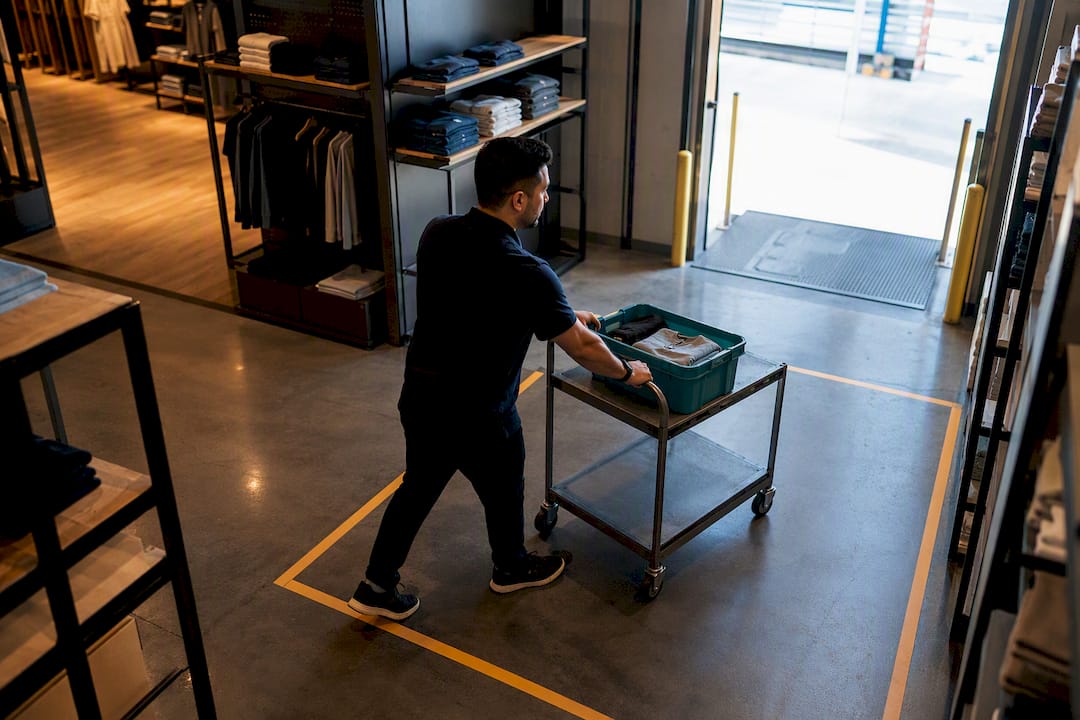
A few rules of thumb make SKU and store selection less painful. High-velocity, high-margin SKUs are strong ship-from-store candidates; bulky, low-margin items usually aren’t worth the labor cost. Store readiness matters more than store size, a location with strong inventory accuracy and a motivated manager will outperform a bigger store with sloppy counts. And you’ll likely need to physically redesign part of the sales floor, carving out a staging zone near the entrance or loading dock so pickers aren’t weaving through customer traffic during peak hours.
What Operational Problems Break Omnichannel Programs?
Most omnichannel failures trace back to five predictable points, and each one has a known fix.
- Inventory accuracy drift. Scanning discipline erodes over time, and small errors compound. Enforce barcode scanning at every touch point, run cycle counts weekly on your highest-velocity SKUs, and reconcile ledger states daily rather than monthly.
- Delivery promise inaccuracy. A static “ships in 2 days” promise ignores current carrier performance and live inventory position. Tie your promise engine to dynamic routing that checks both.
- Split shipments eating margin. Set allocation rules that batch multi-item orders to a single node whenever inventory allows, and set a cost threshold above which the system defaults to consolidated shipping over speed.
- Store staffing strain. Give pickers defined pick windows and prioritize SKUs by order deadline, not by aisle location. Build an exception workflow for out-of-stock-at-pick situations so an order doesn’t just stall silently.
- Returns fraud and abuse. Set disposition rules that flag repeat return patterns and cap acceptable return windows per channel.
Buske’s guide to omnichannel logistics makes the case plainly: without a single source of truth for inventory, every other omnichannel promise you make to customers eventually breaks. Fix visibility first, and half these problems shrink on their own.
Pro Tip: Reconcile your inventory ledger daily during the pilot phase, even if your long-term target cadence is weekly. Early drift is cheap to catch and expensive to unwind once volume ramps.
How Should You Roll Out Omnichannel Fulfillment?
The single biggest mistake operations teams make is treating omnichannel fulfillment as a big-bang systems launch instead of a phased operational rollout. Shopify’s own guidance on aligning shopping channels is explicit on this: start with a pilot at a handful of high-volume stores, prove BOPIS works, then layer in ship-from-store and expand your orchestration rules from there.
A workable roadmap has three stages:
- Pilot: select stores with strong inventory accuracy and management buy-in, define your rollback triggers up front (what accuracy or fill-rate drop pulls the plug), and run it for a full peak and non-peak cycle before scaling
- Expand: add stores in order of readiness, not geography, and widen the orchestration rules to cover more order types
- Optimize: shift from stabilizing operations to tuning routing logic against live KPI data
Store selection deserves real scrutiny, since a location with weak management or thin inventory throughput will sink your pilot’s credibility regardless of how good your technology is.
If you’re bringing in a third-party logistics partner for DC-side execution, vet them against four criteria: real API-level visibility into their WMS (not a portal you check manually), documented SLAs tied to actual performance data, proven peak-season capacity, and a clear data ownership agreement so you’re never locked out of your own inventory history. 3plcowboy’s 3PL selection and diligence framework exists precisely because most brands evaluate 3PLs on a sales call instead of underwriting the operational fit. Governance matters just as much: define who owns performance reporting, what escalation path triggers when a KPI slips, and how often you review the partnership against the original SLA.
Which KPIs Actually Tell You Omnichannel Fulfillment Is Working?
Six metrics matter more than the rest, and most retailers only track two or three of them.
- Available-to-sell (ATS) accuracy, the percentage match between system-reported inventory and physical stock
- Fill rate, the share of orders fulfilled complete from the first-assigned node
- On-time-in-full (OTIF), whether the order arrived on the promised date, complete
- Return rate, tracked by channel and by SKU category
- Fulfillment cost per order, broken out by fulfillment model so you can see which one is actually cheaper in practice, not just on paper
- Split-shipment rate, since a rising trend here usually signals an allocation rule that needs tightening
These numbers should directly set your delivery promise tiers. When fill rate drops below your threshold, say 95% for a top-tier promise, the system should automatically downgrade that node’s promise window rather than let it silently miss commitments. Treat KPI thresholds as live triggers, not quarterly reporting line items.
How Do You Handle Returns Without Killing Margin?
Reverse logistics is where a lot of omnichannel programs quietly bleed money. Shopify’s data suggests retailers are estimating return rates near 15.8% for 2026, and at that volume, disposition decisions add up fast.
The core question for every return is where it should land. In-store processing works well for items that can go straight back on the shelf, quick inspection, quick restock, no shipping cost. Returns centers make more sense for items needing deeper inspection, refurbishment, or liquidation routing.
- Set clear inspection criteria so store staff aren’t guessing whether an item is sellable
- Build disposition rules (resell, refurbish, liquidate, discard) before volume hits, not after
- Automate label generation and routing decisions wherever return volume is high enough to justify it
- Route returns away from low-velocity stores, since dumping returned stock there just creates dead inventory pockets instead of solving the problem
Every return also needs to hit your ATS feed immediately, not at end of day. A returned item sitting unlogged for six hours is inventory your OMS thinks doesn’t exist, and that’s a cancelled order waiting to happen.
Your Pre-Launch and Scale-Up Checklist
Before you flip the switch on a pilot, work through this sequence:
- Run a full physical inventory audit against system records at every pilot location
- Execute the integration test suite covering latency, duplicates, and rollback scenarios
- Finalize your pilot SKU list based on velocity and margin, not convenience
- Train store staff on picking priority, exception handling, and the staging workflow
| Phase | Priority Actions |
|---|---|
| Pre-launch | Inventory audit, integration testing, SKU selection, staff training |
| Launch | Monitor ATS accuracy and fill rate daily, enforce rollback triggers, keep store teams looped in on changes |
| Post-launch | Weekly KPI review cadence, governance check-ins, plan tooling upgrades as volume grows |
Skip step one and everything downstream inherits bad data.
An Operator’s View on What Actually Breaks First
Every rollout I’ve reviewed hits the same wall before it hits a technology wall: culture. Store teams credited on channel-specific sales resist fulfilling online orders that don’t count toward their number, and that friction kills more pilots than any system integration ever does. The technical fixes, cycle counts, event-driven syncing, DOM rules, are the easy half.
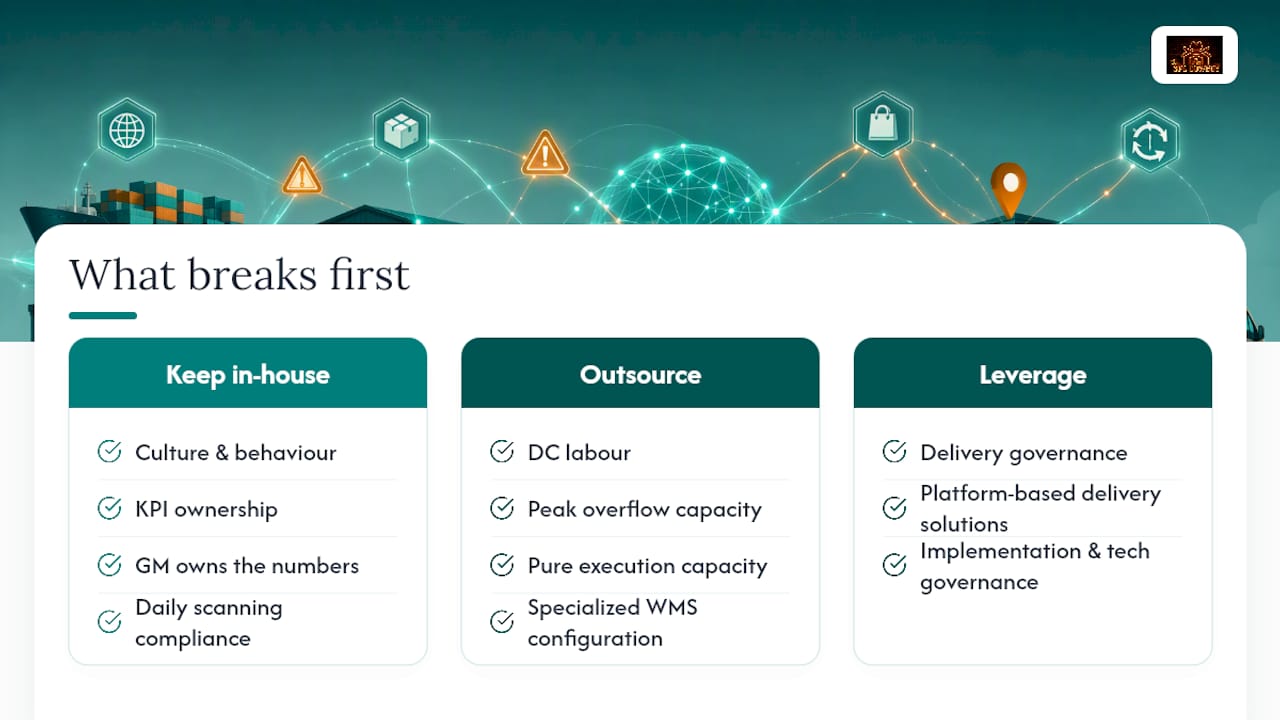
It was a discipline lesson: scanning compliance and reconciliation cadence, enforced daily, not audited quarterly. The same principle held during an 8-month WMS rollout across 60-plus Sysco sites, where the sites that succeeded fastest weren’t the ones with the newest technology, they were the ones with a general manager who owned the numbers personally.
If you’re deciding what to keep in-house versus outsource, keep culture and KPI ownership in-house always, while leveraging delivery governance and platform-based delivery solutions for implementation and technology governance. Outsource the parts that are pure execution capacity, DC labor, peak overflow, specialized WMS configuration, where a partner’s scale beats your internal build time.
— Michael
When Should You Bring in an Operator-Led Advisory?
Most omnichannel rollouts don’t fail on strategy. They fail on execution gaps nobody underwrote before signing a contract. That’s the exact problem 3plcowboy exists to solve: an operator-led advisory, not a broker with a warehouse to fill, applying the same underwriting discipline to your fulfillment decisions that a lender would apply to a loan.

Different phases call for different support. If you’re evaluating 3PL partners for DC-side execution, 3PL selection and diligence benchmarks their tech visibility, SLA history, and peak capacity before you sign anything. If your existing network is already live but underperforming on fill rate or cost per order, 3PL operations advisory digs into the operational root cause instead of just recommending new software. And if node placement itself is the bottleneck, distribution network design maps where your stores and DCs should actually sit relative to demand density.
Clients typically come out the other side with tighter ATS accuracy, a governed rollout timeline instead of a stalled pilot, and a defensible cost-per-order baseline. If you’re staring down a pilot decision right now, start with a conversation about your brand’s fulfillment strategy.
Sources
- A study of 46,000 shoppers shows that omnichannel retailing works | Harvard Business Review
- Omnichannel fulfillment 101: A complete guide from Avenga
- Omnichannel order management guide (Shopify Enterprise)