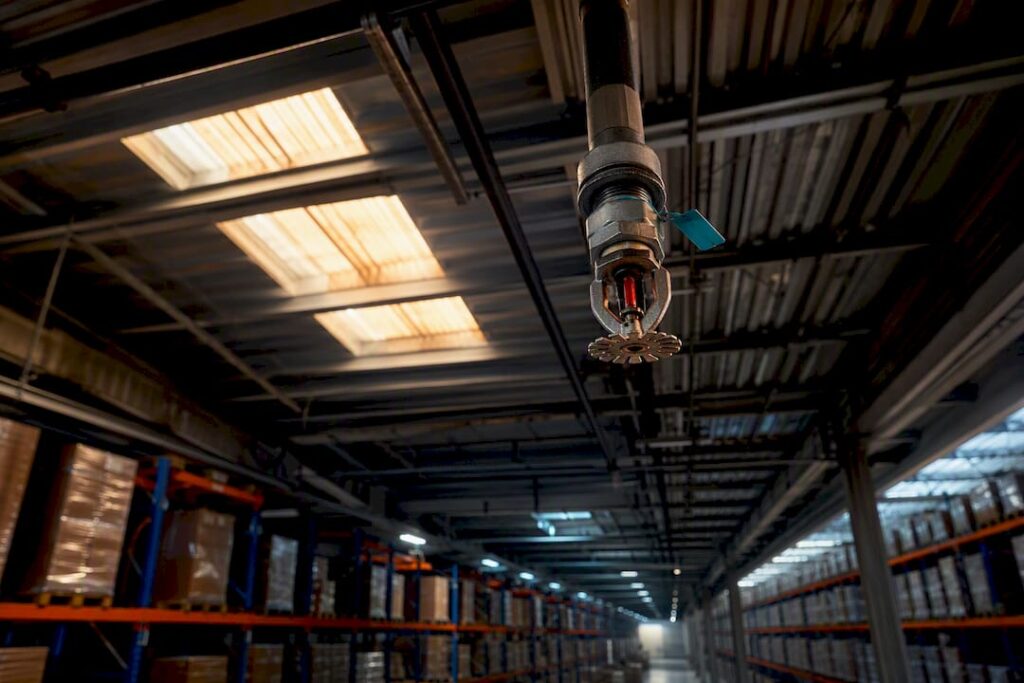
For U.S. ESFR installations, verify four numbers before you commit to a layout: a minimum deflector-to-storage clearance, a minimum horizontal separation from structural bottom chords, and a maximum ceiling slope of about 16.7%, and a K-factor matched to your storage height under the sprinkler’s specific manufacturer listing. NFPA 13 sets the floor, but manufacturer data sheets frequently impose tighter limits, and whichever number is stricter is the one your AHJ will enforce.
TL;DR:
- Confirm that deflector-to-storage clearance, structural separation, and ceiling slope meet tighter manufacturer limits beyond NFPA 13 standards.
- Verify sprinkler K-factor matches specific storage height, ceiling height, and commodity classification before finalizing layout.
- Ensure obstructions like ducts, lights, and catwalks are documented and avoid crossing within 12 inches of the deflector for optimal performance.
- Make obstruction modifications on drawings before installation, as post-build changes are costly and often cause inspection failures.
- Regularly recheck for obstructions and update the layout during rack or lighting reconfigurations to maintain compliance over the system’s lifespan.
Table of Contents
- Esfr Sprinkler Requirements at a Glance
- Dimensional Requirements: Spacing, Clearance, and Height Limits
- How Obstructions Change ESFR Sprinkler Performance
- Choosing a Listed ESFR Sprinkler for Your Storage Configuration
- Hydraulic Design: Pressure, Remote Area, and Water Supply
- Field Installation Practices That Prevent Failed Inspections
- Inspection, Testing, and Maintenance Over the System’s Life
- AHJ Submittal Checklist for ESFR Installations
- What NFPA 13 Expects ESFR Sprinklers to Do in a Real Fire
- When ESFR Sprinklers Are Not the Right Choice
- An Operator’s Take on ESFR Tradeoffs
- Sources
Esfr Sprinkler Requirements at a Glance
Before you spend engineering hours on a full hydraulic model, run the layout against these pass/fail checks. Each one has failed a real submittal somewhere, which is why inspectors ask about it first.
- Ceiling height: confirm it falls within the sprinkler’s listed envelope, not just NFPA’s general table.
- Storage height: measure to the top of the highest anticipated load, not the rack’s nominal height.
- Commodity classification: Class I through IV, plastics, or mixed. This drives everything downstream.
- K-factor minimum: check that the selected head’s K-factor is actually listed for your ceiling and storage combination.
- Clearances: 36 in deflector-to-storage, 12 in from structural members.
- Obstruction mapping: lights, ducts, catwalks, and bar joists documented on a layout overlay.
- Water supply: confirm the site’s available pressure and flow can hit the design demand at the highest, most remote head.
When you submit, expect the authority having jurisdiction to ask for hydraulic calculations, rack and commodity documentation, sprinkler cut sheets with the specific-application listing statement, and an obstruction overlay drawing. Missing any one of those four is the single most common reason ESFR submittals bounce back for revision.
Dimensional Requirements: Spacing, Clearance, and Height Limits
The dimensional rules for ESFR sprinkler spacing are less forgiving than standard sprinkler design, and the Fire Protection Research Foundation’s obstruction testing explains why: the downward, high-momentum spray pattern that makes ESFR heads effective also makes them sensitive to anything nearby that can deflect water before it reaches the fuel.
Here’s what governs the layout:
- Deflector-to-storage clearance: 36 inches (914 mm) minimum, measured from the deflector to the top of storage. This is the single most-cited clearance in NFPA 13 and appears on every current manufacturer data sheet.
- Horizontal separation from structural members: 12 inches minimum from the nearest edge of a bottom chord or bar joist. When a structural member is deeper than 12 inches, the sprinkler typically needs to be installed within the channel that member creates, not straddling it.
- Maximum ceiling slope: 2 in/12. Beyond that, ESFR listings generally do not apply without engineering justification.
- Ceiling and storage height limits: vary by K-factor and listing. A K14.0 head covers a narrower height band than a K25.2 head; always check the specific-application table rather than assuming a blanket NFPA 13 maximum applies.
- Coverage area: minimum 64 square feet per sprinkler, with most listings capping out around 100 square feet.
- Head spacing: typically 8 to 12 feet between sprinklers, tightening as ceiling height increases.
One detail that trips up designers coordinating with European-trained engineers or imported equipment: K-factor notation differs by convention. Metric documents reference K240 or K320, while U.S. paperwork lists the same heads as K22 or K24, using imperial units (gpm/psi½ instead of L/min/bar½). Confirm which convention a given data sheet uses before comparing numbers across documents.
How Obstructions Change ESFR Sprinkler Performance
ESFR heads don’t tolerate obstructions the way standard spray sprinklers do. A duct or catwalk that a conventional system shrugs off can disrupt an ESFR spray pattern enough to leave a real gap in coverage, because the entire suppression strategy depends on large droplets reaching the fuel package with enough force to penetrate the fire plume, according to QRFS’s ESFR explainer.
The core rule is the 12-inch horizontal separation from bottom chords and bar joists. When a structural member’s depth exceeds 12 inches, the fix isn’t to nudge the head sideways. It’s to install the sprinkler inside the channel the member forms, keeping the discharge path clear on both sides.
Beyond structural members, watch for these obstruction categories:
- Lighting fixtures and conduit runs positioned below or adjacent to the deflector plane.
- HVAC ductwork and cable trays wider than a few inches that sit within the discharge cone.
- Catwalks and mezzanine framing that can shadow multiple heads at once.
- Sprinkler piping itself, when branch lines cross too close to another head’s spray pattern.
When an obstruction can’t be avoided, you have four practical options: relocate the head, add a branch line to reposition coverage, install in a channel as described above, or fall back to in-rack sprinklers if ceiling-level protection can’t clear the obstruction. Testing conducted by the Fire Protection Research Foundation has shown that some encroachments beyond the standard limits still perform acceptably, but only with documented test data or engineering analysis backing the deviation, not a general assumption that “it’s probably fine.”
Pro Tip: Build the obstruction overlay before you order a single fitting. Reworking sprinkler locations after steel and ductwork are already up costs far more than adjusting a drawing.
Choosing a Listed ESFR Sprinkler for Your Storage Configuration
The K-factor you select determines what ceiling and storage heights you can protect without in-rack sprinklers, so this decision should happen before you finalize rack layout, not after.
Manufacturer data sheets, like the TYCO Model ESFR-1 14.0K sprinkler data sheet, the TYCO Model ESFR-17 16.8K sprinkler data sheet, and the TYCO Model ESFR-25 25.2K sprinkler data sheet, lay out the application envelope for each K-factor family:
- K14.0 and K16.8: cover most standard warehouse ceiling heights and moderate storage heights, common in general commodity and light-plastic applications.
- K25.2 (K240 family): listed for taller storage and ceiling combinations, sometimes up to 40 feet of storage under 45-foot ceilings depending on the specific listing, and can eliminate the need for in-rack sprinklers in configurations that would otherwise require them.
- Dry-type and orientation variants: exist for freezer and refrigerated storage, where a standard wet pendent isn’t an option.
Verify the UL or FM specific-application listing before finalizing anything. A sprinkler that looks correct on a generic spec sheet can still be unlisted for your exact ceiling height, storage height, and commodity class combination. Follow the manufacturer’s torque and handling instructions to the letter; NFPA 13 sets the design framework, but the manufacturer’s listing conditions govern installation details, and where the two diverge, the stricter requirement wins.
Hydraulic Design: Pressure, Remote Area, and Water Supply
Hydraulic feasibility is often what actually decides whether ESFR works for a given building, more than any spacing rule.

Design guidance commonly references a minimum starting pressure commonly referenced for K240-family designs used to eliminate in-rack sprinklers under NFPA 13 parameters, per Industrial Monitor Direct’s compliance guide. Lower K-factor heads may need higher pressure to deliver the same flow, which changes your pipe sizing math.
Key hydraulic considerations:
- Remote area assumptions: ESFR designs typically use a 12-sprinkler remote area for hydraulic calculations, larger than many conventional systems, which drives pump and piping capacity.
- K-factor tradeoffs: a higher K-factor head can reduce the pressure needed at the sprinkler, but it demands more flow, which can push pipe sizes up even as pressure requirements drop.
- Water supply verification: confirm the site’s available supply curve intersects the system demand curve with margin, not just at the theoretical minimum.
- AHJ deliverables: expect to submit the system’s supply curve, the demand curve, and the minimum pressure at the hydraulically most remote sprinkler.
Water supply constraints are frequently the real reason a project reverts to in-rack sprinklers or a combination system, not a spacing failure.
Field Installation Practices That Prevent Failed Inspections
Most ESFR noncompliance findings trace back to installation errors, not design errors. The layout on paper was fine; the field execution wasn’t.
- Torque and wrenching: manufacturer data sheets specify torque ranges and approved wrench types for each sprinkler model. Over-torquing or using the wrong tool can damage the thermal-sensitive element without any visible sign of failure.
- Deflector plane verification: confirm the deflector sits level and at the correct distance from both the ceiling and the top of storage during installation, not just at design.
- Channel installations: when a sprinkler sits inside a structural channel, verify branch line routing doesn’t reintroduce the obstruction the channel install was meant to avoid.
- Handling the fusible element: dropping or bumping a sprinkler head during install can compromise the thermal-sensitive element long before it’s ever exposed to heat.
- Pre-installation walkdown: walk the ceiling grid against the shop drawings before pipe goes up, while changes are still cheap.
Pro Tip: Photograph every channel installation and every obstruction workaround as it’s built. When the inspector asks how a deviation was handled, a timestamped photo settles the question faster than a verbal explanation.
Inspection, Testing, and Maintenance Over the System’s Life
ESFR systems need the routine inspection intervals NFPA 25 requires for any wet-pipe system, plus a few checks specific to how sensitive ESFR heads are to layout changes.
- Routine NFPA 25 intervals: quarterly, annual, and five-year inspections apply as they would to any sprinkler system.
- Post-change obstruction re-survey: any time racking, lighting, or ductwork changes, re-check the obstruction map. A retrofit that adds conduit above a rack aisle can silently violate the 12-inch rule that passed inspection years earlier.
- Replacement triggers: heads exposed to corrosive atmospheres, physical impact, or paint overspray should be replaced, not cleaned and reused.
- Documentation: log every layout change with a date, a description, and a photo. When an AHJ revisits the facility years later, that log is what proves the system still matches its original design basis.
Treat any racking or lighting retrofit as a trigger for an obstruction re-check, not an afterthought after the work is done.
AHJ Submittal Checklist for ESFR Installations
A clean submittal package moves faster through plan review because it answers the questions before an inspector has to ask them.
| Deliverable | What it should show |
|---|---|
| Hydraulic calculations | Demand curve, supply curve, minimum pressure at the most remote head |
| Rack and commodity documentation | Storage height, commodity classification, rack configuration |
| Sprinkler cut sheets | K-factor, specific-application listing statement, orientation |
| Obstruction overlay | Structural members, ducts, lights, catwalks mapped against sprinkler locations |
| Shop drawings | Channel installs called out explicitly where structural depth exceeds 12 inches |
| Maintenance plan | NFPA 25 inspection schedule and change-log procedure |
Building the obstruction overlay as a single reference sheet, rather than scattering that information across multiple drawings, resolves most of the RFIs that slow down ESFR reviews. If you need help structuring vendor specifications and RFP documentation around these deliverables, warehouse RFP management support can fold fire protection requirements directly into procurement paperwork.
What NFPA 13 Expects ESFR Sprinklers to Do in a Real Fire
ESFR sprinklers operate in suppression mode, not the control mode most conventional storage sprinklers use. That distinction matters because it changes what NFPA 13 expects the system to accomplish during an actual fire event.
A control-mode system is designed to limit a fire’s growth and hold it in check until manual suppression arrives. An ESFR system is designed to actually suppress the fire on its own, using large droplets and a fast-responding thermal element to hit the fuel package hard and early, before the fire can develop into a large plume. That’s the entire reason ESFR heads carry such large K-factors and why obstruction tolerance is so tight: the suppression strategy only works if the full discharge pattern reaches the burning commodity in the first critical minutes.
This performance expectation is also why commodity classification matters so much to ESFR design. A system correctly designed for Class II commodities won’t necessarily suppress a fire involving unexpanded Group A plastics stored in the same racks. NFPA 13’s storage tables tie sprinkler selection, ceiling height, and storage height directly to commodity class because the fire’s heat release rate, not just its size, determines whether suppression mode can keep pace.
Any change to what’s actually stored in a facility, not just how it’s arranged, should trigger a review of whether the installed ESFR system still matches the fire scenario it was designed to suppress.
When ESFR Sprinklers Are Not the Right Choice
ESFR isn’t a universal upgrade over conventional sprinkler protection, and NFPA 13 draws real boundaries around where it applies.
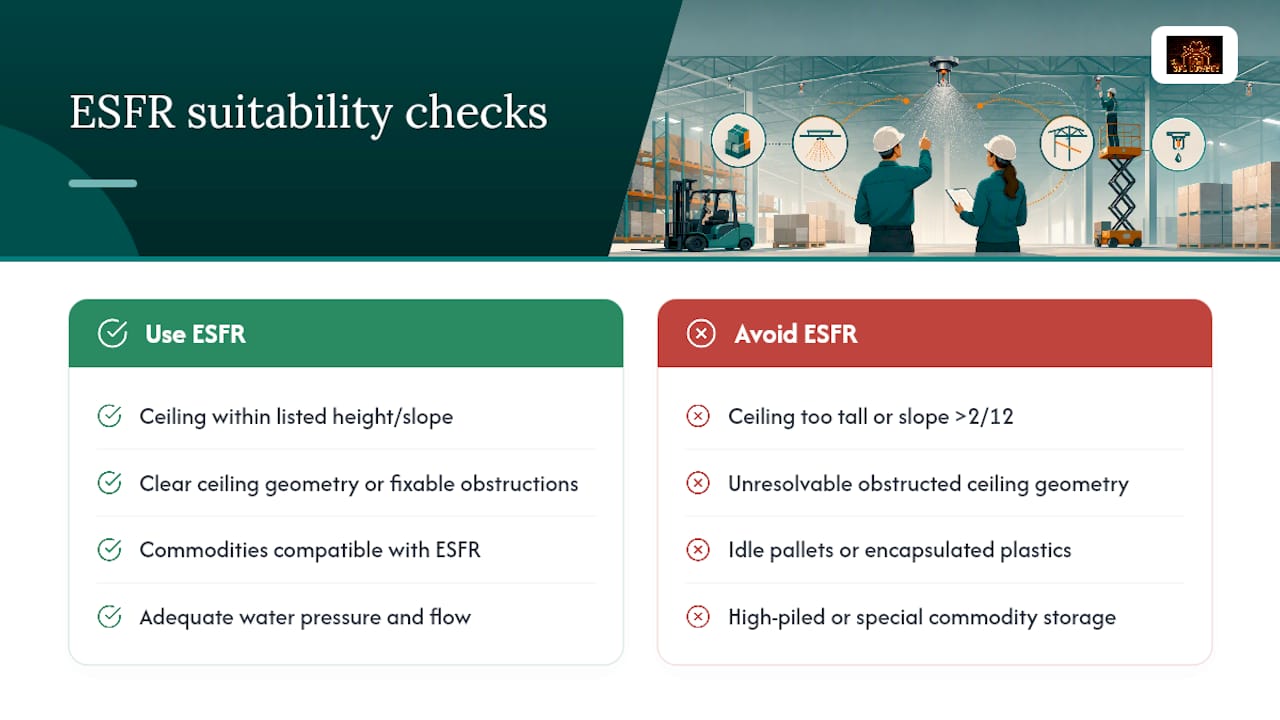
Ceiling height is the first limiter. Buildings with ceilings that exceed the tallest listed ESFR application, or with slopes beyond 2 in/12, fall outside every current listing regardless of K-factor. Buildings with obstructed ceiling geometry that can’t be resolved through channel installs or head relocation, such as dense mechanical penthouses or heavily trussed retrofit structures, often can’t achieve compliant ESFR coverage without extensive and expensive structural modification.
Certain commodity and storage arrangements also push designers back toward alternate protection. Idle pallet storage, some encapsulated plastic commodities, and specific high-piled storage configurations may require in-rack sprinklers or a different protection scheme entirely, even when ceiling height would otherwise allow ESFR. Water supply is the other frequent dealbreaker: a site that can’t deliver the pressure and flow an ESFR design demands isn’t a candidate, full stop, unless the facility invests in supply upgrades or falls back to a lower-K design paired with in-rack protection.
Facilities with rapidly changing storage configurations, seasonal high-piled inventory swings, or frequent racking reconfigurations also deserve a second look. ESFR’s obstruction sensitivity means a system designed once for a static layout can drift out of compliance as operations evolve, which is a maintenance burden some facilities are better off avoiding by choosing a more forgiving protection scheme from the start.
An Operator’s Take on ESFR Tradeoffs
The obstruction overlay is where most ESFR projects actually go wrong, and it’s almost always because someone treated it as a formality instead of a control document. Verify it before fittings get ordered, not after steel is already in the air. A drawing revision is cheap. Relocating installed branch lines around a duct nobody mapped is not.
The upgrade-water-supply-versus-add-in-rack-protection decision deserves real cost modeling, not a gut call. A pump upgrade is a one-time capital cost with predictable long-term maintenance. In-rack sprinklers carry ongoing operational friction, since forklift traffic damages in-rack heads at a rate ceiling-mounted sprinklers never see. Run both scenarios against your facility’s actual damage history before choosing.
Tie obstruction checks to every racking and lighting retrofit workflow, permanently. Facilities rarely fail ESFR compliance on day one. They fail it three years later when someone adds conduit above an aisle and nobody rechecks the 12-inch rule.
If your facility is weighing a new build, a retrofit, or a 3PL transition where ESFR compliance is part of the vendor conversation, 3plcowboy’s 3PL selection and diligence work applies the same underwriting-grade scrutiny to fire protection specs that it applies to labor rates and slotting logic, because a facility that fails inspection on sprinkler coverage is a facility that misses its go-live date.
— Michael