
Peak season planning is the work of matching inventory, warehouse capacity, labor and carrier service to the demand you expect in your busiest weeks, and doing it early enough that you can still change course. For U.S. brands the core window is November 1 through December 31, and today is October 19. If your plan is not locked, this guide shows what to fix first, what to stop worrying about, and how to build the 2027 plan so you are not in this position again.
TL;DR
- Peak is a capacity problem, not just a volume problem. Fewer working days around the holidays push the same orders through a tighter window.
- Do not use last year’s calendar as your plan. Weekdays shift every year, so refresh the forecast against the 2026 calendar.
- If you use a 3PL, get capacity, labor and cutoff commitments in writing, and test the full order flow before volume arrives.
- Run a stress test for the two worst weeks, not for the annual average. A failure in a short peak window costs far more than the same failure in a slow month.
- Real planning starts in the spring or early summer. October is for execution and triage.
Table of Contents
- What peak season planning covers
- Why peak is harder than the volume number suggests
- A peak season planning timeline that works
- Forecast with the calendar, not just last year
- Capacity: space, labor and throughput
- If you use a 3PL: what to confirm now
- Insource, outsource or add overflow
- Pressure-test the plan with a failure drill
- Our perspective
- How we help brands with peak
- What to do this week
- FAQ
- Sources
What peak season planning covers
The phrase gets used loosely. Searchers also ask which months count, what “peak season” means in insurance, and how it differs from the lean season. Here is the short version of each.
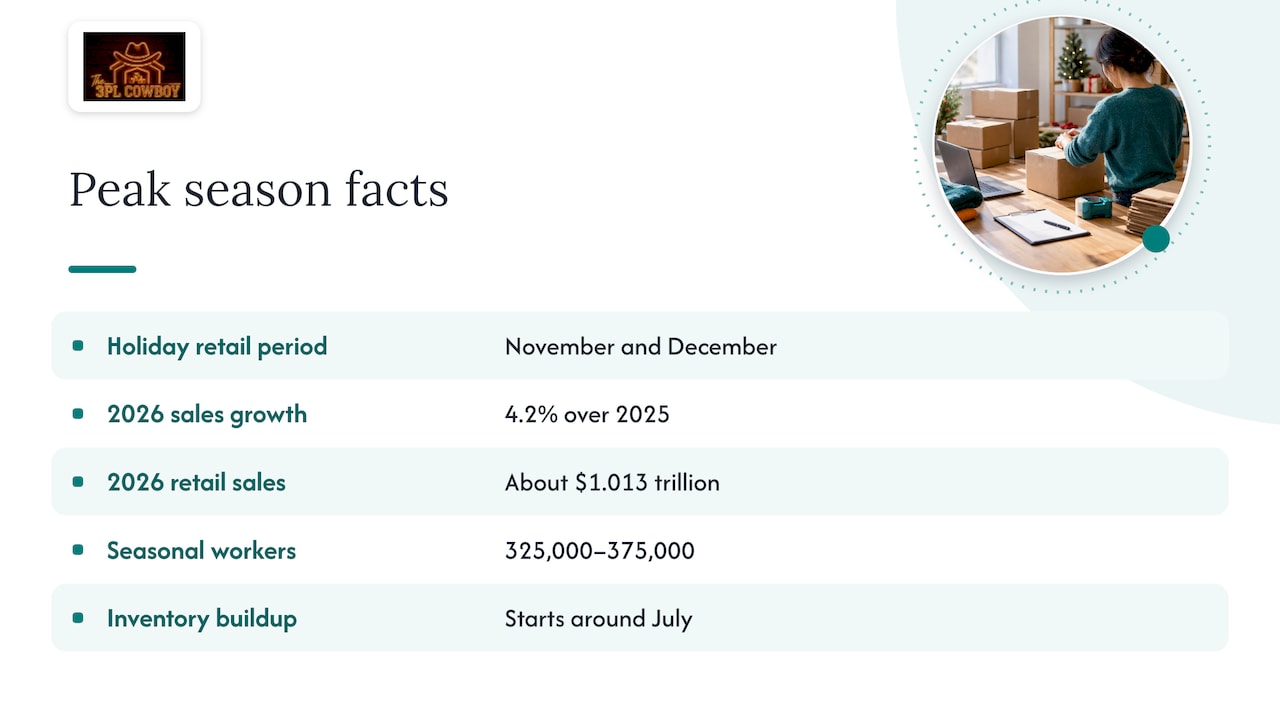
Which months. The National Retail Federation defines the holiday retail period as November and December. Its 2026 forecast calls for sales growth of 4.2% over 2025, about $1.013 trillion, and for retailers to hire between 325,000 and 375,000 seasonal workers. Logistics peaks earlier than retail. Inventory starts accumulating around July for back-to-school and the holidays, so your supply chain peak begins long before November 1.
Insurance. In business insurance, peak season means a stretch when inventory value or activity runs well above normal. Some policies offer peak season endorsements that raise limits temporarily, though most insurers still advise continuous year-round coverage to avoid gaps. If your inventory value triples in Q4, talk to your broker now about limits at peak, not at average.
Peak versus lean. The lean season is when you do the work you cannot safely do in peak: system testing, maintenance, and stress-testing contingency capacity. Risk management guidance treats it as the time for risk improvement, not as downtime.
Why peak is harder than the volume number suggests
A 20% volume increase sounds manageable. The problem is where it lands.
Research on public-holiday logistics shows the same pattern: sales rise while the working days available for logistics processes shrink. Christmas and New Year’s close or slow the network exactly when demand is highest. You are forcing equal or higher throughput into fewer operating days. A forecast built on monthly totals hides that crunch.
Carriers feel it too. The Postal Service said in December 2025 that its package processing capacity had grown to 88 million packages a day, and that peak holiday demand can still roughly double normal daily volume in key late-December periods. Even with added capacity, your parcels compete with everyone else’s on the same few days.
Then there is the cost of failure. A breakdown during a two-week peak window can erase a large share of the year’s profit, while the same breakdown in a slow month is an annoyance. That is why we ask clients to plan against the maximum foreseeable loss in the peak period, not annual averages.
A peak season planning timeline that works
Most guides give you generic tips. A timeline tied to decisions is more useful, because each step closes a door.
| Window | Decision to make | What goes wrong if you skip it |
|---|---|---|
| January to March | Review last peak: service misses, cost per order, dock-to-stock time, overtime | You repeat the same failures with a bigger number |
| April to June | Build the forecast, set capacity needs, confirm or change your 3PL, start RFPs if a switch is possible | Capacity is committed to other brands before you ask |
| June to July | Procure labor, space and packaging; place inbound purchase orders | You compete for the same temps and trailers as everyone else |
| August to September | Receive and slot inventory, load test systems, lock carrier terms | Late inbound blocks the dock when orders ramp |
| October | Run test orders end to end, publish shipping cutoffs, freeze changes | You find integration bugs in the first big sales weekend |
| November to December | Daily control tower: backlog, labor attendance, carrier pickups | Small slips compound into multi-day backlogs |
| January | Debrief while the data is fresh | Next year starts from memory instead of numbers |
Many experienced operators begin peak resource procurement in June or July, and the SBA notes that experienced business owners start holiday planning early for the same reason. If you are reading this in October, you are in the second-to-last row, and the sections below are ordered by what still matters most.
Forecast with the calendar, not just last year
The most common forecasting mistake is copying last year and adding a growth percentage.
Fixed-date holidays land on different weekdays each year, and movable holidays shift across the calendar. The researchers behind the holiday logistics study found that this “calendar effect” makes historical models unreliable, so plans must be refreshed for each year’s weekday pattern. In 2026, ask these questions:
- Which weekdays do Black Friday, Cyber Monday, the last ground-shipping cutoff, December 24 and December 25 fall on this year?
- How many true shipping days does each carrier give you between Thanksgiving and December 24?
- Where do your promotions fall relative to carrier and warehouse closures?
Then build the curve, not the total. Map your inventory accumulation and order ramp over the past three to five years to find your actual ramp-up and ramp-down triggers, instead of leaning on generic quarterly projections. Daily order curves by channel tell you far more than a single Q4 number.
If your forecast error is high in normal months, it will be worse in peak. Our write-up on fixing demand planning covers the first steps to tighten it.
Capacity: space, labor and throughput
Three constraints decide whether you ship on time. Check each one separately.
Space
Peak inventory is higher and lands earlier. Calculate pallet positions needed at the highest point of your inventory curve, plus the overflow you will carry if inbound arrives before outbound clears. If you are close to full at average, you will not have space at peak. See our guide to warehouse capacity planning for ways to free hidden cube before you pay for more.
Labor
Labor is usually the real bottleneck. Compute lines or units per labor hour at your current productivity, divide into your forecast peak day, and add an attendance buffer. Seasonal workers are slower in week one, and the market is competitive: retailers alone are expected to hire hundreds of thousands of seasonal workers this year. Our piece on warehouse labor planning without new software shows how to do this math in a spreadsheet.
Throughput and carrier capacity
The dock, pack stations and parcel pickups cap you even when space and labor are fine. Confirm how many trailers or parcel pickups your carriers will take each day, and what happens when you exceed your tendered volume. Parcel contracts often carry peak and demand surcharges, so read the terms now. Our Parcel & Transportation Strategy work centers on this kind of contract and service-mix review.
A worked example
Say your forecast peak day is 6,000 orders and your pack line currently does 55 orders per labor hour at normal staffing. You need roughly 109 labor hours on that day for packing alone, before picking, receiving and returns. Two missed shifts and a late trailer can erase the cushion. These numbers are illustrative, not benchmarks, but the exercise is the point: do it for every process step, for the worst day, not the average one.
If you use a 3PL: what to confirm now
A 3PL does not remove peak risk. It moves it into a contract and a relationship, and the contract is where most brands are thin. Ask your provider for the following in writing:
- Capacity commitment. How much of your peak volume is reserved, and what is the process if you exceed the forecast by 20% or 40%?
- Labor plan. Headcount by shift, temp agency used, training time, and the productivity assumed for new hires.
- Cutoffs. Order cutoff times, receiving cutoffs for late inventory, and carrier pickup schedules through year-end.
- Peak pricing. Surcharges, minimums, overtime pass-throughs, storage overage rates and any peak fees. Compare them against your agreement line by line.
- Test plan. A scheduled end-to-end test of WMS, order management and store integrations at expected volume.
- Escalation. A named person who answers on Saturdays in December.
If the answers are vague, that is information about how the provider will behave when it gets hard. Use our 3PL selection criteria, built around failure modes, to judge whether the provider can handle a real peak. If you decide a change is needed, do not attempt it between now and January. Document what failed, then start the diligence and RFP in the spring so the new provider is live well before the following October.
Insource, outsource or add overflow
Peak is also when brands ask whether they should have outsourced, or insourced, in the first place. Resist deciding that in November. A single bad peak can distort the analysis, so use the data after the season and compare full-year cost, service and flexibility.
The narrower question for this year is whether to add overflow capacity: a second site or a short-term partner for the weeks when your main node cannot cope. That makes sense when your peak-to-average ratio is high and the cost of missed orders is larger than the premium for temporary space. It does not make sense when it adds inventory splits, extra carrier costs and a second set of systems you have not tested. Our Peak & Overflow Capacity service exists for this decision.
Pressure-test the plan with a failure drill
Before volume arrives, run a short exercise with your operations lead and your 3PL account manager. Pick the five most likely failures and write down what you would do in the first four hours:
- A carrier misses pickups for two days.
- A key SKU is late at the dock and your promotion is live.
- Attendance drops 15% on a peak day.
- Your order management system queues orders and stops releasing to the warehouse.
- A port or inbound delay strands your replenishment.
Guidance on seasonal risk is clear that testing and contingency work belongs outside the peak window, so do what you can this week and note the rest for spring. Our business continuity logistics plan and supply chain risk assessment playbooks give you a structure for the drill.
Our perspective
We have run operations on the inside, and the pattern we see is consistent: brands plan for volume and get hurt by density. Everyone has a Q4 number. Few have a worst-week number, a labor plan with attendance assumptions, and a contract that says what happens when the forecast is wrong.
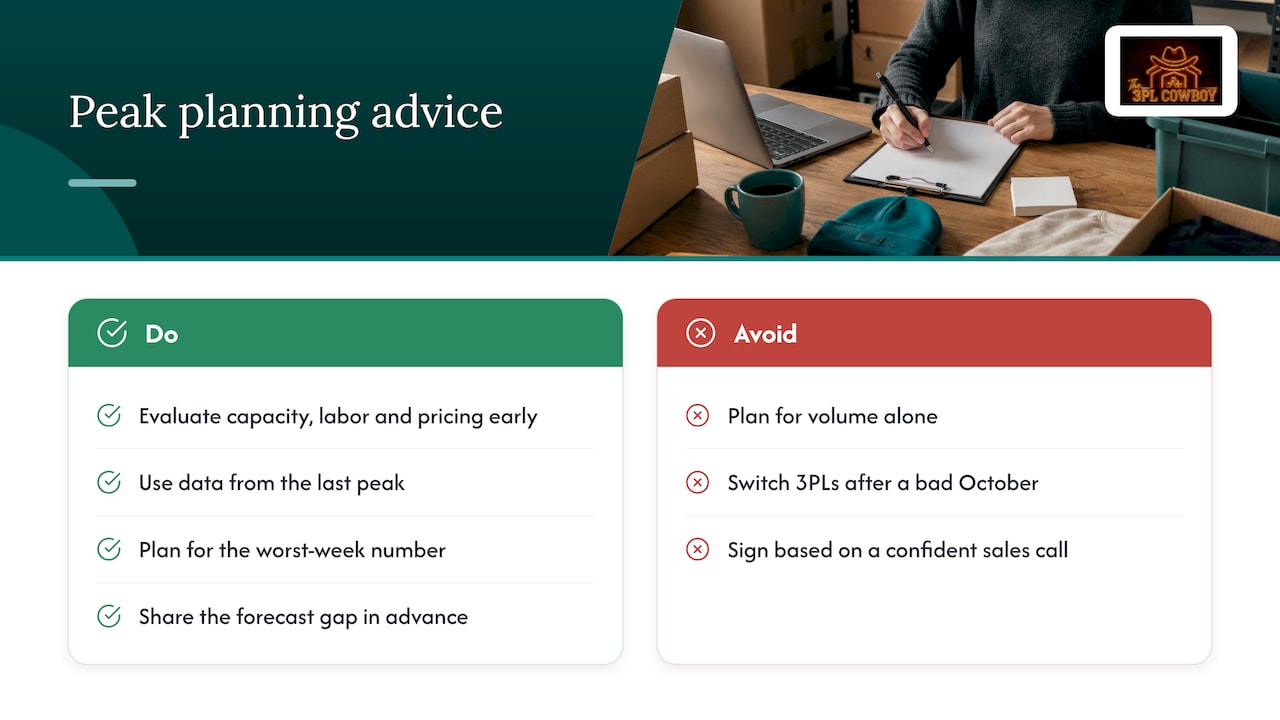
The second pattern is that peak decisions are made too late and on the wrong evidence. A brand switches 3PLs in September because of a bad October, or it signs with a provider because the sales call was confident. Neither is diligence. The right time to evaluate capacity, labor and pricing is when nobody is under pressure, with data from the last peak in hand.
Because we advise both brands and 3PL operators, we see the same peak from both sides of the table. Brands underestimate how early capacity is spoken for. Operators underestimate how much brands will push volume past forecast. The plans that hold up put a number on that gap in advance and share it. Our advice: treat the lean season as the real planning season, and treat October as proof that you did it.
— Michael Nooner
How we help brands with peak
The 3PL Cowboy is an operator-led supply chain advisory for brands and 3PL operators, run by Michael Nooner from Dallas, TX. For brands, peak work usually means a 3PL Selection & Diligence review of your provider’s real capacity and pricing, a Warehouse RFP if a change is warranted, or Peak & Overflow Capacity planning for next year. Start from our brand page or see the full services list.
What to do this week
If your plan is incomplete, do these in order:
- Rebuild the daily forecast on the 2026 calendar, down to the last shipping day before December 25.
- Get your 3PL’s written capacity, labor and cutoff commitments, and compare peak pricing to your contract.
- Run a full test order through every system.
- Publish customer shipping cutoffs by method.
- Confirm insurance limits cover peak inventory value.
- Set a daily review: backlog, orders shipped versus plan, attendance, carrier pickups.
- Put a debrief on the calendar for early January.
FAQ
Which months are peak season?
For U.S. retail, the National Retail Federation treats November and December as the holiday period. Logistics work starts earlier, since inventory builds from around July and many operators begin procuring labor and space in June or July. Your own peak may differ if you sell seasonal categories like sporting goods or solar.
What does peak season mean in insurance?
It refers to a period when inventory value or activity runs unusually high, so you may need higher limits than your annual average suggests. Some insurers offer peak season endorsements that temporarily raise coverage, though many advise continuous year-round coverage to avoid gaps. Ask your broker which applies to your policy.
What is the difference between peak season and lean season?
Peak is the concentrated high-demand window. The lean season is the quieter stretch, and it is when you should test systems, do maintenance and stress-test contingency capacity. Doing that work during peak risks compounding failures.
When should I start peak season planning?
Ideally in the first quarter, with a review of last year’s results, and no later than spring for decisions about 3PL capacity or switching providers. Labor, space and inbound orders are typically committed by June or July. If you are starting in October, focus on testing, cutoffs and contract terms.
Sources
- NRF: 2026 winter holiday forecast
- USPS: ready for the busiest week of 2025
- Operational planning for public holidays in grocery retailing, PMC
- Revenue Seasonality, Insurance Knowledge Graph
- Six Ways to Prepare for a Successful Holiday Season, U.S. Small Business Administration
- Should You Buy Seasonal Business Insurance?, Insureon