Build an integrated business continuity logistics plan that combines multi-tier dependency mapping, redundant routing, and tested crisis playbooks, not a repurposed IT recovery document. A plan built only around servers and office buildings will not tell you what to do when your second-tier supplier’s port closes. According to AHP-based crisis management research, route diversification ranks as the single highest-impact strategy logistics teams can deploy, ahead of most other mitigation tactics studied.
In the next 72 hours:
- Identify your top five revenue-critical shipping lanes and confirm you have at least one alternate carrier qualified on each.
- Pull your current supplier list and flag which vendors you’ve never mapped past tier one.
- Confirm someone owns the crisis communication tree, with backup contacts listed.
- Check that your TMS outage procedure includes a manual dispatch fallback.
Pro Tip: Companies that invest 2 to 4 percent of their logistics budget in continuity development see measurably lower disruption frequency and faster recovery than those that treat continuity as a one-time compliance exercise.
Key Takeaways
A logistics business continuity plan only works when multi-tier dependency mapping, redundant routing, and quarterly testing operate together, not as separate initiatives.
| Point | Details |
|---|---|
| Map past tier one | Most exposure sits with tier-two and tier-three suppliers that never get formally mapped. |
| Prioritize route diversification | Research ranks it the highest-impact crisis strategy available to logistics teams. |
| Test on a real cadence | Run quarterly tabletops, biannual functional drills, and annual joint supplier war games. |
| Budget 2 to 4 percent | Allocate that share of logistics spend to continuity development to cut disruption impact. |
| Bring in advisory support | 3plcowboy helps close visibility and testing gaps through dependency mapping and tested playbooks. |
Table of Contents
- Why Logistics Continuity Differs From Standard BCP
- What Should a Logistics BCP Include?
- How Do You Build a Logistics Continuity Plan?
- What Tactics Keep Freight Moving During a Disruption?
- How Often Should You Test a Continuity Plan?
- How Long Does It Take to Build a Logistics BCP?
- When Should You Bring in Outside Advisory Help?
- What Most Plans Get Wrong
- Get Help Building a Plan That Actually Holds Up
- Primary Sources and Further Reading
- Frequently Asked Questions
- Sources
Why Logistics Continuity Differs From Standard BCP
A traditional business continuity plan protects your building, your servers, and your payroll system. A logistics business continuity plan has to protect something you don’t fully control: the flow of goods through partners, ports, and carriers who answer to their own crisis plans first. Three differences stand out. External dependencies dominate, since your recovery time depends on a supplier’s recovery time, not just your own. Network chokepoints multiply risk, because a single blocked port or highway corridor can stall dozens of shipments simultaneously. And SLA-driven service impacts turn technical delays into contractual and financial penalties within hours, not days.
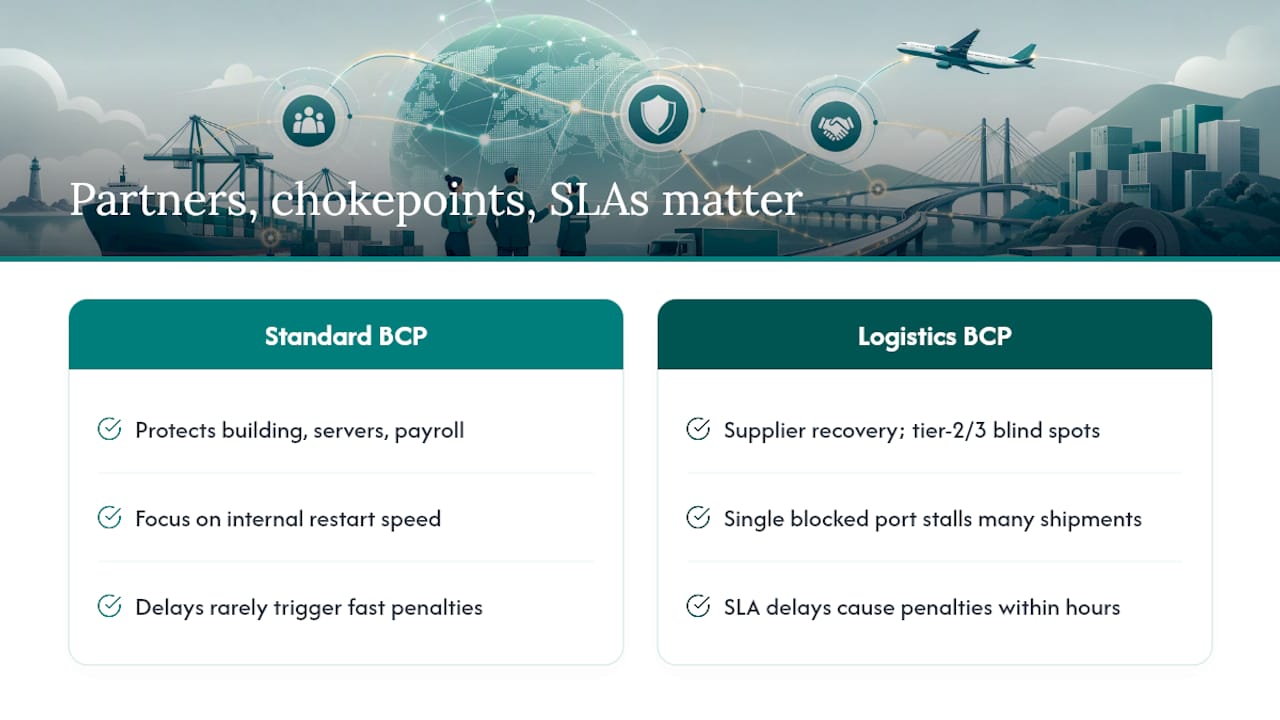
Internal BCP asks “how fast can we restart?” Supply-chain BCP asks “how fast can our partners restart, and what do we do if they can’t?”
Pro Tip: Most planners map their direct suppliers thoroughly and stop there. The real exposure usually sits at tier two or three, the supplier’s supplier, where visibility drops to nearly zero and nobody has a contingency contact on file.
What Should a Logistics BCP Include?
A complete logistics continuity plan covers eight components: a business impact analysis, multi-tier dependency mapping, contingency routing, pre-qualified alternate suppliers, a communications plan, IT and cybersecurity recovery procedures, inventory prepositioning, and continuity clauses baked into supplier contracts. Miss any one of these and you have a partial plan that will fail exactly where it’s weakest.
- Business impact analysis (BIA): Ranks which lanes, warehouses, and customer commitments would hurt most if disrupted, and for how long you can tolerate the disruption. Deliverable: a prioritized risk register.
- Multi-tier dependency mapping: Traces inputs back through tier two and tier three suppliers, not just direct vendors. Deliverable: a visual dependency map with single points of failure flagged.
- Contingency routing: Predefines alternate transport modes and lanes for your highest-volume shipments. Deliverable: a routing matrix with activation triggers.
- Alternate suppliers: Pre-qualified vendors ready to step in without a lengthy procurement cycle. Deliverable: a vetted backup supplier list with lead times.
- Communications plan: Defines who notifies customers, carriers, and staff, and in what order. Deliverable: a contact tree with escalation timing.
- IT/cyber recovery: Covers TMS, WMS, and EDI outages with manual workaround procedures. Deliverable: a system recovery runbook.
- Inventory prepositioning: Sets safety stock levels for critical SKUs at secondary locations. Deliverable: a buffer stock policy by risk tier.
- Contract and SLA clauses: Locks in continuity obligations and penalty terms with suppliers and carriers. Deliverable: standard continuity language for procurement.
How Do You Build a Logistics Continuity Plan?
The build follows four phases: Assess, Design, Test, Operate. Each phase has its own timeline and deliverable, and skipping ahead is the most common reason plans fail their first real test.
- Days 0 to 30, Assess. Run the business impact analysis, build the initial multi-tier dependency map, and identify your top ten single points of failure. Deliverable: a completed BIA and risk register.
- Days 30 to 90, Design. Draft contingency routing agreements, qualify at least two alternate suppliers per critical input, and write the crisis communication playbook. Deliverable: signed alternate routing agreements and a documented playbook.
- Days 90 to 180, Test. Run a tabletop exercise, then a functional drill involving at least one real supplier. Deliverable: an after-action report with corrective actions assigned.
- Ongoing, Operate. Update the dependency map quarterly, retest annually with a joint supplier exercise, and revise SLAs as vendor relationships change. Deliverable: a living plan with version history.
According to multi-tier dependency mapping guidance, the plans that hold up under real disruption are the ones built with joint supplier exercises baked into the design phase, not bolted on afterward.
What Tactics Keep Freight Moving During a Disruption?
Route diversification, pre-qualified carrier backups, backup power at critical facilities, and offline dispatch procedures deliver the highest return for the effort. These are the tactics you pull out of the playbook, not theory you cite in a planning meeting.
- Route diversification: Pre-map two alternate lanes per high-volume corridor; trigger on port closure, weather advisory, or carrier capacity drop. Owner: transportation manager.
- Carrier backups: Maintain signed rate agreements with at least two backup carriers per lane; trigger on primary carrier failure or capacity shortfall. Owner: procurement lead.
- Backup power and facility redundancy: Secure generator contracts or mobile power arrangements for cold storage and cross-dock facilities; trigger on grid outage. Co-optimized dispatch of repair crews with mobile power sources has been shown to speed service restoration meaningfully compared to sequential recovery.
- Offline dispatch procedures: Document manual load-tendering steps for TMS outages lasting beyond two hours. Owner: dispatch supervisor.
Pro Tip: Pre-contract emergency capacity with a backup carrier, then test the relationship with a small, low-stakes shipment once a quarter. A contract you’ve never activated is a hope, not a plan.
Sample playbook snippet: Trigger, primary port closes without notice. Action, activate alternate routing matrix and notify affected customers within two hours. Owner, transportation manager plus communications lead.

How Often Should You Test a Continuity Plan?
Test quarterly at minimum, using three exercise types: tabletop discussions, functional drills, and joint supplier war games. A plan that has never been tested is a document, not a capability.
- Quarterly tabletops: Walk through a disruption scenario verbally with key staff; no live systems involved.
- Biannual functional tests: Actually activate a backup carrier or reroute a real shipment on a controlled basis.
- Annual multi-party war games: Run a joint exercise with suppliers and carriers simulating a major disruption together.
Track recovery time objective (RTO) and recovery point objective (RPO) for critical systems, alternate carrier activation time, and customer notification SLA adherence. Capture every gap in an after-action report and feed corrective actions back into the plan within 30 days. Operational research on tabletop and functional drills shows they surface plan gaps far earlier than waiting for a real crisis to expose them.
How Long Does It Take to Build a Logistics BCP?
A basic plan takes 30 to 90 days; a full multi-tier program with tested supplier agreements runs 6 to 18 months. Budget for both timeline and cost drivers before pitching leadership.
- Quick-start plan (30 to 90 days): BIA, top-lane routing backups, communication tree.
- Full program (6 to 18 months): Complete multi-tier mapping, joint supplier testing, contract renegotiation.
- Cost drivers: technology and mapping tools, third-party exercise facilitation, safety stock carrying costs, emergency capacity contracts, and outside consulting support.
Budgeting tip: size your contingency reserve at 2 to 4 percent of annual logistics spend as a starting benchmark, then adjust based on how concentrated your supplier risk actually is.
When Should You Bring in Outside Advisory Help?
Call in an external advisor when you lack multi-tier visibility past your direct suppliers, can’t qualify an alternate supplier within 72 hours, or don’t have the internal bandwidth to run a real testing program. These three gaps show up constantly, and they’re exactly where an outside team moves faster than an internal one starting from zero.
Consultants earn their fee by producing a completed dependency map, a set of contract playbooks with pre-negotiated continuity clauses, and a tested switchover procedure your team can run without hand-holding. Governance frameworks for supply-chain resilience point to joint supplier testing as the piece internal teams most often skip, usually because they lack the relationships or bandwidth to coordinate it themselves.
Pro Tip: Scope a proof-of-value pilot around one critical lane or supplier relationship first. If the advisor can map it, stress-test it, and hand you a working playbook in 60 days, you know what a full engagement will deliver.
What Most Plans Get Wrong
The biggest gap in most continuity plans isn’t the absence of a document. It’s the absence of a tested relationship with an alternate supplier, a routing partner, or a backup carrier who has actually run a drill with your team before disaster hits. Paper plans fail quietly; tested ones fail loudly enough to fix in real time.
Get Help Building a Plan That Actually Holds Up
3plcowboy works with brands and 3PLs to close the exact gaps that turn a paper plan into a real one: mapping tier-two and tier-three dependencies, qualifying alternate carriers before you need them, and running joint exercises that prove the plan works under pressure.

An engagement typically produces three concrete deliverables: a full multi-tier dependency map showing where single points of failure sit, a set of crisis playbooks with contract language your legal team can actually use, and a tested switchover procedure your operations staff can run without an outside consultant in the room. If your current plan has never been stress-tested against a real supplier failure, start with a supply chain advisory consultation and find out exactly where it would break first.
Primary Sources and Further Reading
- Supply Chain Business Continuity Plan: A Complete Guide With Templates: scope, templates, and multi-tier mapping guidance.
- Risk and Crisis Management Strategies in the Logistics Sector: AHP ranking of crisis strategies and route diversification.
- Business continuity management (BCM), United Nations: governance framework for port and maritime continuity.
- Resilient Disaster Recovery Logistics of Distribution Systems, IEEE: repair crew and mobile power dispatch modeling.
- BCI Supply Chain Resilience Report: joint testing and dependency governance recommendations.
- Business continuity planning for a U.S. supply chain, MIT: academic grounding on U.S. supply chain BCP considerations.
Frequently Asked Questions
What is business continuity logistics?
Business continuity logistics is the practice of keeping goods moving through your supply chain during a disruption, covering dependency mapping, alternate routing, backup suppliers, and tested recovery procedures rather than just internal IT and facility recovery.
How does a logistics BCP differ from a disaster recovery plan?
Disaster recovery typically focuses on restoring IT systems and data after an incident. A logistics business continuity plan is broader, covering physical goods flow, supplier relationships, transportation redundancy, and customer-facing SLA commitments.
What’s the minimum testing frequency for a supply chain continuity plan?
Quarterly tabletop exercises are the floor, paired with functional drills at least twice a year and a joint supplier exercise annually to validate the plan under realistic conditions.
How much should a company budget for logistics continuity planning?
A common benchmark is 2 to 4 percent of annual logistics spend, though the right figure depends on how concentrated your supplier and routing risk actually is.
When does it make sense to hire outside continuity consultants?
Bring in outside help when you lack visibility past your direct suppliers, can’t qualify an alternate vendor within 72 hours, or don’t have the internal capacity to run real testing exercises with partners.
Sources
- Supply Chain Business Continuity Plan: A Complete Guide With Templates
- Risk and Crisis Management Strategies in the Logistics Sector: Theoretical Approaches and Practical Models
- Resilient Disaster Recovery Logistics of Distribution Systems: Co-Optimize Service Restoration With Repair Crew and Mobile Power Source Dispatch | IEEE Journals & Magazine | IEEE Xplore
- Thebci