
Supply chain data governance is the set of policies, roles, and controls that keep supply chain data accurate, timely, and traceable across partners and systems. Start by assigning one accountable owner to a single high-impact use case, such as inventory accuracy or supplier traceability. Anchor the work in NIST and ISO guidance, and use practitioner resources like The 3PL Cowboy to keep it grounded in operations.
TL;DR:
- Name one business owner per data domain and a steward for daily checks; send disputes between domains to a governing council.
- Check accuracy, completeness, timeliness, consistency, and uniqueness at ingestion; reconcile systems regularly and alert teams when variance exceeds set thresholds.
- Link each event record to its predecessor and share only what the next partner needs, preserving verifiable provenance without exposing supplier operations.
- Pilot one site or supplier group around a costly operational metric, measure error rates before and after, then expand only when results support it.
- Set policies, definitions, and decision rights before buying tools; involve partners early, limit data requests, and offer faster dispute resolution or better forecast visibility.
Table of Contents
- What supply chain data governance covers and why it pays off
- Roles, policies, and decision rights that make governance stick
- Data quality metrics, lineage, and checks that catch errors early
- Traceability principles from NIST and GS1 you can adopt without full transparency
- A three-phase roadmap: prioritize, pilot, scale
- Documentation as a daily lifecycle habit
- Aligning governance with AI, privacy, and cybersecurity
- Tooling and integration: standardize categories, not vendors
- KPIs and ROI: how to measure whether governance is working
- Common challenges in supply chain data governance and how to overcome them
- Integrating governance with your existing supply chain systems and IT stack
- Engaging 3PL operators and brand partners so governance gets adopted
- What governance looks like in practice in logistics operations
- Where governance pays first: an operator’s view
- Governance-linked 3PL selection and operations help from The 3PL Cowboy
- FAQ
- Sources
What supply chain data governance covers and why it pays off
Governance has to span every record that moves product or money. That includes master and product data, transaction and event data, inventory records, shipment and supplier data, and traceability records. ASCM’s definition of supply chain management lists forecasting, sourcing, operations, warehousing, logistics, and risk management, and each of those functions produces data someone must own.
When governance works, you see it in daily operations:
- Better supply chain visibility, because partners describe the same item and event the same way.
- Faster recalls, since lot and shipment links already exist when you need them.
- Cleaner forecast inputs, because bad records get caught before they reach planning.
- Fewer exceptions and disputes, since quantities and terms match across systems.
NIST, GS1, and ISO each frame these benefits from a different angle: privacy and risk, product data stewardship, and board-level accountability.
Roles, policies, and decision rights that make governance stick
Governance fails when everyone agrees it matters and nobody owns it. The operating model below gives each decision a home.
- Governing council: a small cross-functional group that sets priorities, approves policies, and settles disputes.
- Data owners: business leaders accountable for a domain, such as inventory in operations or supplier records in procurement.
- Data stewards: the people who maintain definitions, fix errors, and run the daily checks.
- IT and data engineering support: the team that builds the pipelines, access controls, and catalog tooling.
- Core artifacts: a policy register, a data catalog, SLA scorecards, and a classification scheme.
GS1 US guidance recommends centralized points of control and data stewardship for product data, a pattern that carries over to other domains. Define escalation paths in advance: a steward flags the issue, the owner decides, and the council rules only when two domains collide.
Pro Tip: Write down who can say “no” to a bad data change. If that person is unnamed, you do not have decision rights yet.
Data quality metrics, lineage, and checks that catch errors early
Track key dimensions for every governed dataset:
- Accuracy: does the record match physical reality?
- Completeness: are required fields populated?
- Timeliness: does the data arrive before decisions need it?
- Consistency: do systems agree with each other?
- Uniqueness: is each item or event recorded once?
Lineage and provenance matter because auditors and planning models both ask where a number came from. If you cannot trace a figure back to its source event, you cannot defend it.
Put practical checks in three places: validation rules at ingest, scheduled reconciliation between systems, and threshold alerts when variance crosses a limit. Our AI inventory optimization roadmap shows why clean inventory data comes before any modeling.
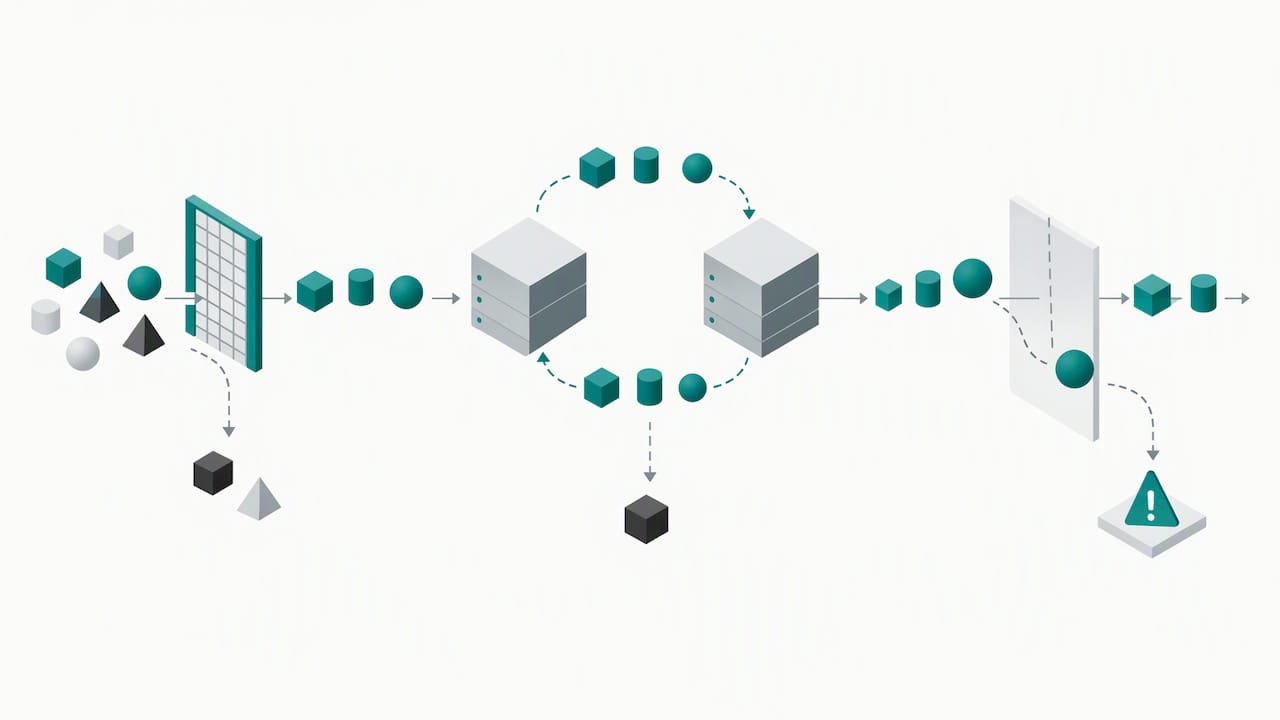
Gartner’s guidance on building a business case for data quality ties data quality investment to measurable business outcomes, which is the framing finance teams respond to.
Traceability principles from NIST and GS1 you can adopt without full transparency
NIST’s manufacturing traceability meta-framework builds on a few principles that suit multi-party logistics:
- Selective disclosure: each party shares only what the next party needs to verify.
- Decentralized trust: provenance does not require one central repository everyone must join.
- Verifiable linking: event records connect to each other so the chain can be checked.
- Pedigree resilience: the history survives even when one participant drops out.
The full NIST publication describes encapsulation and interoperable interfaces for building these linked records. The practical pattern is simple: each event record points to the one before it and carries a minimal payload. Selective disclosure protects supplier IP while still letting an acquirer verify origin. That is how you get traceability without forcing every partner to expose their operations.
A three-phase roadmap: prioritize, pilot, scale
- Phase 1, prioritize: choose one or two use cases with clear dollar impact, such as inventory accuracy or supplier lead-time data. Name an accountable owner and a steward for each.
- Phase 2, pilot: write the policies, add catalog entries, and automate validations. Run a short pilot on one site or one supplier group and measure error rates before and after.
- Phase 3, scale: extend to more domains, add traceability links and interoperability, and embed scorecards into weekly operating reviews.
Our approach to starting change management with one use case applies directly here. Governance programs that begin with a broad charter tend to stall; ones that begin with a measurable pilot earn their budget.
Pro Tip: Pick a pilot where the pain already shows up in a weekly report. People adopt governance faster when it fixes a number they are already being asked about.
Documentation as a daily lifecycle habit
Governance documents go stale when they are written once and filed. NIST’s zero draft on documenting AI datasets and models recommends continuous, distributed documentation built into the lifecycle. The draft targets AI, but the logic fits supply chain data too.
- Create artifacts incrementally as data is designed and changed, not at project close.
- Let subject matter experts contribute directly instead of routing everything through one writer.
- Publish internal guidelines so contributors know what “good enough” looks like.
- Review on a fixed cadence and retire what no longer applies.
This habit supports traceability, audits, and model governance at once, because the record of why a field exists is always current.
Aligning governance with AI, privacy, and cybersecurity
Analytics and AI models are only as safe as their inputs. NIST’s Data Governance and Management Profile concept paper treats data governance as an organizing logic across privacy, cybersecurity, and AI risk, and maps activities to the NIST Privacy Framework, Cybersecurity Framework, and AI Risk Management Framework.
Concrete mapping points are access control, data minimization, and logging with audit trails. Involve security, privacy, data science, procurement, and operations early. For teams building toward formal AI controls, this AI implementation roadmap mapped to ISO/IEC 42001 shows one way to connect the pieces.
Tooling and integration: standardize categories, not vendors
Buy capabilities, not brands. The categories that matter are metadata and catalog tools, validation pipelines, an event store or message bus, and access control with identity management.
Integration works best with canonical schemas, link-based provenance, and APIs that support selective disclosure. When you assess any tool, check for lineage visibility, an API-first design, and support for GS1 and common industry formats. Supplier-facing access also needs discipline; this explainer on ISO 27001 supplier management covers how security teams approach it.
KPIs and ROI: how to measure whether governance is working
Keep the scorecard short and tied to operations:
- Data quality score for each governed domain.
- Time to detect a data error.
- Inventory accuracy at the location level.
- Exception volume and the cost of resolving it.
Link each metric to a business outcome on the same page. The ROI logic is simple: if error-driven cost is X per year and the program costs Y, governance pays back when the avoided errors exceed Y. Our supply chain assessment guide shows how to baseline before you start.
Common challenges in supply chain data governance and how to overcome them
Most programs hit the same walls. The first is unclear ownership: everyone uses the data and nobody answers for it. Fix this by naming one owner per domain and publishing the list.
The second is partner resistance. Suppliers and 3PLs worry about exposing sensitive detail or taking on extra work. Selective disclosure and small, specific data requirements reduce both concerns. Our lessons from vendor compliance programs show that data SLAs land better when tied to clear consequences and clear help.
The third is overreach. Teams try to govern every field in every system at once, and the program collapses under its own weight. Govern the data that drives one operational metric first, then expand.
The fourth is tooling before policy. A catalog with no owners is an expensive spreadsheet. Settle roles and definitions, then automate.
Finally, watch for quiet drift. Definitions change, new systems appear, and scorecards lose attention. A fixed review cadence and a visible scorecard in operating meetings keep governance alive after the launch energy fades.
Integrating governance with your existing supply chain systems and IT stack
You rarely get to start from a clean slate. Governance has to work inside the ERP, WMS, TMS, and planning tools you already run, plus the portals and EDI feeds your partners use.
Begin with an inventory of where each governed data element is created, changed, and consumed. That map shows where validation belongs: at the point of entry, not three systems downstream. Add checks at integration points, where mismatches between systems usually originate.
Use a canonical definition for shared concepts such as item, location, and shipment status, then map each system to it. GS1 identifiers give you a common language for products and locations, and ISO/IEC 38505-1 offers principles for governing bodies on directing and monitoring data handling, including quality and timeliness.
Keep the IT footprint light early. Lean on existing integration layers and add catalog or lineage tooling only where a pilot proves the need. Involve IT from day one so access control, logging, and change management rules match what governance requires.
Engaging 3PL operators and brand partners so governance gets adopted
Governance across company lines is a relationship problem as much as a technical one. A brand cannot mandate clean data from a 3PL and expect it to stick, and a 3PL cannot demand perfect order data from every client.
Start with a shared problem. Pick a metric both sides care about, such as inventory accuracy or dock-to-stock time, and agree on the data that drives it. Then set data requirements in the contract and onboarding materials, so they are expectations, not surprises.
Communicate on a rhythm. A short monthly scorecard review, a named contact on each side, and a clear path for disputes do more than a long policy document. Share results in plain terms: what improved, what slipped, who is acting.
Give partners something back. Faster dispute resolution, earlier visibility into forecasts, or simpler reporting makes the extra effort worth it. Our supply chain risk assessment playbook is a useful starting point for framing these conversations around shared risk. Selective disclosure also helps, since partners are more willing to share when they control how much.
What governance looks like in practice in logistics operations
Public case studies with named results are scarce, so here is how the pattern shows up in operations we know. One illustration from our own background: a supply chain inventory operation improved cycle count accuracy through disciplined ownership of inventory records, defined count procedures, and routine reconciliation, which are governance practices even when nobody calls them that.
A second example is a pallet-program redesign. It depended on agreeing on shared definitions and tracking the data that showed where pallets were going.
A third is a WMS rollout across multiple sites, where standard data definitions and clear site-level ownership were what let the rollout hold together.
The common thread is not technology. Each case tied governance to one operational metric, named accountable people, and checked results on a regular cadence. If you want a model for your own pilot, copy that structure: one metric, one owner, one review rhythm.
Where governance pays first: an operator’s view
Pick the operational metric that hurts most and govern only the data that moves it. Overgoverning kills programs; a measurable pilot earns the right to expand. Two quick wins we see work: focus cycle counts on the highest-value locations first, and put supplier data SLAs on lead times and ship notices. Both are practical starting points for a budget conversation.
— Michael Nooner
Governance-linked 3PL selection and operations help from The 3PL Cowboy

We are an operator-led brand advisor and supply chain advisor for brands and 3PL operators, led by Michael Nooner. Teams that want hands-on help to turn governance into results can work with us on:
- 3PL selection and diligence with data standards built into onboarding.
- Fulfillment cost benchmarking grounded in clean, comparable data.
- 3PL operations advisory that sets up scorecards and ownership.
Explore our full services or get in touch to scope a pilot.
FAQ
What comes in data governance?
Data governance covers the policies, roles, standards, and controls that manage how data is defined, owned, protected, and used. In supply chains that means ownership of product, inventory, shipment, and supplier data, plus quality checks and access rules. GS1 US guidance emphasizes stewardship and centralized control points.
What are the 7 types of supply chain management?
Common ways to divide the field include planning, sourcing, manufacturing, warehousing, logistics, returns, and risk management, which track the functions ASCM describes. Each function generates data that governance needs to cover.
What are the top 5 data management tools?
The right choice depends on your stack, so consider categories such as metadata catalogs, validation pipelines, event stores or message buses, access control, and master data management. Choose tools that show lineage, expose APIs, and support GS1 and common industry formats.
Is data governance in demand?
Interest keeps growing because privacy, cybersecurity, and AI all depend on well-governed data. NIST’s Data Governance and Management Profile concept paper reflects that, treating governance as the organizing logic across privacy, cybersecurity, and AI risk domains.