
A supply chain playbook is an operational manual and daily execution system that converts signals into prioritized actions, replacing ad hoc firefighting with repeatable resilience. Built right, it shortens decision time, standardizes mitigations, and cuts escalations to leadership. The best ones combine a five-step framework, daily operating rhythms, and visibility that reaches past your first-tier suppliers.
TL;DR:
- Building a supply chain playbook requires a sequential process: assess risks first, then map, design, operationalize, and measure for effectiveness.
- The playbook should contain specific decision trees, escalation matrices, SOPs, and ownership details, all indexed by trigger events for quick access.
- To embed the playbook into daily operations, assign decision rights, establish routines, run exception reviews, and keep data standards consistent across locations.
- Mapping beyond Tier 1 suppliers is crucial, focusing on high-risk SKUs and layering in supplier surveys and external data to identify hidden vulnerabilities.
- Regularly measure playbook maturity using a staged model, prioritize fixes based on KPIs like decision time and inventory accuracy, and continuously update the document post-disruption.
Table of Contents
- What Belongs in a Supply Chain Playbook Framework?
- What Should a Supply Chain Playbook Actually Contain?
- How Do You Turn a Playbook Into a Daily Habit?
- How Do You Get Visibility Beyond Your Tier 1 Suppliers?
- How Do You Measure Playbook Maturity?
- Does This Framework Hold Up Under Real Operating Pressure?
- Why Do Most Supply Chain Playbooks Fail?
- Get the Playbook Built and Running in Weeks, Not Quarters
- Sources
- FAQ
What Belongs in a Supply Chain Playbook Framework?
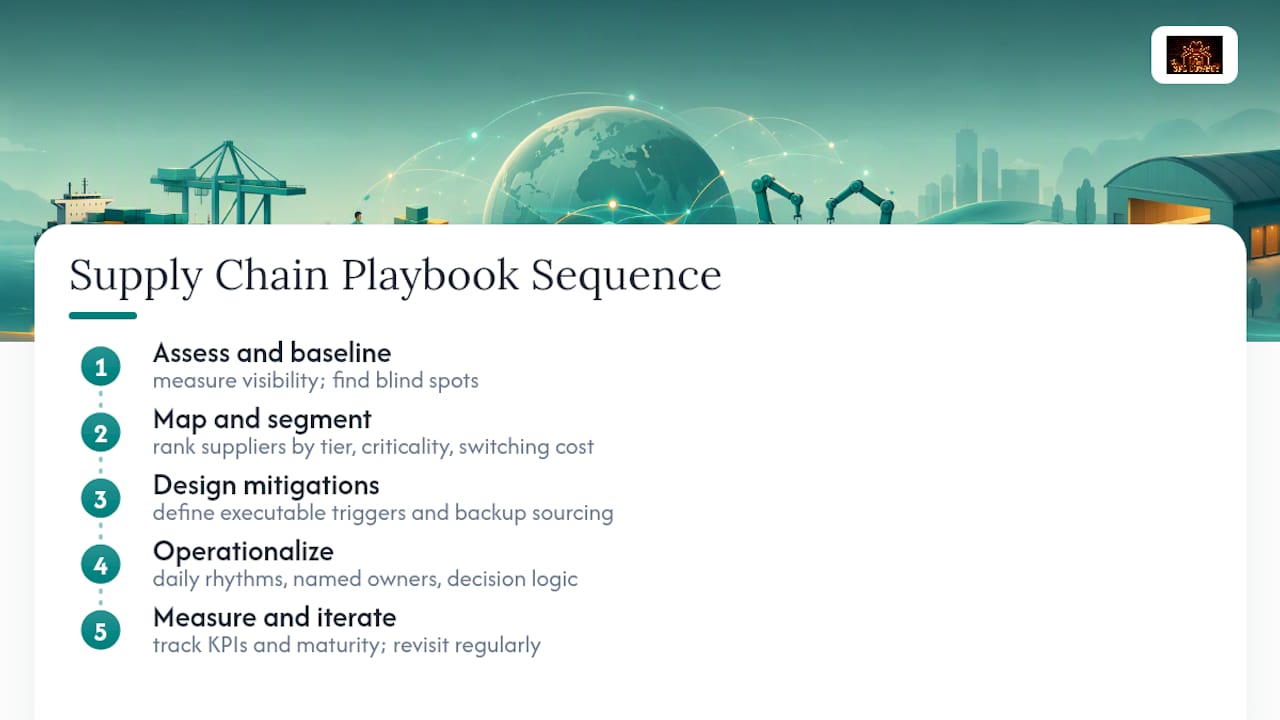
Most operators skip straight to writing contingency plans and wonder why the document gathers dust. The sequence matters more than the content. A supply chain playbook works only when you build it in this order.
1. Assess and baseline. Before writing a single mitigation, find out what you actually know. Where are the blind spots in supplier visibility? Which SKUs and vendors carry disproportionate risk if they fail? DNV’s resilience framework pairs a self-assessment tool with its playbook for exactly this reason: you can’t fix what you haven’t measured, and most teams overestimate how much visibility they have.
2. Map and segment. Rank suppliers by tier, criticality, and switching cost. Segment inventory by placement, not just by SKU count. A supplier feeding one line differently from a supplier feeding six.
3. Design mitigations. This is where dual sourcing, intentional buffer stock, and contractual triggers get written down as specific, executable moves. Not “diversify suppliers” as an aspiration, but “activate backup vendor at X lead time slippage” as an instruction.
4. Operationalize. A playbook that lives in a shared drive is a paperweight. It needs daily rhythms, named owners, and decision logic that a shift lead can follow without calling a director. Execution intelligence built on daily prioritization is what separates a document from a system.
5. Measure and iterate. Track a maturity ladder and a small set of KPIs, then revisit the playbook on a fixed cadence, not just after a disruption forces your hand.
Skipping step one is the most common mistake. Teams write elaborate contingency plans for risks they never confirmed were their biggest exposure, while the supplier that actually goes dark next quarter never makes the document. Run the assessment first. Everything downstream gets cheaper and faster because of it.
What Should a Supply Chain Playbook Actually Contain?
A playbook earns its place on someone’s desk when it answers “what do I do right now” faster than a phone call to a director would. That means specific artifacts, not narrative prose.
- RACI charts for every major decision point, naming who’s responsible, accountable, consulted, and informed, down to a job title, not a department.
- Escalation matrices with contact trees that specify who gets called at hour one, hour four, and day two of a disruption.
- Decision trees that translate a triggering event, a port closure, a supplier bankruptcy filing, a 10-day lead time slip, into a pre-approved next move.
- SOPs with activation thresholds, so a play only fires when a specific, measurable condition is met, not when someone feels nervous.
- A daily execution card summarizing that day’s open exceptions, ranked by dollar impact and time sensitivity.
- Incident play templates for the five or six disruption types your business actually faces (a single-source component, a carrier capacity crunch, a customs hold).
- A supplier contingency activation checklist that walks a buyer through qualifying and onboarding a backup source under time pressure.
- Version control and owner fields on every document, because a playbook with no revision date is a playbook nobody trusts.
Index the whole thing by trigger event, not by department. A warehouse manager searching for what to do about a truncated inbound shipment should find the answer in two clicks, not by paging through an org chart. KPMG’s guidance on effective playbooks frames this correctly: treat it as a living strategic document that integrates financial, operational, and planning layers, not a static contingency binder pulled out once a year. Build it that way from the start and you avoid a painful rewrite later. A risk assessment framework gives you a structured starting point for identifying which incident types deserve their own play in the first place.
How Do You Turn a Playbook Into a Daily Habit?
Most playbooks fail not because the content is wrong but because nobody built the muscle to use it. Governance and rhythm matter more than the document’s polish.
1. Assign real decision rights. Name a cross-site owner for the playbook itself, not just for individual incidents. Give that person authority to approve deviations without a committee vote, or the playbook becomes advisory rather than operational.
2. Build a change control process. Every time you learn something from a disruption, the play needs a formal update path. Otherwise your best lessons live in someone’s memory instead of the document.
3. Run a prioritized exception queue every morning. Fifteen minutes, same time daily, reviewing every open exception ranked by impact. This single habit does more for decision velocity than any software purchase.
4. Assign explicit owners to every open item. An exception with no name attached sits until it becomes a crisis.
5. Close the loop with a follow-up cadence. Check yesterday’s decisions against today’s outcomes. Did the mitigation work? If not, why?
Pro Tip: Run your morning exception review standing up, in under 15 minutes, with only the people who can actually act on what’s discussed. The moment it becomes a scheduled hour-long meeting, it stops happening consistently.
Data standardization underpins all of it. If your item master is inconsistent across sites, or every location interprets “safety stock policy” differently, your playbook’s decision logic breaks the moment someone applies it to real numbers. Oracle’s operator guidance found that organizations standardizing on a single data model and process cut planning cycles by roughly 70%. That’s not a rounding error, that’s the difference between a weekly planning cycle and one that drags into the following month.
The rollout tactic that actually works: pick one critical product family, stabilize its item master and inventory policies, then expand. Trying to fix data governance across the entire catalog before building anything operational is how playbook projects turn into multi-year cleanup efforts that never ship. Same logic applies to your systems. Favor standard, out-of-the-box configurations over heavy customization. Custom code feels like a fit today and becomes technical debt the next time you need to pivot fast.
How Do You Get Visibility Beyond Your Tier 1 Suppliers?
The disruption that takes down your production line rarely starts with your direct supplier. It starts two or three tiers upstream, at a raw material processor or a component maker you’ve never spoken to.
- Start mapping with your highest-revenue or highest-risk SKUs first, not your entire supplier base. You don’t need full-catalog visibility to get meaningful protection.
- Use lightweight supplier surveys as your first data source. Ask your Tier 1 vendors to disclose their own critical suppliers for the components that matter most.
- Layer in commercial data vendors for the gaps a survey won’t fill, particularly for geographic concentration risk you can’t see from a spreadsheet.
- Build a criticality scoring matrix that weighs three factors: how many alternate sources exist, how long a replacement takes to qualify, and how much revenue depends on the item.
- Prioritize remediation work on the suppliers that score high on all three, not the ones that happen to have the most paperwork on file.
- Deploy mitigations that are actually executable under pressure: pre-qualified alternate sources, inventory placed closer to the point of use, and contractual triggers that don’t require a renegotiation mid-crisis.
Mapping two tiers upstream for your most critical items is the realistic floor, not full network transparency. DNV’s research on hidden risk backs this up: the disruptions that catch companies off guard overwhelmingly originate below Tier 1, in the layer most playbooks never bother to map.
How Do You Measure Playbook Maturity?
A playbook that never gets measured never gets better. Four maturity stages give you a common language for where you stand and what to invest in next.
- Crawl. Reactive by default. No formal escalation matrix, decisions made by whoever’s available. Invest here in baseline visibility and a first-pass supplier map.
- Walk. Documented plays exist but live in isolated silos. Invest in a shared data model and named owners for each major risk category.
- Run. Daily rhythms are established, exceptions get triaged consistently, and mitigations activate on defined triggers. Invest in cross-site governance and a formal change control process.
- Fly. The playbook drives proactive decisions before disruptions fully materialize, supported by control-tower-style visibility. Control towers and digital twins can flag disruptions 48 to 72 hours earlier than manual monitoring, but only once your data governance and daily rhythms already work. Technology bolted onto a Crawl-stage operation just adds noise.
Track five KPIs regardless of stage: planning cycle time, inventory accuracy, time-to-decision on flagged exceptions, activation time for contingency plans once triggered, and supplier recovery time after a disruption.
Run a 10-question self-assessment covering visibility (do you know your Tier 2 suppliers for critical items?), governance (is there a named playbook owner?), data (is there one item master or five?), rhythm (does a daily exception review actually happen?), and measurement (do you track time-to-decision?). Score each yes or no, and any category with more than one “no” becomes your first 90-day priority. Trying to fix everything at once is how these initiatives stall before they start.
Does This Framework Hold Up Under Real Operating Pressure?
Frameworks look clean on a whiteboard. They get tested in warehouses at 6 a.m. when a cycle count comes back wrong for the third day in a row.

No single fix did it. The daily rhythm did.
A pallet-program redesign for Kroger delivered more than $6 million in annual savings, and the lesson wasn’t the redesign itself, it was the governance around measuring it. Savings that aren’t tracked against a baseline get absorbed and forgotten within two quarters.
An eight-month WMS rollout across more than 60 Sysco sites survived cutover without phantom inventory because staging and go-live followed a documented play, site by site, with a checklist that didn’t change from location fifteen to location sixty.
Why Do Most Supply Chain Playbooks Fail?
Four causes show up again and again: no named owner, IT systems customized past the point of agility, no daily rhythm to force usage, and supplier segmentation too shallow to matter. Fix the first two within 30 days by naming an accountable owner and auditing custom configurations against standard ones. A tabletop exercise works for testing decision logic on paper. A live drill is the only way to find out whether your escalation contacts actually pick up the phone.
— Michael
Get the Playbook Built and Running in Weeks, Not Quarters
Most teams that try to build a supply chain playbook internally spend months on the document and never get to the governance and daily rhythms that make it actually work. A retained, operator-led advisory skips that gap: instead of another PDF, you get experienced professionals building the framework alongside your team.

3plcowboy’s 3PL Operations Advisory engagement maps directly to what this article covers: governance design, daily execution rhythms, and the data standardization work that shortens your planning cycle. If your playbook also touches partner selection or contingency sourcing, 3PL Selection & Diligence applies underwriting-grade scrutiny to that decision instead of a sales call and a gut feeling. And if a system cutover is part of the picture, ERP-WMS integration support is built specifically to prevent the phantom inventory problem that derails go-lives.
If you’re a brand deciding how much of this to build in-house versus bring in outside expertise for, the For Brands overview lays out where 3plcowboy fits. The next step is simple: reach out and scope a conversation around where your playbook stands today, and where a 90-day plan could take it.
Sources
For deeper reading: Oracle’s supply chain excellence playbook, KPMG’s five keys guide, DNV’s resilience framework, the 2026 execution intelligence playbook, and TechTarget’s SCM primer. For cost-recovery angles, see this hidden logistics costs analysis.
- The Oracle Playbook for Supply Chain Excellence
- Five keys to creating an effective supply chain playbook — KPMG
- Supply Chain Risk Management Playbook — DNV
- The 2026 Supply Chain Playbook — execution intelligence playbook
- Guide to supply chain management — TechTarget
FAQ
What Are the 5 C’s of Supply Chain Management?
Definitions vary across practitioners, but a common version covers connectivity, collaboration, cyber awareness, cost consciousness, and compliance, the five capability areas most often cited when assessing whether a supply chain organization is operating at maturity.
What Are the 7 C’s of Supply Chain Management?
There’s no single, universally agreed list under this name; treat any specific enumeration you encounter with caution and evaluate a supply chain against measurable KPIs like planning cycle time and inventory accuracy instead.
What Are the 5 Pillars of a Supply Chain?
Most frameworks converge on planning, sourcing, manufacturing, delivery, and returns, the same backbone reflected in SCOR-style models and echoed in the five-step playbook framework covered above: assess, map, design, operationalize, and measure.
How Often Should You Update a Supply Chain Playbook?
Treat it as a living document reviewed on a fixed cadence, at minimum quarterly, and immediately after any disruption that exposes a gap, rather than a static binder revisited only once a year.
How Do I Get Started Building a Supply Chain Playbook If I Have Nothing Today?
Run a baseline self-assessment first, using a structured risk assessment framework to identify your biggest visibility gaps, then build mitigations only for the risks that assessment actually surfaces.