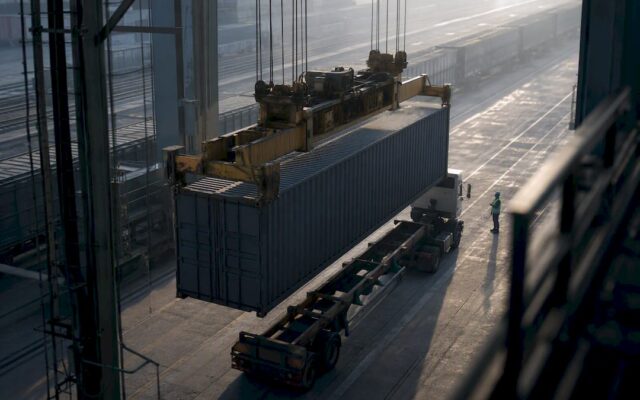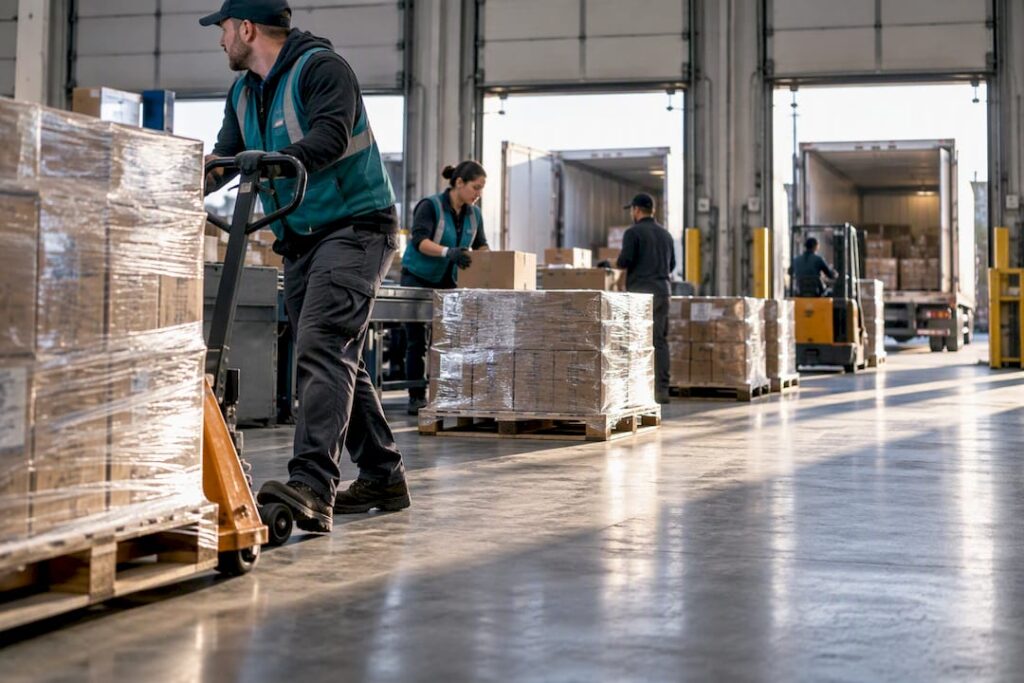
Freight consolidation combines multiple smaller shipments into fewer, fuller loads to lower cost per unit and raise vehicle utilization. A documented case study on truck sharing and route optimization found consolidated routing cut truck usage significantly and trimmed operational costs notably. The trade-off: you gain density at the cost of inventory holding and tighter scheduling discipline.
TL;DR:
- Consolidation models include temporal, spatial, product-based, LTL-to-FTL, shared truckload, and retail, each suited for different volume profiles and service constraints.
- Implementing consolidation can significantly decrease truck usage and operational costs but increases inventory holding, lead times, and coordination complexity.
- Hub-based network redesign offers higher savings than lane-by-lane strategies, especially when multiple facilities serve overlapping zones or low fill rates persist.
- Effective scheduling rules like hybrid release policies optimize shipment timing, but require monitoring and adjustment based on fill rates and carrier rate structures.
- Successful pilots depend on detailed flow mapping, KPI tracking, system integration, and avoiding visibility gaps and over-consolidation pitfalls during rollout.
Table of Contents
- What freight consolidation means and which model fits your network
- The real payoff, and what it costs you operationally
- Why network-level hub design beats lane-by-lane tinkering
- Scheduling rules that keep a consolidation program from unraveling
- From plan to pilot: the implementation playbook
- What actually goes wrong in the field
- When consolidation is the right lever, and when it isn’t
- Getting a consolidation pilot running faster
- Sources
- FAQ
What freight consolidation means and which model fits your network
Freight consolidation is not one technique. It is a family of models, each suited to a different volume profile and service constraint. Picking the wrong one is the most common reason pilots underdeliver.
- Temporal consolidation holds orders for a set window (say, 24 to 48 hours) so more volume ships together, useful when order frequency is high enough that a short delay never breaches the service window, a pattern supported in research on make-to-order freight consolidation.
- Spatial consolidation groups shipments by destination proximity rather than by time, common in dense metro delivery zones.
- Product-based consolidation merges compatible SKUs (same handling class, no contamination risk) into shared trailers.
- LTL-to-FTL conversion rolls several less-than-truckload shipments into one full truckload lane, the most familiar entry point for most shippers.
- Shared truckload splits a single trailer’s capacity across multiple shippers, often brokered through a 3PL or network platform.
- Retail consolidation aggregates purchase orders bound for the same distribution center or big-box retailer, common in CPG and apparel.
LTL-to-FTL suits shippers with steady, multi-stop regional volume. Shared truckload fits lower-volume shippers who cannot fill a trailer alone. Retail consolidation is close to mandatory once a retailer sets appointment and case-pack rules.
The real payoff, and what it costs you operationally
Consolidation’s benefits are measurable, but so are its trade-offs. Ignoring either side produces a pilot that looks good on a slide and falls apart in week six.
A Transet/LSU freight consolidation case study found operational costs decreased significantly and monetized environmental cost (MEC) reduced substantially alongside the truck-usage drop. The MEC figure captures the value of lower emissions, fuel burn, and related externalities once routes are optimized rather than run ad hoc, using conversion methods consistent with EPA transportation emissions guidance.
The trade-offs are just as real:
- Inventory holding cost rises because you are deliberately delaying shipment to build load density.
- Lead time stretches, which can erode on-time-in-full (OTIF) performance if customer windows are tight.
- Coordination complexity increases, since more parties (shippers, cross-docks, carriers) must sync schedules.
- Damage and liability risk shifts when mixed freight travels together, particularly under released-value or limited-liability carrier terms.
For a pilot, track a small KPI set: cost per unit shipped, truck fill rate, OTIF, and inventory carrying cost as a percentage of freight saved. If carrying cost eats more than half the freight savings, the model or the holding window needs adjustment.
Why network-level hub design beats lane-by-lane tinkering
Most consolidation programs start at the lane level: two shippers on the same corridor agree to share a trailer. That works, but it caps the upside. The bigger gains come from redesigning the network around intermediate hubs rather than patching individual lanes.
Research on hinterland network planning modeled integrated hub selection against direct shipping and found transportation cost reductions varying between low to moderate percentages, with a substantial portion of shipment volume routed through intermediate hubs rather than shipped direct. That is a wide range because the payoff depends heavily on how well the hub locations match actual freight density, not on the optimization method alone.
The practical implication: a lane-level review only ever sees the lanes you already run. A network-level model can surface a consolidation point you would never have tested manually, often by upgrading an existing branch or cross-dock into a formal hub rather than building new infrastructure.
Signs your network is a candidate for hub-led redesign:
- You have three or more regional facilities shipping to overlapping destination zones without a shared consolidation point.
- Direct-ship lanes show consistently low trailer fill, even after LTL-to-FTL conversion attempts.
- Carrier rate quotes vary sharply by lane despite similar distances, suggesting your network is fighting its own geography.
Hub location decisions interact directly with warehouse footprint and lease terms, which is why network redesign and industrial real estate strategy tend to get evaluated together rather than in isolation, as detailed by RJR Worldwide Corp..
Scheduling rules that keep a consolidation program from unraveling
A consolidation policy is the rule that decides when a held shipment finally goes out. Get this wrong and either your trucks leave half empty or your on-time delivery collapses. Academic and applied research on shipment consolidation, including work on nonlinear cost structures in consolidation, points to a few policies that outperform ad hoc judgment calls.
- First-Due-First-Delivered (FDFD) prioritizes whichever order has the earliest commit date, useful in commit-to-delivery environments where missing a promised date carries a penalty.
- No-Wait ships as soon as a load reaches a viable threshold, best for short-haul lanes where holding for density costs more in service risk than it saves in freight.
- Temporal release holds orders for a fixed time window regardless of volume, simplest to administer but weakest when order arrival is uneven.
- Quantity release ships once a volume or weight threshold is hit, better fill rates but unpredictable timing.
- Hybrid release ships on whichever trigger, time or quantity, comes first, generally the most balanced choice for mixed order profiles.
Carrier pricing complicates the choice. Nonlinear rate structures (where the marginal cost per pallet drops sharply after a threshold) push toward quantity or hybrid release, since hitting that breakpoint is where the savings actually live.
Pro Tip: Start with a hybrid policy set to a conservative time cap (24 hours) and a modest volume trigger, then tighten one variable at a time once you have two weeks of fill-rate data.
From plan to pilot: the implementation playbook
A consolidation strategy only proves itself in execution. The sequence matters more than any individual tactic.
- Map flows. Pull 90 days of shipment data by origin, destination, weight, and commit date.
- Score opportunities. Rank lanes or facility pairs by estimated transport savings against added inventory cost and service risk.
- Design the pilot. Pick one or two lanes or one hub candidate, not the whole network, and set a defined test window.
- Negotiate carrier terms. Lock in rates tied to the new load pattern before volume shifts, since carriers price consolidated freight differently than spot LTL.
- Integrate TMS and WMS. Load consolidation rules, compatibility flags, and cross-dock workflows into the systems that actually execute daily.
- Measure and scale. Compare pilot KPIs against baseline for at least one full order cycle before expanding.
A simple scoring rubric works well here: weight each lane by estimated freight savings, subtract projected inventory carrying cost, and flag anything with meaningful OTIF exposure for manual review rather than automatic rollout.
The technology layer needs three things to function: TMS rules that encode your release policy, cross-dock processes that can physically sort mixed freight, and visibility feeds that tell planners where every shipment sits in real time. Carrier contracts should include volume commitments and rate tiers that reward density, not just base rate discounts. Our 3PL Growth Strategy guidance covers how these pieces fit together when a 3PL partner is running part of the network.
What actually goes wrong in the field
The gap between a consolidation plan on paper and one that survives contact with daily operations is almost always visibility. Clients come in with a spreadsheet model that assumes perfect data and find the cross-dock has no real-time feed telling planners which pallets actually arrived.
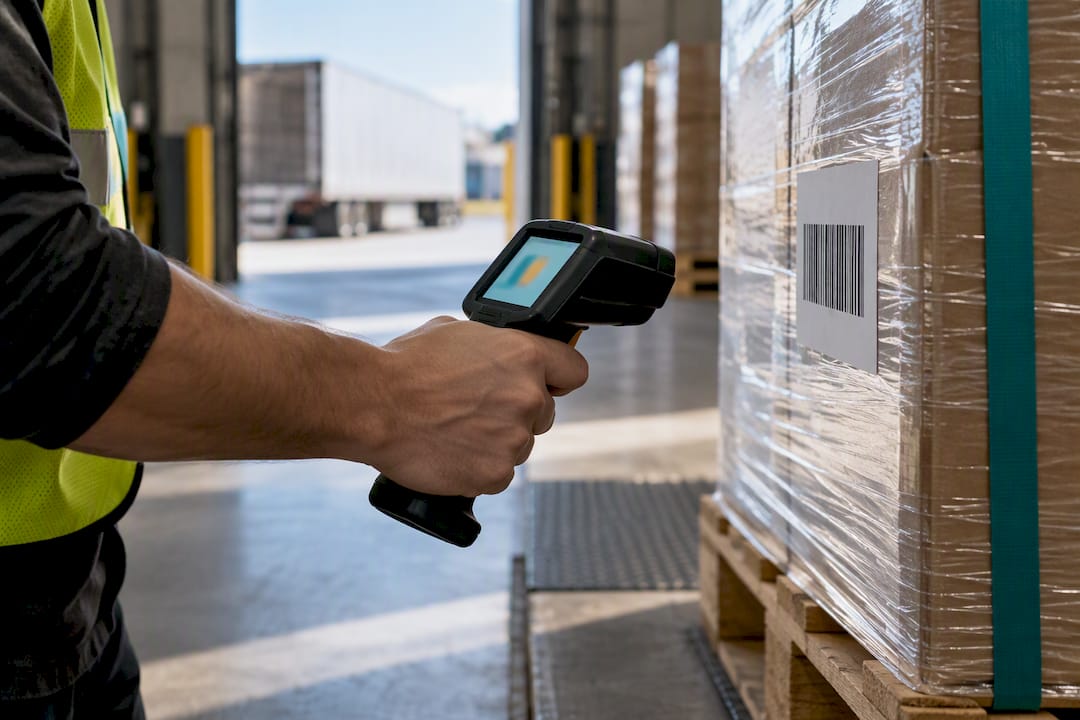
Over-consolidation is the second common failure: teams hold freight too long chasing marginal fill-rate gains and blow through customer commit windows. And shippers using Shipper’s Letter and Certification (SL&C) rules to speed pickups often do not realize they have shifted liability exposure onto themselves, a risk that needs a physical audit step at the consolidation point, not just a policy memo.
A productive first 60 to 90 days produces one validated pilot lane, a documented release policy, and a carrier rate structure tied to real fill data, not projections.
When consolidation is the right lever, and when it isn’t
Consolidation earns its complexity when volume is steady, margins are thin enough that per-unit freight cost matters, and customers tolerate a modest lead-time shift. When volume is lumpy or customers demand next-day windows, dedicated capacity or staggered replenishment usually outperforms it. Match the tool to the constraint, not the trend.
— Michael
Getting a consolidation pilot running faster
Most teams lose months mapping flows and negotiating carrier rates before they ever test a hypothesis. A retained advisory engagement compresses that timeline by running the diagnostic, scoring lane opportunities, and designing the pilot alongside your team rather than handing over a deck.

A typical engagement includes:
- A flow and lane-scoring diagnostic built from your own shipment data.
- A pilot design with carrier rate negotiation support.
- TMS and WMS integration guidance scoped to your existing systems.
Running this internally works when you already have a data team and TMS access. Hiring an advisor makes sense when speed matters or when your network needs a hub redesign, not just a lane fix. See the full list of 3PL Growth Strategy, 3PL Selection & Diligence, and related advisory services to scope an engagement.
Sources
- The Impacts of Freight Consolidation and Truck Sharing on Freight Mobility (Transet/LSU)
- Partitioned vs. Integrated Planning of Hinterland Networks for LCL Transportation (arXiv)
FAQ
What is freight consolidation?
Freight consolidation combines multiple smaller shipments into fewer, larger loads to improve truck fill rates and lower cost per unit shipped. It can happen at the lane level, between shippers, or at the network level through intermediate hubs.
What are the three types of bill of lading used in consolidated shipping?
The three common types are the straight bill of lading, the order bill of lading, and the through bill of lading, each defining different rights of ownership and liability during transit. A consolidator or freight forwarder typically issues a house bill of lading covering the combined shipment, tied to individual bills for each shipper.
What is the difference between LCL and consolidation shipments?
LCL, or less than container load, refers specifically to ocean freight where multiple shippers share container space. Consolidation is the broader practice, covering LCL alongside LTL-to-FTL conversion, shared truckload, and retail consolidation across any transport mode.
What are the seven pillars of logistics?
Definitions vary across sources, but common versions include product, price, place, promotion, packaging, process, and people, adapted from broader supply chain frameworks rather than a single fixed standard. Freight consolidation touches several of these directly, particularly process and place, since it reshapes how and where goods move.
How much can freight consolidation reduce shipping costs?
A documented case study found optimized consolidation routes reduced operational costs by about 23% while cutting truck usage to roughly 67% of baseline. Network-level hub optimization in separate research found additional transportation savings of about 1.13% to 7.11% when hubs are properly sited.