For most consistent long-haul lanes, a well-scoped mode shift to intermodal or rail is the fastest way to cut landed transportation cost and per-ton emissions. The catch is that not every lane qualifies, and the shift only pays off when you run a lane screen and freight-fit check before committing volume. Skip that discipline and drayage variability alone can erase the savings.
TL;DR:
- A successful mode shift requires thorough lane qualification, including distance, volume, freight characteristics, and terminal access, to ensure cost savings and emissions benefits.
- Operational issues such as drayage variability, terminal congestion, and lack of clear exception workflows are the leading causes of mode shift program failures.
- Tracking systems must be integrated and tested in advance, especially for multi-party visibility, to prevent data gaps that compromise performance measurement.
- Pilot programs should be carefully designed with defined KPIs, contract terms, and ownership of exception handling to avoid late-stage surprises and ensure scalability.
- Putting operational ownership and exception workflows in writing before starting the pilot significantly improves the chances of a smooth, successful scale-up.
Table of Contents
- When a mode shift pays: cost, distance, volume, and service tolerance
- A 5-stage framework to convert lanes from truckload to intermodal
- Implementation checklist: TMS setup, contracts, and ownership
- The failure modes that erase mode shift savings
- Measuring outcomes: KPIs, accounting, and emissions rules
- An operator’s view on where mode shift programs actually break
- Getting buy-in: change management for a mode shift
- Regulatory and compliance factors that affect mode shift decisions
- Technology and data integration that make mode shift work
- Environmental impact beyond the emissions number
- Managing risk during the transition
- Turning a successful pilot into a full program
- Editorial take: the pilot discipline matters more than the mode
- How The 3PL Cowboy helps you pilot a mode shift without the guesswork
- Sources
- FAQ
When a mode shift pays: cost, distance, volume, and service tolerance
Distance and mileage composition decide most of the economics before you ever price a rate. A widely used practitioner rule of thumb is that rail linehaul should represent at least two-thirds of total move mileage, or the lane should run around 750 miles or more, before intermodal pencils out against truckload, because drayage on both ends eats into savings on shorter moves. Per ton-mile, rail and water are among the least energy-intensive freight modes, which is the main source of the emissions upside.
Volume and freight characteristics matter just as much as distance.
- A lane needs enough consistent volume, often cited around 50 to 100 loads a year, to justify the operational overhead of a second mode.
- Over-dimensional freight, strict appointment windows, or highly intermittent volume tend to disqualify a lane regardless of mileage.
- Freight that unitizes cleanly onto standard containers or trailers moves through transload and rail terminals with far less friction.
Emissions math needs the same rigor as cost math. Use lane-level, life-cycle figures rather than national averages: GREET-based well-to-wheel modeling shows the emissions benefit of a mode shift depends heavily on the specific lane, equipment, and fuel pathway involved, not a blanket industry number.
A 5-stage framework to convert lanes from truckload to intermodal
Converting a lane is a sequence, not a single decision. Skipping a stage is usually where the savings disappear.
- Lane economics screen. Map dray distance on both ends, confirm terminal access near origin and destination, and estimate what share of total miles will actually run by rail.
- Freight qualification. Check dimensions, weight, unitization method, appointment rigidity, and shipment density to confirm the freight is a physical fit for intermodal equipment.
- Provider selection. Decide between an intermodal marketing company, an asset-based rail carrier, or an internal rail relationship. Dray quality on both ends is usually the deciding factor, since most intermodal service failures trace back to drayage rather than the rail leg itself.
- Pilot design. Run 3 to 5 lanes with clean, comparable data and defined guardrails: free days, demurrage caps, and a clear go or no-go trigger before you touch the routing guide.
- Scale cadence. Add lanes in 30-day batches, updating the routing guide and tender waterfall as each batch proves out, and lock in contract structure once the pattern holds.
Pro Tip: Run your pilot on lanes with a dedicated dray provider already under contract. A weak dray relationship will sink an otherwise perfect rail lane.
Provider selection deserves particular weight here. A distribution network with clean terminal access changes the math on every stage above, and vetting an intermodal marketing company or asset carrier through the same selection and diligence process you’d apply to a warehouse partner catches problems before they show up in your KPIs.
Implementation checklist: TMS setup, contracts, and ownership
Once a lane clears the screen, the work shifts to systems and paperwork. Get these details wrong and the pilot’s clean data turns messy fast.
- Build routing guide entries and tender waterfalls in your TMS so intermodal lanes route automatically once conditions are met.
- Negotiate committed versus spot exposure deliberately, since a lane that flips to spot mid-pilot will distort your cost comparison.
- Set free days, demurrage terms, and a chassis strategy in writing before the first load moves, not after the first invoice arrives.
- Define who owns dray and transload bookings, appointment syncing, and exception handling, whether that’s your team, the IMC, or a named dray provider.
- Add inventory buffer rules for lanes carrying safety-critical SKUs to absorb the extra day or two of transit variability.
Pro Tip: Put the exception workflow in writing before day one. A pilot that runs smoothly on paper but has no owner for a missed appointment will fail on the second load, not the fiftieth.
Parcel and transportation teams that already run a formal transportation strategy tend to fold these contract terms into existing carrier agreements faster than teams building the process from scratch.
The failure modes that erase mode shift savings
Most mode shift programs don’t fail on the rail leg. They fail on the parts around it.
- Visibility loss. Adding a rail carrier, a dray provider, and a terminal to a single move creates more handoff points than truckload, and tracking gaps most often show up in the drayage segment. Require booking ownership and TMS eventing at every handoff, and hold providers to a written visibility SLA.
- Drayage variability. Audit dray KPIs before committing volume, keep a backup dray pool for peak periods, and where possible contract for chassis availability rather than hoping one shows up.
- Terminal congestion and dwell. Choose cleaner, less congested terminals for your pilot lanes specifically, and build schedule buffers into service commitments rather than promising truckload-speed transit on a rail lane.
- Equipment shortages. Negotiate priority clauses with your IMC relationship so your loads aren’t the ones bumped when container or chassis supply tightens.
Measuring outcomes: KPIs, accounting, and emissions rules
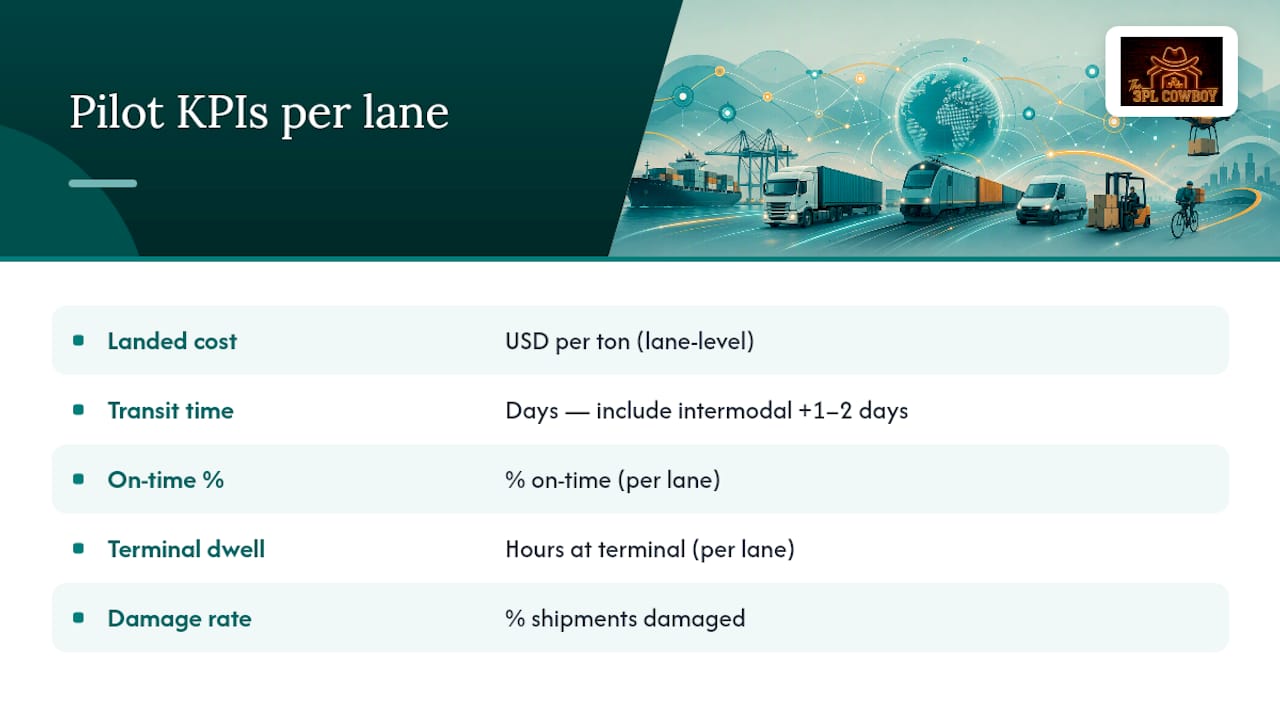
Track the same five metrics on every pilot lane so comparisons stay honest: landed cost per ton, door-to-door transit time, on-time percentage, terminal dwell time, and damage rate. Comparing a truckload lane’s on-time percentage against an intermodal lane’s without adjusting for the extra transit days built into rail service is the single most common measurement error.
Simulation research shows rail’s cost advantage depends heavily on volume and terminal performance, not distance alone. A multi-modal freight simulation study found significant swings between pre-estimated and simulated costs, with the sensitivity driven largely by drayage rates, terminal delays, and container volume, meaning a lane that looks profitable on paper can miss the mark without a stress test.
For emissions, calculate figures at the lane level using life-cycle accounting rather than a generic per-mile average. Intermodal transit also typically runs 1 to 2 days longer than truckload because of pickup and deramp handling, a factor that belongs in your service-tolerance math from the start, not discovered mid-pilot.
An operator’s view on where mode shift programs actually break
Seventeen years of running physical operations across brands like Nike, Walmart, DHL, FedEx, Kellogg’s, and Peloton leaves you with a specific bias: distrust anything that looks good in a spreadsheet before it’s been tested against a real dray schedule. That bias shows up in every pilot design recommendation above.
The pitfalls that sink mode shift programs are almost always operational, not strategic: nobody owns the exception workflow, the dray pool has one provider instead of two, or the pilot launches on a lane where the terminal is already congested. The fixes are the same ones that worked on a Kroger pallet-program redesign or a 60-site WMS rollout: name an owner for every handoff, batch changes in small groups, and measure before scaling. A three-lane pilot with clean data beats a twenty-lane rollout with none.
Getting buy-in: change management for a mode shift
A mode shift touches more departments than most transportation decisions, and that’s where a lot of programs stall before the first pilot load ever moves. Procurement worries about rate volatility, customer service worries about the extra transit days, and finance wants proof before committing budget to a new contract structure.
Get ahead of that by bringing the affected teams into the lane screen itself, not just the results. Customer service needs to know upfront that a converted lane may run a day or two longer, so they can set expectations with accounts before a shipment is late rather than after. Finance needs the pilot’s KPI plan before launch, including what “success” looks like in dollars and days, so a mid-pilot review doesn’t turn into a debate about the goalposts.
Sales and account management deserve a heads-up too, especially on lanes serving customers with tight delivery windows. A pilot that quietly changes service levels on a key account, without anyone telling the account team, tends to generate more internal friction than the freight savings are worth. The programs that scale smoothly are usually the ones where operations, customer service, and finance agreed on the success metrics before the first load, not after the first invoice came in lower than expected.
Regulatory and compliance factors that affect mode shift decisions
Mode shifts carry their own compliance layer, separate from the commercial terms. Rail and intermodal moves are subject to different documentation, liability, and claims frameworks than over-the-road truckload, and a shipper used to a standard bill of lading process needs to confirm how those terms change under an intermodal or rail contract.
Hazmat and regulated commodities carry additional handling and documentation rules specific to rail transport that don’t map directly from truckload requirements, so any lane carrying regulated freight needs a compliance review as part of the freight qualification stage, not as an afterthought during the pilot.
Cross-border lanes add another layer, since customs documentation, in-bond movement rules, and carrier liability terms shift depending on whether freight moves by rail or truck across a border. Any mode shift touching a Canada or Mexico lane should get a compliance check specific to that mode before the pilot launches, not just a cost comparison.
Contract liability terms also change. Rail carriers and intermodal marketing companies often carry different cargo liability limits than truckload carriers, and those limits belong in the contract review stage alongside free days and demurrage terms, not discovered after a claim.
Technology and data integration that make mode shift work
A mode shift lives or dies on whether your systems can actually route, track, and reconcile a multi-party move. A TMS that only knows how to tender truckload loads will need routing guide updates, new tender logic for intermodal providers, and often a new integration for tracking data that doesn’t come through the same EDI feed as a truckload carrier.
Real-time tracking is the piece most teams underestimate. Truckload visibility usually comes from a single carrier’s tracking feed. An intermodal move adds a dray carrier, a rail carrier, and a terminal, each with its own data feed and its own gaps, and stitching those together into one usable view is what separates a program with clean pilot data from one that can’t tell where a load actually is.

Building that integration before the pilot starts, rather than during it, saves the pilot’s credibility. A KPI review that runs on incomplete visibility data will always understate performance, and a stakeholder skeptical of the mode shift will seize on that gap as proof it doesn’t work. Get the tracking feeds connected and tested on a dummy load before the first real shipment moves.
Environmental impact beyond the emissions number
Emissions accounting gets most of the attention in a mode shift business case, but it isn’t the only environmental factor worth naming, especially if the business case needs to hold up to scrutiny beyond a sustainability report.
Rail terminals concentrate truck traffic, noise, and idling in a smaller footprint than distributed truckload lanes, which matters for any facility near a residential area or one operating under local noise ordinances. Land use is a real tradeoff too: a mode shift that reduces highway miles can increase local drayage trips around a terminal, shifting the environmental footprint rather than simply shrinking it.
None of that undermines the case for a mode shift on a qualifying lane. It does mean the environmental story is more complete when it accounts for where the truck miles actually move, not just how many total miles disappear.
Managing risk during the transition
The riskiest period in any mode shift is the transition itself, not the steady-state operation once it’s running. Capacity commitments, contract terms, and internal processes are all in flux at the same time, which is exactly when a disruption does the most damage.
Keep a truckload option live on every converted lane during the pilot and early scale phases, so a rail service disruption or terminal shutdown doesn’t leave a shipment stranded with no backup plan. Build contract flexibility into the intermodal agreement itself, particularly around volume commitments, so a slow pilot doesn’t lock you into a minimum volume you can’t hit.
Weather and terminal congestion are the two disruptions that show up most often in practice. A pilot that launches during peak season or storm season without a contingency plan is testing the mode shift and a disruption response at the same time, which makes it harder to tell which one failed if the numbers come in soft.
Turning a successful pilot into a full program
A pilot that hits its KPIs still isn’t the same as a program ready to scale. The jump from 3 to 5 lanes running cleanly to 30 or more lanes running reliably is where most of the operational strain shows up.
Scale in the same batches you piloted with, adding groups of lanes on a set cadence rather than converting the entire network at once. Each batch should get the same clean-data discipline as the original pilot, because a lane added in month six that skips the freight qualification step is the one most likely to cause a service failure.
Recontract as you scale, not before. Locking in committed volume rates across the whole program before the pilot proves out removes your leverage and your flexibility. Once several batches have run cleanly, a committed contract structure with the IMC or rail carrier usually captures better rates than staying on spot exposure lane by lane.
Editorial take: the pilot discipline matters more than the mode
Most of the advice circulating on mode shift strategy treats the mode choice itself as the hard part. It isn’t. The mileage thresholds and freight-fit rules are well established and not particularly controversial. What’s underrated is how much a program’s success depends on unglamorous operational decisions made before the first load ever moves: who owns the dray booking, what happens when a terminal is congested, whether the contract has a real exception workflow instead of a vague service-level promise.
The conventional advice tends to stop at “screen your lanes and pick a good IMC.” That’s necessary but incomplete. The programs that actually hold their savings are the ones that treat the pilot as an operations project first and a procurement project second. If you take one thing from this, prioritize the dray relationship and the exception workflow before you negotiate the rail rate. A great rate on a lane with no backup dray provider is not a good lane.
— Michael
How The 3PL Cowboy helps you pilot a mode shift without the guesswork
Running a clean 3 to 5 lane pilot takes more than a spreadsheet. It takes someone who has actually built routing guides, negotiated dray SLAs, and cleaned up a failed WMS rollout when the exception workflow had no owner. Operator-grade diligence is critical to mode shift decisions, rather than relying on brokered recommendations that may have incentives to move volume.

Depending on where you are in the process, that can look like:
- Lane analysis and freight-fit screening to identify which lanes are actually ready for a shift.
- Pilot design with contract guardrails, KPI definitions, and a go or no-go framework built in.
- 3PL selection and diligence for IMCs, dray providers, or asset carriers who will operate the handoffs.
- Fulfillment cost benchmarking to validate projected savings before you scale past the pilot.
If you’re a brand or 3PL operator planning a multi-lane mode shift and want a second set of eyes before you commit volume, start with our services overview to see where an operator-led review fits your timeline.
Sources
For deeper technical grounding, consult GREET life-cycle emissions materials, Stanford’s energy and transportation overview, and practitioner truckload-to-intermodal conversion guides for pilot design specifics. Fleet operators managing fuel exposure during a transition may also find value in reviewing on-site fuel delivery options.
- Stanford: Energy and transportation overview
- How to Convert Truckload Freight to Intermodal: 5-Stage Shipper Guide
- Supply Chain Dive: intermodal visibility and drayage challenges
- R&D GREET 2024 hydrogen fact sheet (US DOE / Argonne)
FAQ
What is a mode shift strategy in freight transportation?
A mode shift strategy means deliberately moving freight from one transportation mode to another, most often truckload to intermodal or rail, to lower cost, manage capacity, or reduce emissions. It works best on consistent, high-volume lanes where rail linehaul makes up most of the total mileage.
How many miles does a lane need for intermodal to make sense?
A common screening rule is that rail linehaul should represent at least two-thirds of total mileage, which typically means lanes around 750 miles or longer. Shorter lanes usually lose their savings to drayage costs on both ends.
Why do intermodal pilots fail even when the lane economics look good?
Most failures trace back to drayage and terminal handoffs rather than the rail leg itself, since visibility and control tend to degrade whenever a mode shift adds more parties to a move. Clean pilot data and a named owner for exception handling prevent most of these failures.
How long does an intermodal shipment take compared to truckload?
Intermodal moves typically run 1 to 2 days longer than truckload because of pickup and deramp handling at rail terminals. That transit difference should be built into service commitments before a lane launches, not discovered mid-pilot.
How can a company get help designing a mode shift pilot?
Working with an operator-led advisory like The 3PL Cowboy can help validate lane economics, structure the pilot’s contract guardrails, and benchmark projected savings before committing volume to a new mode.