
Pick the 3PL whose network, technology, and measurable performance history map directly to your specific failure modes, not the one with the slickest sales deck. Before you sign anything, verify five things: vertical experience with your SKU type, real integration depth with your tech stack, trailing performance data (not projections), transparent landed cost per order, and SLA terms with enforceable credits. The scoring framework and 21 to 45 day process below turn that into a repeatable evaluation instead of a gut call.
TL;DR:
- Verify a 3PL’s industry experience with similar SKUs and volume, and challenge vague claims like “great accuracy” by requesting actual performance data.
- Focus on their technology integration history, especially API documentation and incident reports, rather than trusting verbal assurances or sales pitches.
- Ensure their operational performance metrics meet industry standards, such as above 99.5% order accuracy and 97% on-time shipping, broken down by SKU class.
- Run a two-week parallel period before full switch, requiring worked sample invoices and references to identify potential issues early.
- Develop a scoring system weighted according to your specific failure modes, and demand contractual clauses for clear SLAs, credits, and exit conditions to avoid costly surprises.
Table of Contents
- What Are the Core 3PL Selection Criteria to Evaluate?
- How Do You Run a Structured 3PL Selection Process?
- How Do You Score and Weight 3PL Candidates?
- Contract Terms and Red Flags You Cannot Skip
- What Practitioner Experience Teaches About 3PL Selection
- An Operator’s Take on the Real Selection Bottleneck
- When It Makes Sense to Bring In Retained Advisory
- Sources
- FAQ
What Are the Core 3PL Selection Criteria to Evaluate?
Most brands ask the right questions but accept the wrong evidence. A 3PL telling you they have “great accuracy” means nothing until you see the number and the time window it covers. Here is what to actually request from every candidate, and why each piece matters.
Industry and vertical experience. Ask for two or three references operating similar SKUs at similar volume, ideally in your category. A 3PL that has run apparel with size and color variants for a decade will handle your returns rate differently than one that mostly ships CPG cases.
Technology and integrations. Request the WMS feature list, current API documentation, and a log of integration downtime over the past twelve months to understand their e-commerce technology integration. If they can’t produce an incident report, assume they don’t track one.
Operational performance metrics. Demand trailing 90 day and 365 day numbers on order accuracy, inventory accuracy, and same-day ship rate, broken down by SKU class rather than a blended average. Top-quartile 3PLs typically report shipping accuracy above 99.5%, on-time performance above 97%, and inventory accuracy above 99%. Anything meaningfully below those numbers deserves a hard conversation, not a footnote.
Scalability and peak handling. Ask how they’ve handled a documented peak day in the past, and what capacity plan exists if your volume doubles in Q4.
Network and node strategy. Have them map transit times from their facilities to your customer base, not just list warehouse addresses.
Cost structure. Insist on a worked landed cost per order using your actual SKU mix and volume, not a generic rate card.
Service model and governance. Confirm the account team structure, guaranteed SLA response windows, and the escalation matrix for when something breaks.
Security and compliance. Request certificates of insurance, SOC2 or ISO evidence if you handle sensitive data, and hazmat or temperature control qualifications if your products need them.
Sustainability, when it matters to your buyers. Ask for packaging waste data or carbon reporting if your brand markets on environmental credentials.
Pro Tip: If a candidate hesitates to hand over 90 day performance data broken down by SKU class, that hesitation is itself the data point. Operators with strong numbers show them off unprompted.
How Do You Run a Structured 3PL Selection Process?
A focused selection process takes 21 to 45 days if you run it with discipline. Here’s the sequence that keeps it from dragging into a quarter.
- Define your operational profile. Someone internally (usually the VP of ops or supply chain director) owns pulling your order history, SKU count, return rate, and seasonal peaks before any calls start.
- Build a shortlist of 3 to 5 candidates. Disqualify anyone who won’t share integration specs, lacks certifications your category requires, or refuses to discuss performance metrics before signing an NDA.
- Send a real RFP, not a feature checklist. Require pricing worked against your actual SKU and volume profile, a sample invoice, specific SLA language, and at least one written scenario response (a peak-day surge, a recall, a system outage).
- Run demos and facility visits with standardized questions. Watch how staff handle an unscripted question on the floor, not just the slide deck in the conference room.
- Call references unprompted. Ask what broke in the first 90 days and how it got fixed, not just whether they’re happy.
- Run a two-week parallel period before full cutover, with defined go-live thresholds on order accuracy and integration latency.
A short, intensive RFP that demands worked pricing and scenario answers reveals operational truth that a sales deck never will.
How Do You Score and Weight 3PL Candidates?
Weights should reflect your failure modes, not a generic template. A direct-to-consumer brand that lives or dies on same-day ship and checkout integration needs a different scorecard than a B2B operation running EDI with retail partners. Research using the best-worst method consistently finds operational efficiency and customer service carry the heaviest weight across industries, but the exact split still depends on your business stage.
Score each category 1 to 5, multiply by weight, and sum for a total per candidate. Then run a sensitivity check: shift two of the weights by 5 points and see if the ranking flips. If it does, the decision is closer than it looks and probably deserves a pilot before you commit. Watch for candidates who win on a single headline number, like pick rate, while quietly losing on landed cost once accessorial fees get added in.
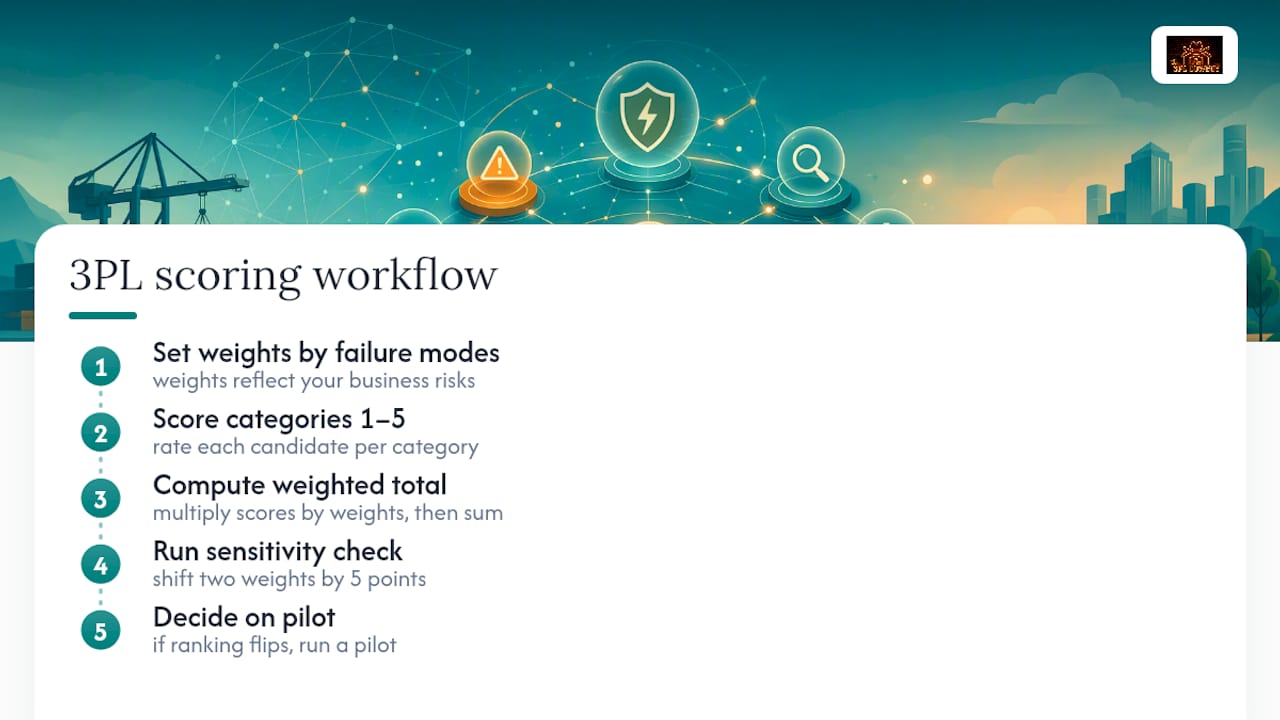
Our 3PL performance scorecard breaks these categories into specific KPI definitions you can drop straight into an RFP.
Contract Terms and Red Flags You Cannot Skip
Get these clauses in writing before you sign: termination notice period, defined exit support and data export timelines, SKU transfer terms if you switch providers, and a clear volume measurement methodology so billing disputes don’t turn into month-long arguments.
On service levels, push for concrete numbers: order accuracy at 99.5% or higher, a defined same-day ship percentage target, and integration uptime commitments with a credit mechanism that actually pays out when missed, not just a warning email. Onboarding should include a full SKU audit, labeled sample shipments, named staff owners on both sides, and go-live gates tied to the metrics above.
Red flags that predict trouble later:
- Evasive or delayed answers when you ask for specific metrics.
- SLA language with no defined credit mechanics attached.
- No customer references available at your revenue tier.
- Auto-renewal clauses with short opt-out windows.
- Rate cards with vague “accessorial fees may apply” language.
Contract traps like uncapped rate escalation and stealth minimums are where good-looking deals go bad. Negotiate CPI-tied rate caps and volume minimums you can actually hit.
Pro Tip: Ask for one worked invoice from an existing client at similar volume, with names redacted. If they can’t produce one, they’re either hiding fee complexity or don’t have systems mature enough to generate it.
What Practitioner Experience Teaches About 3PL Selection
Weighting is where most selection processes quietly fail. Teams build a scorecard, then let the highest number win even when the winning candidate scored poorly on the one category that actually predicts their failure mode. A DTC brand that weighted integrations properly would never advance a candidate with a shaky API, no matter how attractive their per-unit rate looked on paper. Failure modes should drive the weighting, not the other way around.
Three moves that cut risk fast: run a two-week parallel period before full cutover instead of trusting a go-live date, demand a worked sample invoice before signing rather than after your first billing cycle, and call two references the 3PL didn’t hand-pick. Each of these takes a day or two and catches problems a sales call never surfaces.
An Operator’s Take on the Real Selection Bottleneck
The conventional advice treats 3PL selection like a vendor comparison: line up feature lists, pick the best score, move on. That misses the actual failure point. Most bad 3PL decisions aren’t caused by picking a weak operator. They’re caused by picking a strong operator whose strengths don’t match the brand’s actual problem.
A 3PL with excellent EDI depth and mediocre same-day ship rates is a fine partner for a wholesale-heavy business and a poor one for a DTC brand living on Amazon Prime-style delivery expectations. The scorecard only works if the weights come from your failure modes first, not from a generic template borrowed off a blog post.
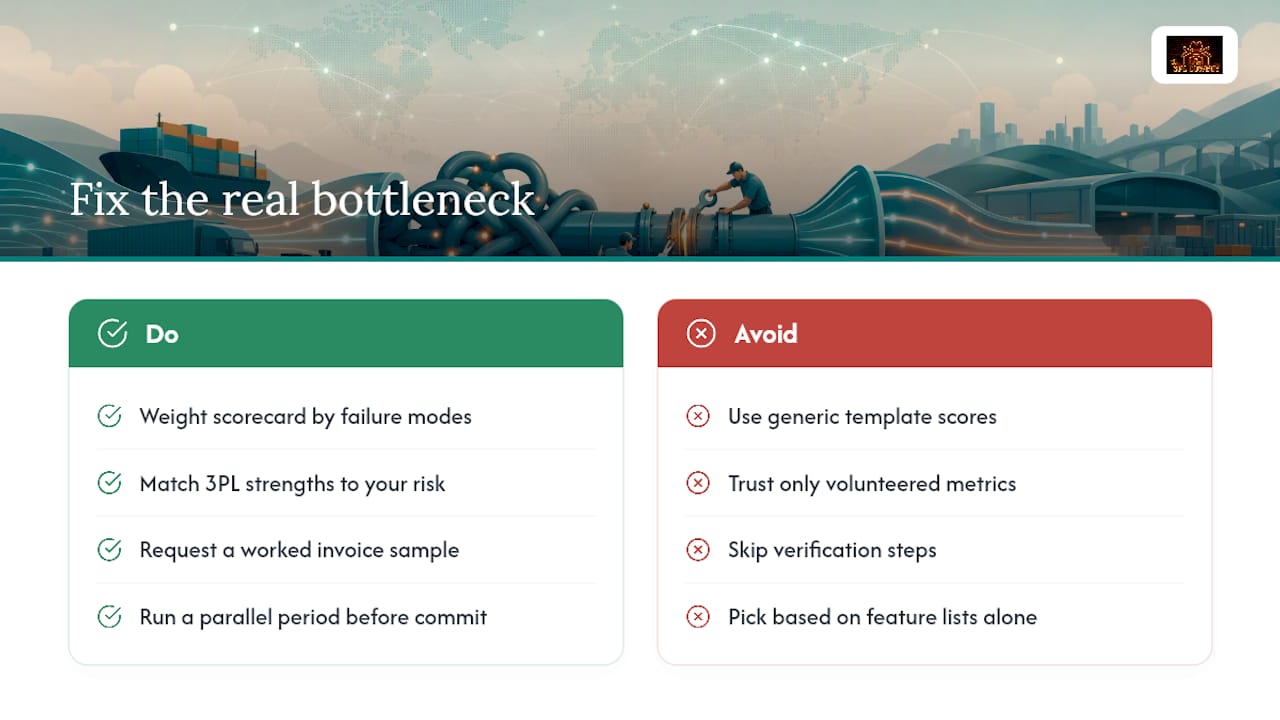
The other gap: everyone reads the metrics candidates volunteer, and almost nobody demands the worked invoice or runs the parallel period before committing full volume. That’s where the real information lives, and it’s the cheapest diligence step teams consistently skip.
Prioritize matching provider strengths to your specific operational risk, then verify with real data before you sign, not after.
— Michael
When It Makes Sense to Bring In Retained Advisory
Running the process above internally works fine when you have someone who has done it before and the bandwidth to chase down worked invoices and reference calls for six weeks straight. It gets harder fast with a complex SKU portfolio, multiple sales channels, or a team that has never negotiated an SLA credit clause against a 3PL’s legal department. Operator-led diligence is available for brands that need the scorecard built correctly, the RFP run tight, and the references checked without the sales-cycle noise most brands get pulled into.
Available engagements may cover a weighted scorecard built around your actual failure modes, full RFP management with worked pricing requirements, unprompted reference validation, and onboarding support through the parallel run. If your next 3PL decision affects six figures in annual fulfillment spend, get the 3PL Selection & Diligence team involved before you send a single RFP, not after you’ve already picked a favorite.
Sources
For deeper methodology, the best-worst method framework and the FAHP-TOPSIS model offer academic grounding for formal weighting and sensitivity analysis if you want to build a more rigorous internal scoring tool.
- How to Build a 3PL Selection Framework That Actually Scales in 2026
- Prioritizing the selection criteria of a third-party logistics company using the best-worst method
- How to Choose a 3PL — 8-Step Selection Guide (2026)
FAQ
What Are the 7 C’s of Logistics?
The checklist typically refers to ensuring the right customer, product, cost, condition, quantity, time, and place to make sure fulfillment execution matches what the customer actually ordered.
What Is the Difference Between 1PL, 2PL, 3PL, 4PL, and 5PL?
1PL means a company moves its own goods; 2PL is a single-mode carrier like a trucking company; 3PL outsources warehousing and fulfillment to a specialized provider; 4PL manages multiple 3PLs and the broader supply chain strategy; 5PL coordinates entire logistics networks across multiple 4PLs, often for large-scale e-commerce ecosystems.
What Are the 5 P’s of Logistics?
Common versions cite product, price, place, promotion, and people, borrowed loosely from marketing frameworks and applied to how logistics decisions support the broader business.
Is Amazon a 3PL or a 4PL?
Amazon’s fulfillment arm (FBA) operates as a 3PL for most sellers, handling storage and shipping, though its broader logistics network and multi-carrier management functions edge toward 4PL territory for larger enterprise accounts.
How Long Should a 3PL Selection Process Take?
A focused process runs 21 to 45 days from defining your operational profile through a completed parallel run, assuming you shortlist 3 to 5 candidates and require worked pricing data upfront rather than negotiating pricing after the fact.