A supply chain digital twin is a continuously updated, instrumented digital replica of your network that lets teams simulate scenarios and make faster, higher confidence operational decisions. Done right, it delivers measurable gains in forecast accuracy, inventory efficiency, and resilience. The sections below cover how it’s built, how it differs from a traditional simulation model, and the standards and pitfalls that decide whether a pilot ever scales.
TL;DR:
- Most successful pilots focus on a single high-value use case, like inventory positioning, with clear baseline metrics and limited data scope.
- Digital twins are most effective in complex, dynamic networks where frequent, interdependent decisions carry significant costs if made wrong.
- Building a twin requires establishing a canonical data model and defining key stakeholder roles before scaling to prevent costly integration issues.
- Interoperability, trust, cybersecurity, and data provenance are critical factors that must be addressed early to enable scaling beyond initial pilots.
- Avoid modeling entire networks immediately; start with a narrow scope, prove ROI on a single bottleneck, and expand only after long-term success.
Table of Contents
- The technical anatomy of a supply chain digital twin
- Digital twin vs. simulation: what’s actually different
- The building blocks of a working digital twin
- Where digital twins pay off fastest
- Build a pilot before you build a program
- Standards, data trust, and security you can’t skip
- What 17 years of operations work teaches you about digital twins
- When a digital twin is strategic, and when it’s a distraction
- Getting hands-on help scoping a digital twin pilot
- FAQ
- Sources
The technical anatomy of a supply chain digital twin
A digital twin is built on a digital thread: the connected stream of data that links a physical asset, process, or network to its virtual counterpart in close to real time. Supply chain twins are usually described in three layers. An asset twin models a single machine or vehicle. A process twin models a warehouse or production line. A network twin models the full flow of goods, information, and cash across suppliers, sites, and customers.
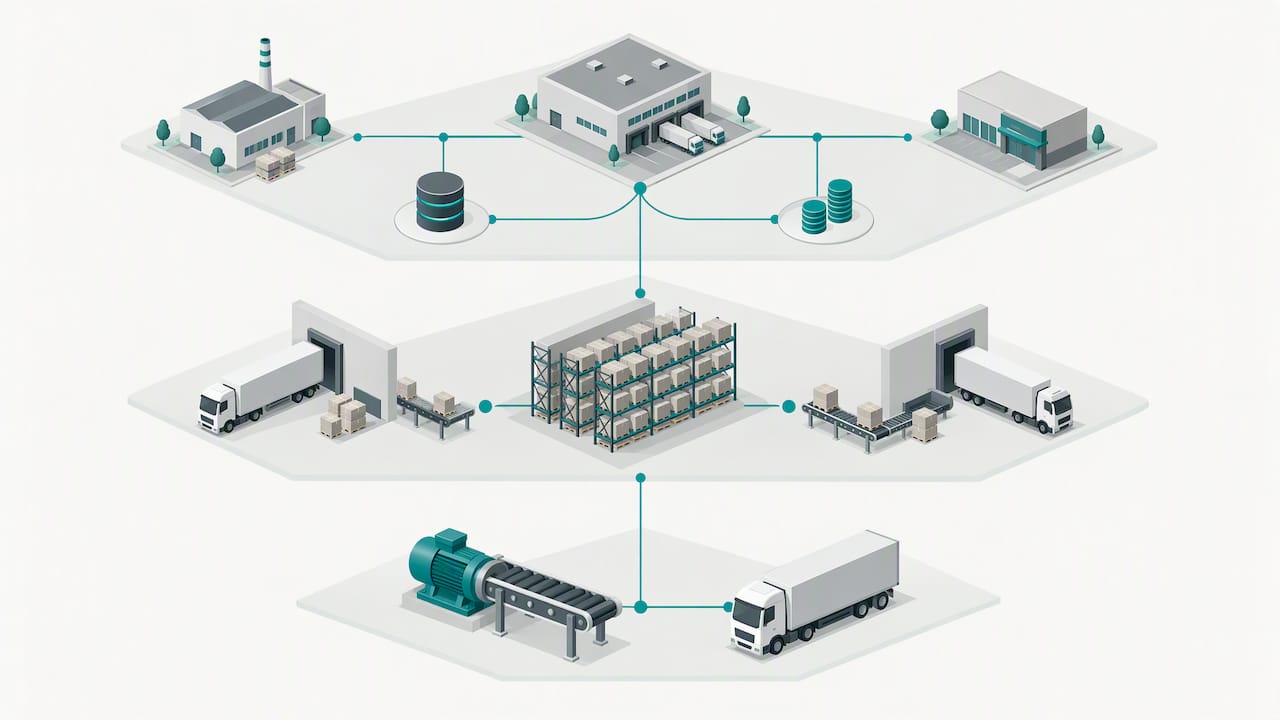
The distinction that matters most is continuous instrumentation versus periodic simulation. A twin ingests live signals constantly and updates its state; a simulation runs on demand with assumptions frozen at the moment of the study. That difference drives everything downstream, including cost.
Common data feeds include:
- Enterprise resource planning (ERP) transactions for orders, costs, and financials
- Warehouse and transportation management system (WMS/TMS) events
- IoT sensor streams from equipment, fleets, and facilities
- Point-of-sale and demand signals from downstream channels
- Supplier and logistics provider data feeds
Model fidelity is a trade-off: higher resolution data improves accuracy but raises integration cost and latency, so most programs scope fidelity to the decision the twin is meant to support.
Digital twin vs. simulation: what’s actually different
A simulation model is a snapshot tool. An analyst builds it, runs scenarios, draws conclusions, and shelves it until the next study. A digital twin is bi-directional and always on: it ingests live operational data, reflects current state, and can feed recommendations back into execution systems.
That distinction should drive your tooling choice:
- Use simulation for one-off questions, like testing a new DC layout before a lease is signed
- Use a twin when the system is dynamic and interdependent, with inventory, transportation, and demand shifting daily
- Expect a twin to cost more up front and take longer to reach value, because it requires ongoing data pipelines, not a single dataset
- Expect simulation to answer a narrow question quickly, then go stale
Organizations with stable, slow-moving networks often get more from a well-built simulation than from the maintenance burden of a full twin. Complexity and volatility are what justify the investment.
The building blocks of a working digital twin
Standing up a twin means assembling data architecture before any visualization layer gets attention. The components break into a few groups:
- Data sources: ERP, WMS, TMS, point-of-sale, IoT sensors, supplier feeds, and external signals like weather or port congestion
- Ingestion and storage: streaming pipelines, a canonical data model, and a digital thread that ties every record back to its source
- Modeling stack: first-principles logic for known physical constraints, machine learning for pattern-based forecasting, and optimization engines for scenario scoring
- Visualization and APIs: dashboards and system hooks that put twin outputs in front of planners and feed decisions back into execution tools
- Operational controls: human-in-the-loop checkpoints so recommendations get reviewed before they trigger automated action
Skipping the canonical data model is the most common early mistake. Without it, every new data source becomes a custom integration project instead of a plug-in.
Pro Tip: Build the data contract before you build the dashboard; a beautiful visualization on bad data just helps people make confident mistakes faster.
Where digital twins pay off fastest
The use cases with the clearest payback share one trait: they involve a decision made repeatedly, under uncertainty, with real cost attached to being wrong.
- Demand forecasting: shorter decision cycles and lower forecast error as the model updates against live sell-through
- Inventory positioning: tighter days-of-supply targets and improved service levels without blanket safety stock
- Network and DC design: testing footprint, throughput, and cost trade-offs before committing capital
- Resilience stress-testing: running scenario libraries against disruptions like a port closure or a supplier outage
Digital twins have helped retailers achieve significant reductions in carbon emissions and improvements in on-time orders in reported deployments, alongside labor cost improvements where twins integrate directly with planning tools. Twins turn the network into a low-risk testing ground: teams can run demand shocks or geopolitical disruptions against the model without touching live operations. Unilever’s scaled AI and digital twin program reported an 8% improvement in overall equipment effectiveness and up to 20% waste reduction, with plans to deploy more than 40 twins across its network.
Build a pilot before you build a program
Most failed digital twin programs failed because they tried to model everything at once. The path that works is narrower.
- Pick one high-value use case, such as inventory positioning at a single distribution center, and set a measurable baseline
- Define the minimum viable instrumentation: the smallest data set that can actually answer the question
- Assign four roles: a product owner, a data steward, an analytics lead, and an operations subject matter expert who can sanity-check outputs
- Set acceptance criteria up front: what forecast error reduction or service-level gain qualifies as a win worth scaling
- Decide whether to build in-house or bring in a vendor, and write the data-sharing terms into the contract before the pilot starts, not after
Running a structured supply chain assessment before you pick a pilot use case prevents the most expensive mistake: instrumenting the wrong bottleneck.
Pro Tip: Treat the pilot like a funded experiment with a kill switch, not a proof of concept you’re emotionally committed to defending.
Standards, data trust, and security you can’t skip
Interoperability and trust are the two issues that quietly kill scaled digital twin programs, and they need to be addressed before the second pilot, not after.
- NIST IR 8356 recommends zero-trust architecture, strong encryption, and access governance for digital twin deployments, pointing to instrumentation and trust as the primary adoption barriers
- CHIPS R&D interoperability workshops identified cryptographic identifiers and traceability standards as priorities for connecting digital twin data across organizational boundaries
- Data provenance matters as much as data volume: every record in the twin needs a traceable origin, especially once suppliers start feeding it
- Contractual controls should define exactly what supplier data enters the twin and what stays proprietary, before integration begins
NIST guidance states that digital twin deployments require substantial cybersecurity measures and should follow the NIST Risk Management Framework, treating the twin as a system that needs the same governance as any production environment handling sensitive operational data. Model outputs should also come with explicit confidence ranges rather than being treated as certainties, since uncertainty quantification is one of the interoperability priorities CHIPS workshops flagged.
What 17 years of operations work teaches you about digital twins
Most digital twin failures trace back to one decision: trying to model the whole network before proving value on a single bottleneck. A narrower scope gets executive backing faster and surfaces data problems while they’re still cheap to fix.
A working 90-day checklist looks like this:
- Confirm data hygiene on the one or two systems feeding the pilot before adding a third
- Name a single accountable owner, not a committee
- Set two or three KPIs maximum, tied to dollars or service level
- Instrument only what the pilot’s decision actually requires
- Put governance and data-sharing terms in writing before vendor onboarding starts
Early wins tend to show up as inventory or labor efficiency gains within the first quarter, not sweeping network transformation. Treat anything bigger as a red flag that the pilot was scoped too wide.
Pro Tip: If your first pilot requires more than three new data integrations, you’ve picked the wrong starting point.
When a digital twin is strategic, and when it’s a distraction
Digital twins earn their keep in networks with real complexity: multiple nodes, variable demand, and interdependent decisions where a bad call compounds fast. If your network is simple and stable, that budget is better spent elsewhere, at least for now.
Twins also don’t replace sound 3PL strategy or governance; they inform it. A twin that recommends a network change still needs a disciplined selection and diligence process behind the facility or partner decision that follows. My recommendation: fund a single pilot with hard ROI gates, not an enterprise rollout, and let the pilot’s numbers decide whether round two gets a budget.
— Michael
Getting hands-on help scoping a digital twin pilot
Picking the right first use case, the right data scope, and the right vendor terms is where most digital twin programs lose months, and where an outside, operator-grade perspective pays for itself. The advisory works with both brands and 3PL operators, offering vendor selection advice free from referral fees or warehouse incentives.

Services relevant to a twin pilot include:
- 3PL Selection & Diligence for vetting technology and fulfillment partners without a sales-driven shortcut
- Distribution Network Design for testing footprint and DC decisions the twin is meant to inform
- 3PL Operations Advisory for governance and KPI baselining once a pilot is running
- Fulfillment Cost Benchmarking for proving the pilot’s dollar impact before you ask for scale budget
A readiness check like the operational maturity model is a useful first step if you’re unsure your data and org structure can support a pilot yet. From there, the path is a short assessment, a defined pilot with baseline KPIs, and execution milestones tied to the metrics that matter. See the full service lineup to find where your team needs the most support first.
FAQ
What is a digital twin in supply chain management?
A supply chain digital twin is a continuously updated virtual replica of a network, built from live data feeds like ERP, WMS, TMS, and IoT sensors. It lets planners simulate scenarios and test decisions before committing resources in the physical network.
Is a digital twin still relevant for supply chains?
Yes, particularly for complex, variable networks where interdependent decisions carry real cost when they go wrong. McKinsey reports measurable outcomes from recent deployments, including emissions and on-time order improvements, and Unilever’s program continues to scale across its network.
How does a digital twin differ from a traditional simulation?
A simulation is a one-off study run on a frozen dataset, useful for questions like testing a new warehouse layout. A digital twin ingests data continuously and stays current, which makes it better suited to dynamic systems where inventory, demand, and transportation shift daily.
Which companies are using supply chain digital twins?
Unilever has deployed AI-powered digital twins across dozens of facilities, reporting OEE and waste reduction gains, and Ford has documented a staged, multi-layer approach that starts intracompany before extending to supplier networks. Adoption tends to concentrate among large, complex networks where the data infrastructure can support continuous instrumentation.
What’s the biggest reason digital twin pilots fail to scale?
Fragmented data and unclear ownership are the most common causes, according to academic reviews of digital twin adoption. Programs that start with a single, well-governed bottleneck and prove ROI before expanding have a better track record of reaching full scale.
Sources
- Digital twins: The key to unlocking end-to-end supply chain growth (McKinsey)
- Security and trust considerations for digital twin technology (NIST IR 8356)
- How Unilever is deploying AI for supply chain resilience (Supply Chain Digital)