
Run change in logistics as a phased, people-first rollout: pick one high-impact use case, define the KPIs before you touch anything, prove it, then scale. Skip the department-wide rollout on day one, and never let the old process stay alive next to the new one. Governance has to include a named operational owner who can force the old workflow into retirement, because the workaround that survives is the one that eventually wins.
TL;DR:
- Successful logistics change requires a phased, people-focused approach that includes assessing current workflows, piloting high-impact use cases, and formally retiring old processes.
- KPIs must be defined before pilots begin and used as gates to determine whether to scale or fix friction points, avoiding premature expansion.
- Combining role-based training with continuous feedback and short, frequent clarity checks ensures staff proficiency and fosters lasting adoption.
- Risks such as shadow workarounds or process drift can undermine transformation unless actively monitored and addressed through governance and contingency plans.
- External operator-led advisory is recommended when the program involves multiple departments, previous failures, or limited internal capacity, to ensure disciplined implementation.
Table of Contents
- What Is Change Management Logistics, and Why Does It Matter Now?
- An Operator-Ready Framework for Logistics Change
- Phased Sequencing: What Comes First and Why It Matters
- Which Metrics Actually Prove the Change Is Working?
- Common Pitfalls in Logistics Change Management
- Operator Proof Points: What This Looks Like in Practice
- Training and Development That Actually Builds Adoption
- Communication Strategies Built for Logistics Teams
- Managing Risk During a Logistics Change Program
- What Change Management Means in a Logistics Context
- When to Bring In External, Operator-Led Advisory
- How 3plcowboy Supports Logistics Change Programs
- Sources
- FAQ
What Is Change Management Logistics, and Why Does It Matter Now?
Change management in logistics is the discipline of moving people, process, and technology through a transition without breaking the daily operation that keeps freight moving. It sounds simple. It rarely is.
A significant majority of major organizational and supply chain transformations fail to hit their objectives, and the cause is almost never the software. It’s the people side: resistance, job-security fears, and the daily friction of a warehouse team that has fifteen minutes to hit a truck cutoff and no patience for a new scanner workflow that adds two steps.
The stakes are higher than they were five years ago because logistics itself is changing shape. The industry is shifting from standalone products to connected operating systems, where a WMS, a TMS, and a forecasting layer all have to talk to each other and to the people running the floor. That raises the coordination bar considerably. A change that used to touch one team now touches four.
What operational failure actually looks like on the ground:
- Pickers reverting to a paper pick list because the new handheld app is one screen too slow
- Supervisors running a shadow spreadsheet because they don’t trust the new inventory count yet
- Exceptions piling up in a queue nobody owns because the old escalation path got deleted before a new one was built
Each of those is a small decision made under pressure. String enough of them together and the transformation is dead in three months, regardless of what the project plan said.
An Operator-Ready Framework for Logistics Change
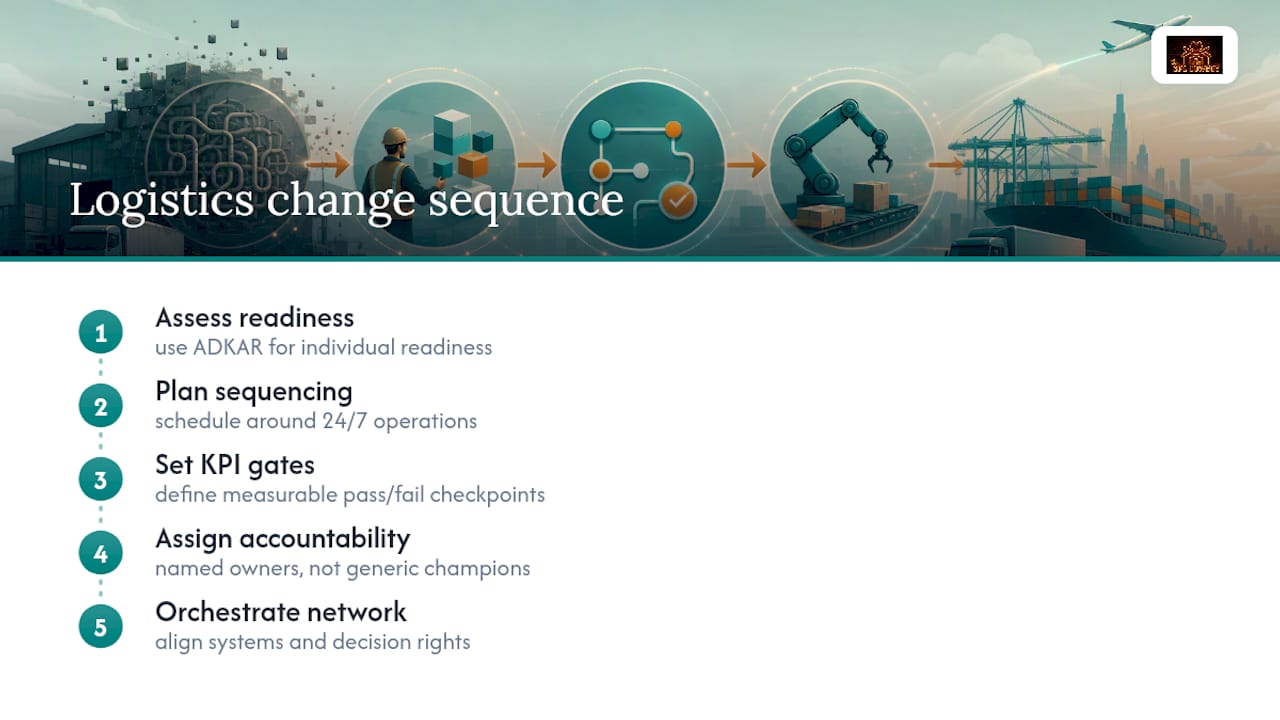
Forget generic change theory. What works on a warehouse floor is a five-step sequence that borrows the diagnostic clarity of ADKAR and the momentum-building logic of Kotter’s model, adapted for people who measure success in units per hour, not slide decks.
- Assess. Map the current state: who does what, where the data lives, and where the real bottleneck sits. This is where an honest supply chain risk assessment earns its keep, because it surfaces the operational risks a software vendor will never mention.
- Design. Build the target workflow with the people who will run it, not just the managers who approved the budget. Assign a single accountable owner for the new process.
- Pilot. Run the change in one facility, one shift, or one product line. Set KPI thresholds before you start, not after you see the results.
- Scale. Roll out to additional sites only after the pilot clears its thresholds, using the same playbook and the same training materials.
- Sustain. Formally retire the old process. Monitor for drift for at least one full quarter.
Governance needs three seats at the table: a steering committee that owns funding and timeline decisions, an operational owner in each facility who has authority to stop or adjust the rollout, and a clear escalation path so a floor-level problem reaches a decision-maker in hours, not weeks.
A quick checklist per phase:
- Assess: deliverable is a current-state map and a documented list of workarounds already in use
- Design: deliverable is a signed-off workflow with named process owners
- Pilot: deliverable is a KPI scorecard against pre-set thresholds
- Scale: deliverable is a rollout schedule tied to pilot performance, not a calendar date
- Sustain: deliverable is a decommissioning record showing the old process is actually gone
Phased Sequencing: What Comes First and Why It Matters
Start with a single high-impact use case. Pick something measurable, like reducing pick errors in one zone or cutting order-to-ship time for one customer segment, and define the KPI targets before the pilot begins. Trying to fix everything at once is the fastest way to prove nothing.
The recommended sequence for logistics transformation runs data governance, then platform consolidation, then workflow redesign, then automation or AI. Automation layered onto messy data just automates the mess faster.
In practice, that looks like:
- Weeks 1 to 4: clean up data ownership and agree on a single source of truth
- Weeks 5 to 8: consolidate overlapping systems where it’s realistic to do so
- Weeks 9 to 14: redesign the actual workflow with the team that runs it
- Weeks 15 to 20: pilot any automation or AI layer against the redesigned workflow
- Ongoing: review KPIs biweekly during the pilot, monthly after scale
A pilot shorter than four weeks rarely surfaces real friction points. Longer than twelve weeks without a KPI review usually means the pilot has quietly stalled.
Pro Tip: Set your go/no-go gate before the pilot starts, in writing, with numbers attached. A vague “let’s see how it feels” gate gets renegotiated the moment leadership gets impatient.
Which Metrics Actually Prove the Change Is Working?
Two categories matter, and most teams only track one of them.
Adoption metrics tell you whether people are actually using the new process:
- User adoption rate by shift and by role
- Feature usage broken out by role, not just an aggregate number
- Training completion paired with a proficiency check, not just attendance
Operational outcome metrics tell you whether the business is actually better off:
- Exception cycle time from flag to resolution
- Decision-to-action latency, a newer KPI class that measures how fast a decision actually becomes an operational change
- Error rates, rework volume, and throughput per labor hour
Treat these as gates, not dashboards. If adoption sits below your threshold after the pilot window, do not scale. Fix the friction first. A pipeline-focused scorecard approach helps translate these into numbers a steering committee will actually act on instead of just admire in a slide.
Common Pitfalls in Logistics Change Management
Most failures trace back to three repeatable mistakes.
- Treating change as an IT project. Software gets installed, nobody owns the operational outcome, and the rollout stalls. Fix: assign an operations owner from day one, require their sign-off before go-live, and decommission the legacy process on a set date.
- Allowing shadow workarounds to persist. Old and new processes running in parallel invite staff to quietly revert the moment the new one gets inconvenient. Fix: remove the fallback where it’s safe to do so, and monitor for informal workarounds during the first sixty days.
- Underinvesting in role-based training. A single all-hands training session does not equal proficiency. Fix: run short clarity checks, keep an open feedback channel, and verify proficiency by role before scaling further.
Pro Tip: A fifteen-minute weekly clarity check with frontline staff surfaces friction weeks before it shows up in your KPI dashboard.
Operator Proof Points: What This Looks Like in Practice
Framework talk is cheap until it’s tested against a real operation.
- A pallet-program redesign for Kroger delivered $6M+ in annual savings by fixing process ownership before touching equipment.
- An 8-month WMS rollout across 60+ Sysco sites followed a pilot-then-scale sequence rather than a simultaneous go-live.
- Each engagement paired a named operational owner with a hard KPI gate before expanding scope.
Training and Development That Actually Builds Adoption
A training program that consists of one webinar and a PDF will not survive contact with a busy shift. What works is role-based, hands-on, and repeated.
Start by separating training tracks by role. A picker needs a different training path than a shift supervisor or a planner, because they interact with the new process at completely different points. Bundling everyone into one generic session wastes time and buries the details that actually matter to each group.
Build in a proficiency check, not just a completion checkbox. Attendance tells you someone sat through a session. A short, practical test tells you whether they can actually run the new process under normal shift pressure. Tie that proficiency check to your adoption KPIs so training gaps show up on the same scorecard as operational metrics.
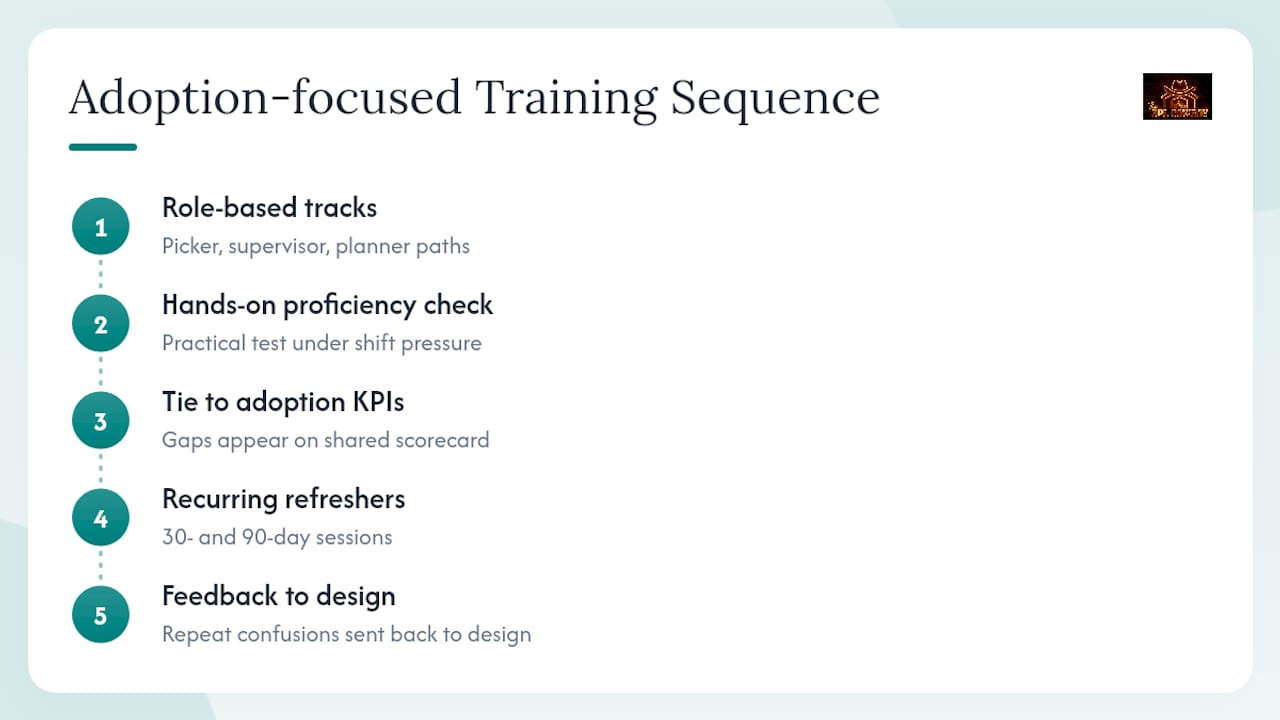
Repeat the training at intervals, not once. A single onboarding session fades fast in a high-turnover warehouse environment. Refresher sessions at the thirty and ninety day marks catch the drift back to old habits before it becomes entrenched.
Give supervisors extra depth, not just extra hours. They are the ones who will field questions on the floor in real time, and if they only know as much as the people they’re training, the whole program loses credibility fast.
Finally, treat feedback from training sessions as operational data. If the same confusion keeps surfacing across three sessions, that’s not a training problem. That’s a workflow design flaw the pilot should have caught, and it belongs back in the design phase, not buried in a trainer’s notes.
Communication Strategies Built for Logistics Teams
Logistics teams don’t read long memos between shifts, and a change communication plan that assumes they will is dead on arrival. Communication here needs to be short, frequent, and delivered where people already are, whether that’s a shift huddle, a break room whiteboard, or a text alert.
Lead with the “why,” not just the “how.” Practitioners consistently find that transparency about the reason for a change matters as much as training on the mechanics, because employees who feel consulted are far more likely to actually support the rollout instead of quietly resisting it.
Use short, recurring clarity checks rather than one big kickoff meeting. A fifteen-minute daily or weekly check-in during a pilot surfaces confusion while it’s still small and fixable. Waiting for a monthly all-hands means problems have three extra weeks to calcify into habits.
Build a two-way channel, not a broadcast. A suggestion box that nobody checks is worse than no channel at all, because it signals that feedback doesn’t matter. Assign someone to actually read and respond to floor-level input within a set number of days.
Match the message to the shift. Night shift, weekend crews, and seasonal staff often get the least communication during a rollout and carry the highest resistance as a result. A communication plan that skips them is not actually a communication plan.
Managing Risk During a Logistics Change Program
Risk in a logistics transformation isn’t abstract. It shows up as a missed truck cutoff, a mispicked order, or a warehouse team quietly reverting to a spreadsheet because nobody trusts the new system yet.
Start every program with a formal readiness assessment before committing budget or timeline. A structured supply chain assessment identifies where data gaps, process ownership gaps, or capacity constraints are likely to derail a rollout before they actually do. Tools like KnowSpan’s continuity risk assessment can add a useful outside check on operational resilience during the transition window.
Build a rollback plan for every pilot, not just a forward plan. If a KPI threshold isn’t met, know in advance exactly what reverting looks like, and make sure that reversal doesn’t quietly resurrect the shadow workarounds you were trying to eliminate in the first place.
Separate live-transaction risk from process risk. A change touching a system that’s actively processing customer orders carries a different risk profile than an internal reporting update, and it deserves tighter monitoring windows, more frequent checkpoints, and a faster escalation path if something breaks mid-transaction.
Finally, treat vendor risk as operational risk. A WMS or TMS rollout that depends heavily on one vendor’s support responsiveness needs contingency planning built into the same governance structure as the internal change itself, not handled separately as a procurement afterthought.
What Change Management Means in a Logistics Context
Change management in logistics is the structured process of moving an operation from one way of working to another without breaking service levels along the way. That includes new technology like a WMS or TMS, but it also includes process changes that have nothing to do with software: a new slotting strategy, a revised labor model, or a shift in how orders get allocated across a distribution network.
It differs from general corporate change management in one critical way: logistics operations run continuously. There’s no quiet weekend to flip a switch when trucks are loading around the clock and customer orders don’t pause for a rollout. That constraint shapes everything about how the process has to be sequenced.
The discipline pulls from established frameworks like ADKAR, which focuses on individual readiness, and Kotter’s eight-step model, which focuses on organizational momentum. Neither was built specifically for a warehouse floor, which is why the operator-ready framework above adapts both into something closer to how logistics teams actually work: sequential, KPI-gated, and built around named accountability rather than a generic change champion network.
The core insight worth internalizing is that competitive advantage in logistics increasingly comes from the ability to orchestrate systems and decision rights across a network, not from any single piece of software. Change management is the mechanism that makes that orchestration possible instead of theoretical.
When to Bring In External, Operator-Led Advisory
Bring in outside help when a program spans multiple departments, touches live customer transactions, has already failed once internally, or your team simply lacks bandwidth to run assessment and execution in parallel. A good operator-led advisor brings implementation discipline and benchmarking, not just a framework on a slide. Start with a short diagnostic before committing to a full retained engagement.
— Michael
How 3plcowboy Supports Logistics Change Programs
Most change programs stall for one of three reasons: nobody owns the operational outcome, the KPI thresholds were never set before the pilot started, or the old process never actually got shut off. This advisory service exists specifically to close those gaps, relying on extensive hands-on operating experience behind the recommendations, not consulting theory built from a template.

If your program involves selecting or benchmarking a 3PL partner as part of the transition, 3PL Selection & Diligence applies the same underwriting-grade rigor to that decision that most companies reserve for a sales call. If the challenge is closer to operational execution, whether that’s a WMS rollout, a workflow redesign, or fixing adoption on a program already underway, 3PL Operations Advisory is the direct path for retained, operator-led support.
Book a discovery call to talk through where your program stands and whether a short diagnostic or a fuller engagement makes sense for your timeline.
Sources
- Why Change Management Remains the “Says Easy, Does Hard” Skill Every Supply Chain Leader Must Master
- From legacy applications to AI ecosystems: The executive road map for logistics modernization
- Logistics Is Moving From Products to Systems
FAQ
Is a Supply Chain Career Stressful?
Supply chain roles carry real pressure, especially during transformation periods when service levels have to hold while processes change underneath the team. Programs that follow a phased, people-first sequence tend to reduce that pressure because problems surface in a controlled pilot instead of during a full-scale, all-at-once rollout.
What Are the 7 C’s of Change Management?
Definitions vary across sources, and there is no single agreed-upon list specific to logistics. Rather than force a canonical framework, most operator-led programs focus on the practical sequence covered above: assess, design, pilot, scale, and sustain, with clear KPIs at each gate.
What Does a Change Management Role in Logistics Pay?
Compensation varies widely by seniority, region, and whether the role sits inside a company or with an outside advisory firm, so no single figure applies across the industry. Current rates and engagement terms for advisory support are listed directly on the 3plcowboy site.
Will AI Replace Supply Chain Management Roles?
AI is changing what supply chain roles look like, but the sequencing evidence points the other way from replacement: automation applied before data governance and workflow ownership are settled tends to amplify existing problems rather than solve them. That means human judgment on sequencing and change management stays central, even as specific tasks get automated.