
Yes, hire an interim supply chain leader when a vacancy, a system cutover, or a performance crisis threatens the next two quarters. Expect engagements to run 3 to 12 months, with some extending past a year. Your first move should be to write a clear mandate and designate an internal sponsor before conducting interviews.
TL;DR:
- Most interim supply chain leaders should be hired for engagements lasting three to twelve months, depending on the scope of the project and complexity.
- Clear decision-making authority and scope definition are crucial to avoid delays, especially when owning KPIs, system cutovers, and commercial levers from day one.
- Candidates must demonstrate specific experience with multi-site operations, system implementations, and documented improvements with real results, not just advisory roles.
- Contract structure should specify scope, decision rights, KPIs, and duration, with fixed or rolling terms aligned to the project’s nature.
- Rapid onboarding focuses on system access, stabilizing operations, quick wins, and preparing for a transition or scope extension within the first three months.
Table of Contents
- When does a business actually need interim supply chain leadership?
- What should an interim leader own from day one to stabilization?
- What should you look for when choosing an interim supply chain leader?
- How should you structure the contract, duration, and fees?
- How do you onboard an interim leader fast enough to see results?
- What does operator-led interim leadership look like in practice?
- Why the conventional hiring advice on this topic falls short
- How The 3PL Cowboy fills the interim leadership gap
- Sources
- FAQ
When does a business actually need interim supply chain leadership?
Most companies wait too long to call in interim help, usually because they assume the gap is temporary or the fix is simple. It rarely is. Interim leaders earn their fee fastest when the trigger is specific and the clock is already running.
- A sudden departure leaves a permanent search stretching past 60 or 90 days.
- A WMS, TMS, or ERP cutover needs a steady hand who has done it before.
- Repeated OTIF failures or inventory losses are eating margin faster than the team can diagnose.
- Peak season or a demand surge requires someone who has run scaled operations under pressure.
- An M&A integration needs a neutral operator to merge two supply chains without political baggage.
Scope drives duration. A single distribution center recovering from an inventory crisis might need three months. A multi-site network redesign tied to an ERP migration often runs closer to a year, sometimes longer, which lines up with Heidrick’s finding that interim projects increasingly include full transformation work rather than short-term coverage.
What should an interim leader own from day one to stabilization?
Scope creep kills interim engagements faster than almost anything else. Before the person starts, the hiring team needs to know exactly what decisions belong to the interim leader and which ones stay with the board or the CEO.
- Own daily operational KPIs: on-time shipping, labor productivity, and fill rate from week one.
- Take direct ownership of systems cutover: WMS or TMS rollouts, ERP integration, and closing the phantom inventory gaps that appear when two systems run in parallel.
- Control commercial levers: carrier contract renegotiation, 3PL performance reviews, and procurement decisions tied to cost-to-serve.
- Sit inside S&OP and own the finance conversation around cost-to-serve, not just report on it after the fact.
Seniority should match the mandate. A tactical fix (a broken pick-and-pack process, a single carrier renegotiation) calls for an experienced operations manager. A multi-site transformation with P&L accountability calls for someone who has run that scope before, not someone learning it on the client’s dime.
What should you look for when choosing an interim supply chain leader?
Screening for interim leadership is different from a permanent hire. You are not evaluating culture fit over five years, you are evaluating whether this person can move fast and own outcomes with limited ramp time.
- Confirm multi-site operational experience, not single-warehouse tenure.
- Ask for specifics on WMS, TMS, or ERP rollouts they personally led, not advised on.
- Request documented inventory or cost-to-serve improvements with real before-and-after numbers.
- Test their carrier and vendor negotiation experience with a concrete example.
- Check for APICS or ASCM certifications, which correlate with higher median compensation and often signal stronger demand planning and analytics skills.
Pro Tip: Ask every candidate to walk through one decision they made without sign-off from above. Their answer tells you more about readiness than any resume line.
Watch for red flags: candidates whose background is advisory-only with no implementation history, anyone who has never held real decision authority, or vague answers about what they actually delivered. Russell Reynolds’ guidance on interim executives is blunt on this point: without explicit decision rights, even a strong operator rarely produces measurable results.
How should you structure the contract, duration, and fees?
The contract is where most interim engagements quietly fail. A vague scope of work or an undefined fee structure creates friction exactly when the leader needs to move fastest.
- Choose a duration model: fixed-term (3, 6, or 12 months) works for a defined project, while rolling month-to-month suits an open-ended vacancy. Heidrick’s 2026 survey found 63% of engagements land between 3 and 12 months, with 42% running longer than six months and 16% stretching past a year.
- Pick a fee model that fits the work: a daily or weekly rate suits short, well-defined projects, a monthly retainer suits open-ended stabilization work, and milestone payments work best when deliverables are countable, like a completed WMS cutover.
- Lock in contract essentials: a written mandate, explicit decision rights, a defined scope of work, milestone KPIs, a knowledge-transfer clause, and a named sponsor for escalation.
- Set KPIs before day one: on-time shipment rate, inventory accuracy, order cycle time, cost-to-serve reduction, and documented vendor savings.
Hand your legal team a short clause checklist covering decision authority, termination notice, confidentiality, and knowledge-transfer obligations at exit. Skipping this step is the single most common reason interim engagements stall midway.
How do you onboard an interim leader fast enough to see results?
Ramp time is the whole point of hiring interim leadership. If it takes six weeks just to get system access, you have erased half the value of the engagement.
- Before day one, grant access to KPI dashboards, current vendor contracts, WMS/TMS/ERP admin logins, payroll basics, the ops calendar, and a list of key stakeholders.
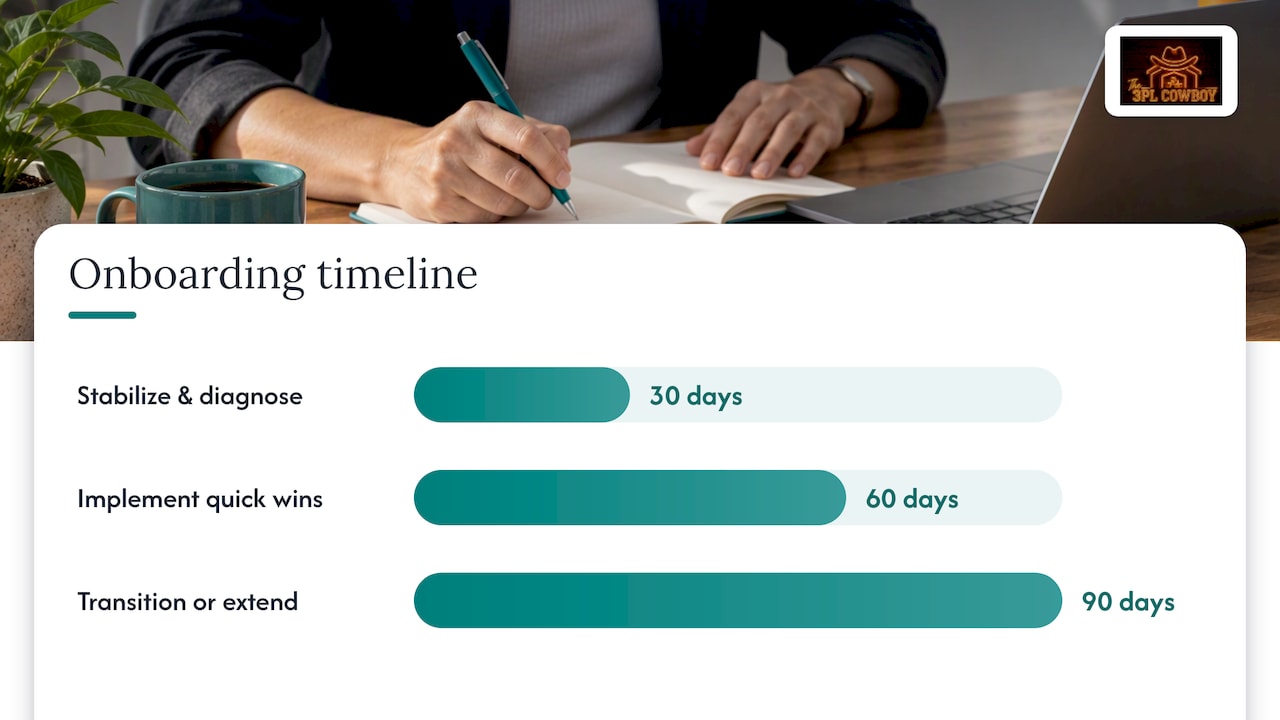
- In the first 30 days, focus entirely on stabilizing operations and diagnosing the real root cause behind whatever triggered the hire.
- By day 60, implement the quick-win fixes: a carrier rate correction, a slotting adjustment, or a vendor contract reset that frees up cash or time.
- By day 90, prepare either a transition plan for a permanent successor or a scope extension backed by measurable KPI movement.
Pro Tip: Brief every internal stakeholder the interim leader will need cooperation from in the first week, not the first month. Silence from the sponsor is the fastest way to stall an interim hire.
Quick wins in the first 30 to 60 days typically come from carrier rate corrections, warehouse slotting fixes, or renegotiated 3PL terms, the same levers covered in change management practices for operators.
What does operator-led interim leadership look like in practice?
Marketplace matchmaking sells you a resume. An operator-led approach sells you a mandate, a diligence process, and accountability for the numbers that matter.
- Michael Nooner brings 17+ years of direct operating leadership across Nike, Walmart, DHL, FedEx, Kellogg’s, and Peloton, not consulting theory.
- A Nike inventory operation moved from 61% to 98%+ cycle count accuracy across more than 450,000 SKUs under his direct leadership.
- A pallet-program redesign for Kroger delivered more than $6 million in annual savings.
- An 8-month WMS rollout spanned more than 60 Sysco sites.
This kind of track record shapes how an operator-first engagement runs: the mandate gets negotiated before day one, vendor contracts get audited early, and KPIs get tracked against a baseline rather than reported after the fact. It is a different posture than a staffing marketplace that places a resume and moves on.
Why the conventional hiring advice on this topic falls short
Most guidance on interim leadership treats the hire like a staffing problem: find someone available, plug the gap, move on. That misses the real risk. An interim leader without a written mandate and real decision rights is functionally an expensive advisor, not an operator, and advisory-only engagements rarely move the KPIs that justified the hire in the first place.
The overrated part of this process is the resume screen. Years of experience and a polished title say little about whether someone can walk into a broken WMS cutover and stabilize it in three weeks. What matters is documented execution: a specific rollout, a specific renegotiation, a specific inventory recovery with real numbers attached.
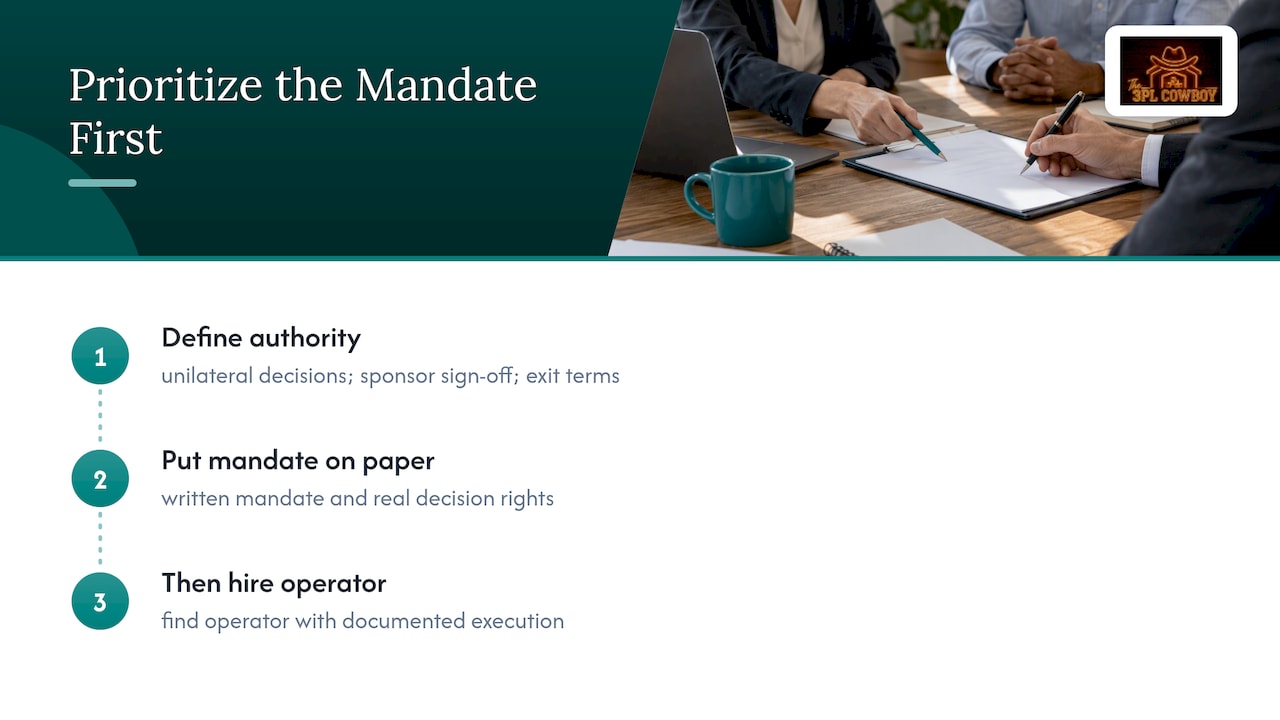
If you take one thing from this playbook, prioritize the mandate before the person. Define what the interim leader can decide unilaterally, what needs sponsor sign-off, and what the exit looks like. Get that on paper first, then go find the operator who fits it. Skip that step, and even the best interim hire on the market will spend their first month negotiating authority instead of fixing your supply chain.
— Michael
How The 3PL Cowboy fills the interim leadership gap
Most interim searches end with a resume and a hope. The 3PL Cowboy works differently: no warehouse to fill, no listings to move, just an operator-led advisory that maps directly onto the gaps interim hiring is supposed to close.

Our services line up with the exact needs covered in this playbook: Executive Advisory for fractional COO-level coverage, 3PL Selection & Diligence when the gap involves switching or benchmarking a logistics partner, and Fulfillment Cost Benchmarking when cost-to-serve is the trigger behind the hire.
- Executive Advisory provides fractional COO-level oversight.
- 3PL Selection & Diligence applies underwriting-grade review to a 3PL transition or renegotiation.
- Fulfillment Cost Benchmarking pinpoints where cost-to-serve is bleeding margin before a full engagement starts.
| Need | Service | Fit |
|---|---|---|
| Fractional executive coverage | Executive Advisory | Vacancy or transition gap |
| 3PL transition or benchmarking | 3PL Selection & Diligence | Performance crisis or contract reset |
| Cost-to-serve diagnosis | Fulfillment Cost Benchmarking | Margin erosion trigger |
Pro Tip: Book a scoping call before you finalize a job posting. Sometimes the fix is a two-week diligence engagement, not a six-month hire.
An initial scoping call typically runs through your current KPIs, the trigger behind the gap, and whether a retainer, project, or advisory shape fits best. Interim engagements are now treated as structural talent by many organizations, not just emergency coverage.
Visit the services page to review the full list of engagement types and start a scoping conversation.
Sources
- 2026 Talent Lens Survey: The State of Interim Talent — Heidrick & Struggles
- Leadership Lounge: How to succeed as an interim CEO — Russell Reynolds Associates
FAQ
What does interim leadership mean?
Interim leadership means a qualified executive steps into a leadership role on a temporary, defined basis to stabilize operations, run a specific project, or bridge a vacancy until a permanent hire is in place. The role carries real decision authority, not just advisory input, which distinguishes it from a consultant engagement.
What is the hierarchy of supply chain titles?
Titles typically run from coordinator or analyst up through manager, director, and vice president, with scope and P&L responsibility mattering more than the title itself. Job mapping guidance notes that director-level hiring should be judged by multi-site responsibility and documented decisions rather than title alone.
How long does an interim CEO typically serve?
Duration varies by mandate, but interim executive engagements commonly run 3 to 12 months, with a meaningful share extending beyond a year for complex transformations. A clear, written mandate at the start tends to correlate with a more predictable timeline.
How long does an interim position last?
Most interim supply chain positions run 3 to 12 months, depending on whether the mandate is a stabilization fix or a full transformation. Complexity, scope, and how quickly the sponsor grants decision rights all affect the actual length.
How does The 3PL Cowboy structure an interim-style engagement?
Engagements are scoped around the specific trigger, whether that is a 3PL transition, a cost-to-serve problem, or fractional executive coverage, and shaped as a retainer, project, or advisory arrangement. Pricing depends on scope and is available on request through an initial scoping call.