
Supply chain change management is the discipline that turns a new WMS, an automation rollout, or a network redesign into results your P&L can see. The first move is simple: pick one bounded, measurable use case and put a named owner on it before you touch any technology. A 2025 benchmarking study found Major supply chain transformations often do not meet their objectives, while structured approaches like ADKAR and Kotter’s model significantly improve success rates. This gap is often an underpriced risk in supply chain operations.
TL;DR:
- Effective change management is essential to ensure supply chain technology rollouts are adopted successfully, especially as automation outpaces workforce readiness.
- Combining Kotter’s organizational model with ADKAR’s individual-focused approach improves buy-in at all levels and prevents stalls during implementation.
- Restricting scope to one measurable use case and actively engaging frontline staff minimizes resistance and boosts the likelihood of sustaining change.
- External advisors are most valuable during multi-site or high-risk projects, providing unbiased diagnostics and practical support beyond internal capabilities.
- Monitoring key metrics such as adoption rate, error reduction, and process cycle time at 30, 60, and 90 days allows early detection of issues and course correction.
Table of Contents
- What Is Supply Chain Change Management?
- Why Supply Chain Change Management Matters Right Now
- Frameworks That Work: Kotter, ADKAR, and How to Pair Them
- The Step-by-Step Process for Managing Supply Chain Change
- Why Do Supply Chain Change Efforts Face Resistance?
- When Should You Bring in External Advisory Support?
- How Do You Measure Success in Supply Chain Change Management?
- Quick Wins You Can Start This Week
- Operator Perspective: Stop Managing Change Like a Rollout Announcement
- How 3plcowboy Helps You Execute Supply Chain Change
- Sources
- FAQ
What Is Supply Chain Change Management?
Supply chain change management is the structured process of moving people, workflows, and systems from a current state to a new one, without breaking throughput along the way. It covers the human and procedural side of transformation: retraining pickers on a new WMS, renegotiating supplier SLAs, or rewriting SOPs after a network redesign. Project management handles the timeline, budget, and technical build. Change management handles whether anyone actually uses what got built.
The distinction matters because most technical rollouts succeed on paper and fail on the floor. Common change types include:
- WMS and TMS implementations or replacements
- Automation and robotics adoption (AS/RS, goods-to-person, conveyance)
- Distribution network redesign (consolidation, new DCs, regionalization)
- Supplier consolidation or vendor transitions
- AI and predictive analytics adoption for demand planning or slotting
Each of these looks like an IT or engineering project. Each one actually lives or dies on adoption.
Why Supply Chain Change Management Matters Right Now
Warehouses are automating faster than the workforce running them is adjusting, and that gap is where transformations quietly stall.
The Numbers: Projects with excellent change management meet or exceed objectives Projects with excellent change management commonly succeed compared to those with poor change management. Such efforts also tend to stay on or ahead of schedule and keep within budget more frequently.
Three forces are driving urgency: automation and AI adoption outpacing workforce readiness, network redesigns triggered by cost and tariff pressure, and labor markets that punish any rollout requiring a steep learning curve. Robotics and AI projects in particular tend to fail for people reasons, not technology reasons — unclear roles, no retraining plan, no champion on the floor.
The failure patterns repeat across industries:
- Treating a supply chain change as an IT deployment instead of an operational one
- Skipping adoption work entirely and assuming training slides count as change management
- Trying to transform the whole network at once instead of proving one use case first
Frameworks That Work: Kotter, ADKAR, and How to Pair Them
Two frameworks dominate practitioner use, and they solve different problems. John Kotter’s eight-step model orchestrates organizational change: build urgency, form a coalition, craft a vision, remove obstacles, generate short-term wins, and anchor the change in culture. It works best at the leadership and cross-functional level, where you need buy-in across finance, ops, and IT before anything moves.
ADKAR (Awareness, Desire, Knowledge, Ability, Reinforcement) operates at the individual level. It maps directly to floor execution: does the picker know why the change is happening, do they want it to succeed, do they have the skill, can they perform it under real conditions, and will the new behavior stick after the trainers leave?
Georgia Tech’s Chris Gaffney frames these as complementary rather than competing: Kotter drives the organizational transformation while ADKAR drives individual adoption, and the strongest programs apply both with situational judgment instead of running either one mechanically.
- Use Kotter for executive alignment, coalition building, and network-level vision
- Use ADKAR for supervisor and associate-level training, role clarity, and reinforcement
- Run them in parallel, not sequence: leadership alignment without floor-level adoption plans stalls at go-live
Pro Tip: Run an ADKAR readiness check on your frontline supervisors two weeks before go-live. If more than a third can’t explain the “why” in their own words, your Potter-level messaging hasn’t reached the floor yet.
The Step-by-Step Process for Managing Supply Chain Change
Effective transformation follows a sequence, and skipping steps is where most programs lose control.
- Identify. Choose one bounded, measurable use case, not a network-wide overhaul. Define three core KPIs before writing a single requirement.
- Prepare. Map stakeholders across frontline, supervisors, IT, and suppliers. Run a readiness assessment and inventory the data and processes the change will touch.
- Design. Build process maps, an integration plan for existing systems, and a training and cutover plan with named trainers.
- Execute. Set pilot acceptance criteria, roll out in phases, define rollback triggers in advance, and hold a fixed communication cadence (weekly at minimum during cutover).
- Sustain and monitor. Decommission the old workflow explicitly, govern the KPIs on a set cadence, and build a feedback loop that reaches the design team, not just a suggestion box.
Practitioners consistently point to two mistakes at this stage: leaving the old workflow technically available (so people quietly revert under pressure), and treating change as one big-bang launch instead of a phased one. Starting with a single use case and clear KPIs rather than attempting network-wide change at once is the difference between a program that compounds and one that collapses under its own scope.
- Identify: bounded scope, three KPIs
- Prepare: stakeholder map, readiness score, data inventory
- Design: process maps, training plan, cutover checklist
- Execute: pilot gates, rollback triggers, weekly comms
- Sustain: decommission old system, KPI governance, feedback loop
Why Do Supply Chain Change Efforts Face Resistance?
Resistance shows up differently depending on where it sits in the organization, and treating it as one problem is a mistake.
Frontline workers resist because the new process looks slower before it looks faster, and nobody explained the tradeoff. Supervisors resist because they’re accountable for output during the transition but rarely get a seat in the design phase. Suppliers resist because a network redesign or SLA change lands on them as a surprise, not a negotiation.
Practical mitigations map to each group:
- Involve frontline staff and supervisors in design sessions, not just training sessions
- Build role-based training instead of one-size-fits-all onboarding decks
- Run sampling feedback loops in the first two weeks of go-live, not a single post-launch survey
- Decommission the old process physically, not just procedurally, so reverting isn’t an option
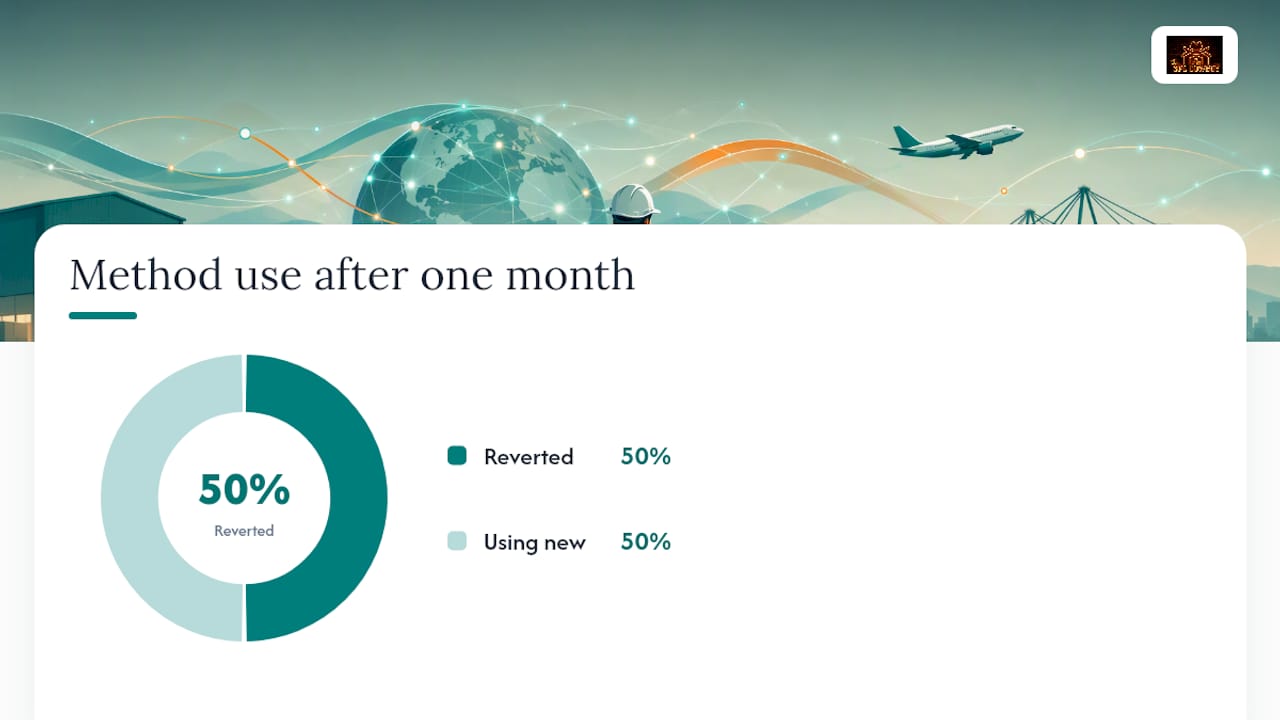
A common reversion pattern: a new putaway process launches, but the legacy scan gun profile stays active “just in case.” Within a month, half the floor is back on the old method because it’s marginally faster for them individually, even though it breaks downstream accuracy. Academic reviews of human factors in change management confirm that engagement, training, and visible leadership involvement are the strongest predictors of whether new behavior sticks or quietly erodes.
When Should You Bring in External Advisory Support?
Multi-site rollouts, high-risk automation investments, and programs where internal credibility is already damaged from a prior failed rollout are the three clearest signals that outside help pays for itself. When organizational change management, not technology, is the constraint, an outsider with no political history in the building can say things employees can’t.
Accenture’s research backs this directly: Organizational change management, legacy ERP, and data silos, rather than technology availability, are main barriers to scaling digital supply chains. That’s a readiness problem, and readiness problems respond to outside diagnosis better than internal advocacy.
An operator-led advisor should deliver concrete artifacts, not slide decks: benchmark data against comparable operations, structured RFP management for vendor and 3PL decisions, hands-on execution coaching during cutover, and training design that supervisors can actually run without a consultant in the room. Track records matter here more than frameworks on a whiteboard.
- Multi-site or multi-DC rollouts where inconsistency compounds fast
- High-capital automation decisions where a wrong bet is expensive to reverse
- Programs where internal change fatigue or a past failure has burned credibility
How Do You Measure Success in Supply Chain Change Management?
Five KPIs cover most transformation efforts: adoption rate (percentage of staff using the new process without reverting), inventory accuracy, process cycle time, error and rework rate, and throughput against baseline.
Checkpoint discipline: Set explicit pilot acceptance criteria before go-live, then review at 30, 60, and 90 days. Programs with strong change management are 5x more likely to stay on or ahead of schedule than those without it.
Red flags that should trigger corrective action:
- Adoption rate stuck below 70% past the 30-day mark
- Error rates climbing instead of falling after week two of go-live
- Budget variance exceeding 15% before the pilot phase even closes
A pipeline-focused scorecard approach gives managers a consistent way to track these signals across sites instead of relying on one DC manager’s gut read.
Quick Wins You Can Start This Week
- Pick one bounded use case, not the whole network
- Assign a single named owner, not a committee
- Run a 15-minute clarity check: can your team explain the “why”?
- Identify the two roles most affected by the change
- Set three KPIs before writing requirements
- Scope a small pilot with a hard start and end date
- Schedule two training touchpoints, not one
- Open a feedback channel that reaches the design team
- Write the decommission plan for the old workflow now
- Publicly recognize the first team that hits the KPI target
Operator Perspective: Stop Managing Change Like a Rollout Announcement
Most leaders treat go-live as the finish line. It’s the starting gun. The programs that hold up are the ones where someone kept measuring adoption and rework at 30 and 60 days, long after the launch email stopped feeling urgent.
Stop announcing change and hoping it sticks. Start assigning an owner, decommissioning the old workflow the same week you launch the new one, and treating week four as more important than week one.
— Michael
How 3plcowboy Helps You Execute Supply Chain Change
Most brands and 3PL operators try to run transformation with the same team that’s already stretched running daily operations, and that’s exactly where a high failure rate comes from. Some consultancies claim to be operator-led advisories with no warehouse to fill and no vendor to push, applying rigorous diligence to 3PL selection, WMS rollout, or network redesign rather than sales pitches.

Whether vetting a new 3PL partner, planning a multi-site WMS rollout, or redesigning a distribution network under cost pressure, some operator-led engagements provide benchmark data, RFP management, and hands-on execution coaching rather than generic playbooks. If you’re weighing a 3PL selection or operational overhaul right now, start with a 3PL selection and diligence review or a 3PL operations advisory engagement to scope what change management your specific rollout actually needs before you commit budget to it.
Sources
- Why Change Management Remains the “Says Easy, Does Hard” Skill Every Supply Chain Leader Must Master
- How to Make Supply Chain Transformation Stick with Effective Change Management
FAQ
What Are the 5 C’s of Supply Chain Management?
Definitions vary across sources, but a commonly cited version includes connectivity, collaboration, cost reduction, coordination, and capacity, all tied to how well partners across the network communicate and execute together.
Can You Make $200k in Supply Chain Management?
Senior supply chain roles, including directors, VPs, and specialized consultants working on transformation or network design, can reach or exceed that income level, particularly in high-cost markets or with deep 3PL and automation expertise.
What Are the 5 C’s of Change Leadership?
Common frameworks describing change leadership emphasize communication, commitment, clarity, capability, and culture, though the exact list varies by author and there’s no single agreed-upon standard.
What Are the 7 C’s of Supply Chain Management?
There’s no universally standardized “7 C’s” framework in supply chain management; most practitioners rely on named models like Kotter’s eight steps or ADKAR instead of a fixed C-based list.
Do I Need a Framework Like Kotter or ADKAR for a Small Rollout?
Even a single-site WMS update benefits from lightweight versions of both: a short vision statement and coalition (Kotter) paired with role-based training and reinforcement (ADKAR) meaningfully reduces reversion risk.