The right order fulfillment strategy prioritizes reliable, right-first-time delivery by aligning inventory placement, routing logic, and warehouse execution around one goal: getting the correct order to the customer without a second touch. Get that alignment right, and the payoff shows up fast, in shorter transit times, higher on-time-in-full rates, and lower cost per order.
TL;DR:
- Distributed inventory across regional nodes can enable next-day delivery for up to 60% of demand, reducing transit times and safety stock needs.
- Real-time order routing that considers inventory levels, carrier ETA, and delivery SLAs prevents backorders and missed delivery windows.
- Maintaining high inventory accuracy through daily cycle counts and disciplined adjustments is essential to improve fulfillment reliability beyond 98%.
- Having documented contingency plans and diversifying carriers and warehouses minimizes the impact of disruptions and supply chain failures.
- Tracking key metrics like cycle time under 24 hours, order accuracy above 99.5%, and OTIF rates in the 95-99% range guides continuous performance improvements.
Table of Contents
- What Is an Order Fulfillment Strategy, Exactly?
- High-Impact Strategies to Speed Up Fulfillment
- How Should You Build Order Routing Logic?
- Where Should Technology and AI Investment Go First?
- What KPIs Should You Track to Measure Fulfillment Performance?
- A Practical 90 to 180 Day Roadmap
- How Do You Keep Inventory Accuracy High at Scale?
- How Do You Plan for Fulfillment Disruptions?
- What Should Customer Communication Look Like During Fulfillment?
- What Are the Best Ways to Cut Fulfillment Costs Without Cutting Service?
- How Do You Add Personalization Without Slowing Down Fulfillment?
- How Sustainable Can an Order Fulfillment Strategy Actually Be?
- What Actually Separates a Good Fulfillment Strategy From a Great One
- How The 3PL Cowboy Helps You Build and Execute This Strategy
- Sources
- FAQ
What Is an Order Fulfillment Strategy, Exactly?
An order fulfillment strategy is the set of decisions that govern how inventory moves from storage to a customer’s door: where you hold stock, how you route each order, which carriers you use, and how you handle exceptions. It’s distinct from “logistics” in general because it’s execution focused. Logistics strategy covers the whole network, including procurement and inbound freight. Fulfillment strategy is what happens after the order drops.
Most operators inherit a fulfillment setup rather than design one. A warehouse gets picked because it was available, a WMS gets bolted on because the old spreadsheet broke, and carrier contracts get renewed because renegotiating felt like too much work. That’s how a company ends up with a 3.2-day average cycle time when the market standard is closer to 24 hours.
The core order fulfillment steps
Every fulfillment operation, regardless of size, runs through the same eight stages. Skipping the ownership question at any one of them is where most order fulfillment challenges start.
- Receiving — inbound freight gets checked against purchase orders. Ownership: warehouse receiving team, validated against your OMS or ERP. Common failure: no dock scheduling, causing detention fees and delayed putaway.
- Putaway — SKUs move from the dock to a storage location. Ownership: WMS-directed labor. Failure mode: manual location assignment that ignores velocity, burying fast movers in slow zones.
- Inventory management — ongoing counts, cycle counting, and reconciliation. Ownership: inventory control lead. Failure mode: relying on annual physical counts instead of continuous cycle counts.
- Order processing — the order is validated, allocated against available stock, and released to the floor. Ownership: OMS, with exception review by a fulfillment coordinator.
- Picking — items are pulled per pick list or wave. Ownership: warehouse floor team, guided by pick-path logic.
- Packing — items are boxed, cartonized, and labeled. Ownership: pack station staff, governed by packing rules tied to carton dimensions.
- Shipping — the carrier is selected, labels generated, and the shipment handed off. Ownership: shipping supervisor, working from carrier rate and SLA rules.
- Delivery and returns — the parcel reaches the customer, and any return gets processed back through reverse logistics. Ownership: customer service plus a dedicated returns team.
Map each of these to a named owner and a system of record, and you’ve already closed half the gaps that show up in a typical fulfillment cost benchmarking exercise.
High-Impact Strategies to Speed Up Fulfillment
Speed and accuracy come from a handful of structural decisions, not from working the same broken process harder.
Distributed inventory versus centralized inventory is the first fork in the road. A single distribution center keeps overhead low and simplifies inventory management, but it caps your delivery radius for ground shipping and forces expensive expedited freight for distant customers. Distributed inventory, spread across two to four regional nodes, cuts transit distance and often shifts orders from two-day to next-day delivery without touching your carrier contract. The trade-off is real: more nodes mean more safety stock, more inventory-accuracy risk, and more coordination overhead. The decision usually comes down to order density by region. If 60% of demand sits in three metro clusters, a distributed footprint pays for itself; if demand is thin and scattered, centralization keeps working capital in check.
Warehouse-floor improvements matter just as much as network design:
- Re-slot by velocity so A-movers sit closest to pack stations, cutting picker travel time.
- Redesign pick paths to eliminate backtracking, a fix that costs nothing but labor hours to implement.
- Standardize cartonization rules so packers aren’t guessing box sizes order by order.
- Set packing rules that flag fragile or hazardous SKUs automatically instead of relying on memory.
Carrier strategy is the third lever. A multi-carrier setup, rather than a single-carrier contract, gives you leverage on rate negotiations and a fallback when one carrier has a service disruption. Layer in service-mix rules (ground for standard orders, expedited only when SLA requires it) and you control cost per order without sacrificing delivery promises.
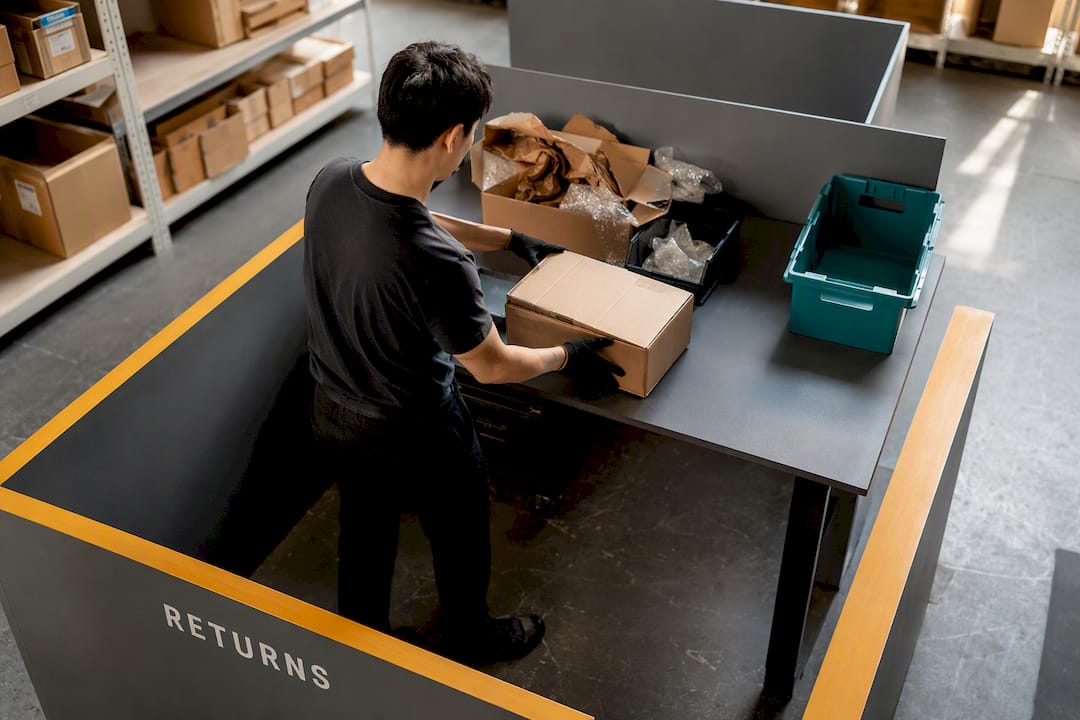
Reverse logistics deserves the same design attention as the outbound path. Returns that sit unprocessed for weeks tie up working capital and distort your inventory accuracy numbers. Building a returns lane into your warehouse layout, rather than treating returns as an afterthought, keeps that capital moving.
Pro Tip: Run a “day in the life” audit where you physically walk one order from receiving to shipping. You’ll find more friction points in ninety minutes of walking the floor than in a month of dashboard review.
How Should You Build Order Routing Logic?
Order routing decides which fulfillment location fills a given order, and getting it wrong is one of the fastest ways to blow both cost and delivery-speed targets. Four routing strategies form the foundation, according to Pipe17’s order routing guide:
- Proximity-based routing ships from whichever node is geographically closest to the customer, minimizing transit time.
- Inventory-availability routing sends the order wherever stock actually exists, avoiding split shipments and backorders.
- Cost-optimized routing picks the fulfillment path with the lowest total cost, balancing labor, freight, and handling.
- SLA and inventory-age routing prioritizes orders against delivery promises and pushes aging inventory out first to avoid write-offs.
No single rule works in isolation. A pure proximity model ships from the closest warehouse even when that warehouse is out of stock, causing a backorder the customer never expected. A pure cost model might route every order to the cheapest node regardless of transit time, blowing your two-day delivery promise. The fix is a routing engine that weighs all four inputs simultaneously and recalculates as conditions change.
That recalculation only works with real-time data. Routing logic built on inventory counts from this morning fails the moment an item sells out at noon. The same goes for carrier ETAs. A carrier running two days behind on a lane needs to drop out of routing consideration immediately, not after a week of missed SLAs. Static rule sets built once and left alone are, as Pipe17’s guide points out, the most common reason routing engines stop performing.
Exception routing is the safety net. When the primary rule fails, whether from a stockout, a warehouse outage, or a carrier disruption, the system needs a documented fallback: reroute to the next-closest node with stock, or hold the order and notify the customer with a revised date.
| Routing input | Why it matters | Failure if stale |
|---|---|---|
| Real-time inventory | Prevents split shipments and backorders | Orders route to out-of-stock nodes |
| Carrier ETA data | Keeps SLA promises accurate | Orders miss delivery windows silently |
| SLA/inventory-age metadata | Prioritizes at-risk orders and aging stock | Aging inventory sits unsold, tying up capital |
The most durable setups run this logic through a configurable orchestration layer, not hardcoded rules buried in a WMS. Non-engineers on the fulfillment team need to be able to adjust routing weights when a new distribution center opens or a carrier lane changes, without submitting a ticket to IT and waiting three weeks.
Where Should Technology and AI Investment Go First?
Sequence matters more than any single tool. Get a WMS and OMS talking to each other first, add an orchestration layer for routing, layer in multi-carrier shipping software, and only then consider physical automation like autonomous mobile robots or goods-to-person systems. Skipping straight to robotics without clean data underneath it is how companies end up automating a broken process faster.
AI earns its place in three specific spots:
- Demand sensing that links point-of-sale and channel signals directly to fulfillment decisions, so inventory gets deployed ahead of a spike instead of reacting to it.
- Dynamic rebalancing that shifts stock between nodes based on real-time sell-through rather than a monthly replenishment cycle.
- ETA prediction and routing recommendations that flag a carrier lane degrading before it causes a missed delivery promise.
Accenture’s research on AI in supply chain fulfillment finds that advanced fulfillment automation delivers higher inventory accuracy, lower warehousing costs, and substantially higher productivity compared with traditional manual operations. Separately, Maersk’s analysis of AI in demand and fulfillment points out that AI’s real value is reducing signal noise, not replacing the judgment calls a fulfillment manager makes every day.
Governance is where a lot of pilots quietly fail. An AI routing recommendation that nobody can explain doesn’t get trusted, and a tool the operations team can’t override doesn’t get used. Run pilots in a single region or product line first, keep a human sign-off step on any recommendation with cost or SLA impact above a set threshold, and expand only once the model’s logic has been stress-tested against a bad week, not just a normal one. Tools that handle data extraction from packing slips, invoices, and carrier documents, a category partners like DocuPow specialize in, can also feed cleaner data into whichever demand-sensing model you choose.
What KPIs Should You Track to Measure Fulfillment Performance?
A good order fulfillment rate lives in the 95 to 99% range for perfect order rate (OTIF), depending on vertical and order complexity. Below that, customer complaints and return rates both climb fast. The core metrics worth tracking on a weekly cadence:
- Order cycle time — hours from order placement to shipment; target under 24 hours for standard orders.
- Perfect order rate / OTIF — orders delivered complete, undamaged, and on time.
- Pick and pack accuracy — should sit above 99.5% in a well-run operation.
- Inventory accuracy — cycle count results versus system records.
- Cost per order — fully loaded, including labor, packaging, and outbound freight.
- Return rate — by SKU and by reason code, not just an aggregate number.
Build an executive scorecard that pairs each metric with a target band and a trend line, not just a snapshot. That’s how you catch a slow slide in pick accuracy before it becomes a customer service crisis. When you test a change, whether it’s a new pick path or a routing rule adjustment, run it as a controlled experiment against a baseline group before rolling it network-wide. A 3PL performance scorecard built this way also gives you leverage in vendor conversations, because you’re negotiating from measured performance instead of a gut feeling.
A Practical 90 to 180 Day Roadmap
Prioritize projects using impact times effort times risk, and start with the ones that move the needle fastest without requiring a system overhaul.
- Days 1 to 30: Inventory accuracy pilot. Pick one warehouse or one product category, run daily cycle counts instead of monthly, and fix the root causes behind discrepancies (mislabeled bins, unscanned returns).
- Days 30 to 90: Routing rules pilot. Build or tighten routing logic on a subset of SKUs or one region, using inventory availability and SLA data as the primary inputs. Measure split-shipment rate and cost per order before and after.
- Days 90 to 150: Carrier optimization. Introduce a second carrier for a specific lane or service tier, and measure on-time performance and cost against the incumbent.
- Days 150 to 180: Scale what worked. Roll the validated changes network-wide, formalize data contracts with your 3PL or carrier partners, and set a quarterly review cadence.
Every pilot needs a written checklist before it starts: the objective, the KPI it moves, the sample size, a named owner, and rollback criteria if the metric goes the wrong way. Skipping the rollback plan is how a well-intentioned pilot turns into a permanent, unmeasured mess.
Pro Tip: Never scale a pilot past its original sample size until you’ve run it for at least one full peak or trough demand cycle. A routing rule that looks great in a slow week can fall apart the moment volume triples.
How Do You Keep Inventory Accuracy High at Scale?
Inventory accuracy is the foundation every other metric sits on top of. If your system says 40 units are on hand and the shelf has 22, every routing decision built on that number is wrong before the order even gets picked. Cycle counting, done daily on high-velocity SKUs and weekly on the rest, catches discrepancies while they’re still small enough to trace back to a cause.
Barcode and RFID scanning at every touchpoint (receiving, putaway, picking, packing) removes the manual data entry errors that account for a large share of inventory drift. Serialized or lot-tracked SKUs need tighter controls still, since a single misplaced unit can cascade into a compliance issue in regulated verticals like health and wellness or medical supply.
The other lever is discipline around adjustments. Every inventory adjustment needs a reason code and an owner, not a blanket “system correction” that hides the real cause. Track adjustment volume by SKU and by warehouse location. A location with a disproportionate share of adjustments is telling you something about slotting, training, or process, not bad luck. Companies that treat inventory accuracy as a project with a start and end date almost always see it drift back down within a quarter. Treating it as an ongoing operating discipline, with a named owner and a standing weekly review, is what keeps 98%+ accuracy from becoming a one-time achievement.
How Do You Plan for Fulfillment Disruptions?
Every fulfillment network eventually hits a disruption, whether it’s a carrier service failure, a warehouse system outage, a port delay, or a sudden demand spike that outstrips available inventory. The operations that recover fastest have a documented contingency plan before the disruption happens, not a scramble session during it.
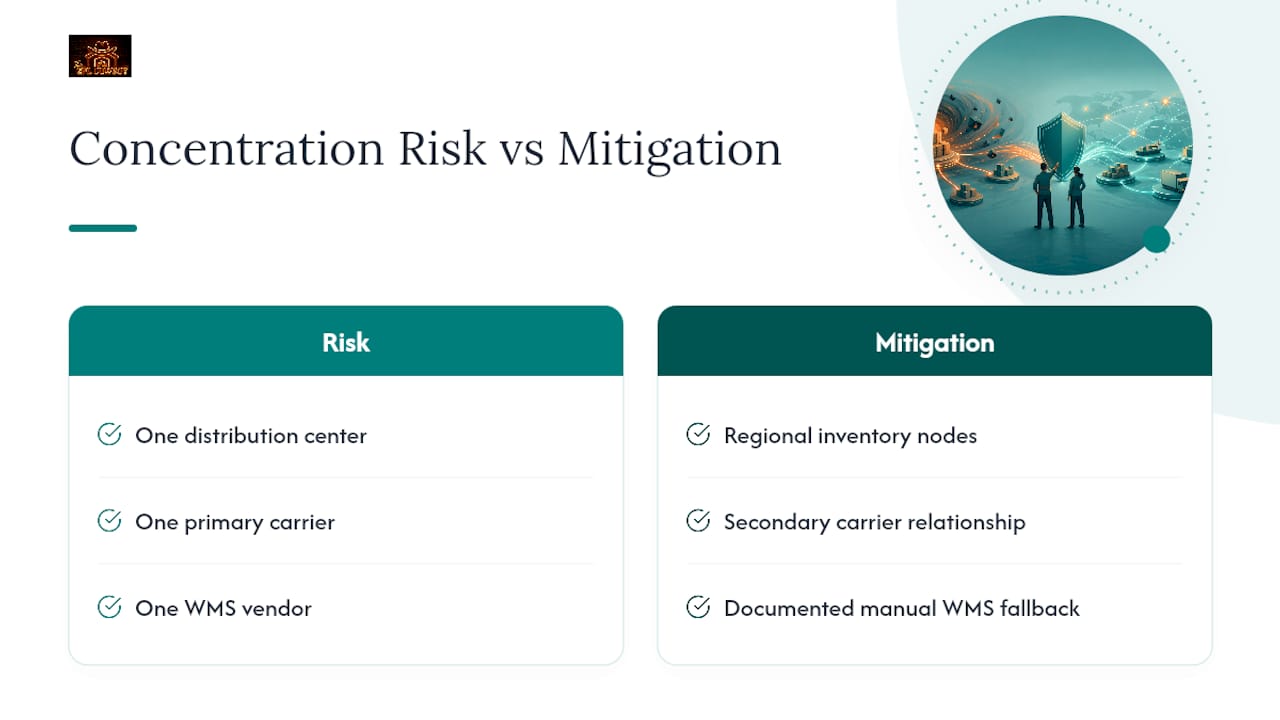
Start with a risk map: identify your single points of failure. A network with one distribution center, one primary carrier, and one WMS vendor has three of them stacked on top of each other. Diversifying inventory across regional nodes, maintaining a secondary carrier relationship even if it handles low volume, and keeping a documented manual fallback process for when the WMS goes down all reduce that concentration risk.
Buffer stock strategy needs to be deliberate, not accidental. Holding extra safety stock on your highest-velocity, highest-margin SKUs protects revenue during a supply disruption without tying up excessive working capital across your entire catalog. Maersk’s research on network strategy makes the case that treating the network as an integrated system, rather than optimizing warehouses and carriers separately, reduces the downstream expediting costs and margin erosion that show up when a disruption hits an uncoordinated network.
Run a tabletop exercise at least twice a year: simulate a carrier outage or a warehouse system failure and walk the team through the actual response, not the theoretical one. The gaps that surface in that exercise are cheaper to fix on a Tuesday afternoon than during an actual peak-season outage.
What Should Customer Communication Look Like During Fulfillment?
Customers tolerate a delay far better than they tolerate silence. A proactive notification strategy, covering order confirmation, processing status, shipment, and delivery, cuts “where’s my order” support tickets substantially and builds trust even when something goes wrong.
The notification cadence that works best follows the order through each of the core steps: confirmation the moment the order is placed, a status update if processing takes longer than the customer’s expected window, a shipping notification with a working tracking link the moment the label prints, and a delivery confirmation. Each one needs to originate from a system that’s actually accurate. A shipping notification that fires before the order physically leaves the building erodes trust the first time a customer clicks a tracking link that shows nothing.
Exception communication matters even more than routine updates. If a delay happens, whether from a stockout, a carrier issue, or a weather event, the customer should hear about it from you before they have to ask. A short, specific message (“your order is delayed two days due to a carrier service disruption in your region”) lands far better than a generic “your order is running late” template. Give customer service teams visibility into the same real-time data your routing engine uses, so a support rep can answer a tracking question accurately instead of guessing from a stale order status.
What Are the Best Ways to Cut Fulfillment Costs Without Cutting Service?
Cost optimization in fulfillment works best when it targets waste, not service levels. The biggest cost levers, in order of typical impact, are: carrier rate management, warehouse labor efficiency, packaging optimization, and inventory carrying cost.
Carrier rate negotiation only works with volume data and service-level benchmarks in hand. A multi-carrier strategy, combined with a documented parcel and transportation strategy, gives you leverage to renegotiate annually instead of accepting automatic rate increases. Dimensional weight pricing has made packaging optimization a direct cost lever too. Right-sizing cartons to the product, rather than defaulting to a standard box size, cuts both material cost and the dimensional weight charge carriers apply to oversized packaging.

Labor efficiency comes from the same slotting and pick-path work covered earlier, but it’s worth tracking separately as a cost metric: labor cost per order shipped, tracked weekly, shows whether floor changes are actually paying off. Inventory carrying cost, often overlooked in fulfillment cost conversations, includes storage, insurance, and the capital tied up in slow-moving stock. A cost-to-serve analysis that breaks down true cost by SKU and by channel usually surfaces at least a few products that are quietly losing money on every order shipped.
How Do You Add Personalization Without Slowing Down Fulfillment?
Customization inside fulfillment, whether it’s gift wrapping, custom inserts, kitting, or personalized packaging, adds real customer value but also adds handling time and complexity if it’s bolted onto standard workflows without planning.
The operations that do this well segment personalized orders into a dedicated workflow rather than mixing them into standard pick-and-pack lanes. A kitting station set up specifically for build-to-order bundles or subscription boxes keeps that complexity from slowing down the 80% of orders that ship standard. Packing rules need to flag personalization requirements automatically, at the order level, so a packer isn’t relying on a printed note that might get missed.
Subscription and replenishment programs benefit from a slightly different fulfillment lens: predictable order timing means you can pre-stage inventory and even pre-pack partial orders ahead of the actual ship date, smoothing labor demand instead of spiking it. Build-to-order and made-to-order models need the opposite treatment: routing rules that account for the extra processing time so the delivery promise shown to the customer reflects reality, not the standard SKU’s cycle time. Mislabeling a customized order’s expected ship date is one of the fastest ways to generate a support ticket and a canceled order both.
How Sustainable Can an Order Fulfillment Strategy Actually Be?
Sustainability in fulfillment shows up in three practical places: packaging, transportation routing, and returns handling, and all three intersect with cost in ways that make the business case easier than most managers expect.
Right-sized packaging, the same change that cuts dimensional weight charges, also cuts material waste and the empty-space void-fill that ends up in landfill. Consolidating shipments where possible, rather than splitting a single order across multiple boxes because of a routing failure, reduces both packaging use and carbon output per order. That’s another reason accurate, real-time routing logic matters: split shipments caused by stale inventory data are a sustainability problem as much as a cost problem.
Distributed inventory, positioned closer to demand, cuts average transit distance and the associated emissions per shipment, on top of the speed benefits already covered. Returns handling is the area most fulfillment strategies overlook entirely. A returned item that gets written off and discarded because reverse logistics wasn’t designed to restock it efficiently is a sustainability loss and a working-capital loss at the same time. Building a returns lane that inspects, restocks, or resells returned inventory quickly (rather than letting it sit in a corner of the warehouse for months) addresses both problems with the same fix.
What Actually Separates a Good Fulfillment Strategy From a Great One
Most fulfillment consulting conversations focus on the wrong variable. Companies obsess over which WMS to buy or which 3PL has the best sales pitch, when the real gap almost always sits in inventory accuracy and data quality underneath whatever system sits on top. A Nike inventory operation that moved from 61% to over 98% cycle count accuracy across more than 450,000 SKUs didn’t get there by installing new software. It got there by fixing the process discipline: reason codes on every adjustment, daily counts on velocity SKUs, and an owner accountable for the number every single week.
The vendor pitch that should raise your guard is the one promising a routing engine or automation platform will fix a fulfillment problem rooted in bad data. It won’t. An orchestration layer built on inaccurate inventory counts just routes bad decisions faster. Before signing any technology contract, run a basic validation: pull a sample of SKUs and physically verify the count against the system to ensure accuracy.
Three rules of thumb for vendor and partner selection: verify claims against a physical count, not a dashboard demo; ask for references from a company at your actual order volume, not their biggest logo; and never sign a multi-year contract without a defined exit clause tied to measurable performance.
— Michael
How The 3PL Cowboy Helps You Build and Execute This Strategy
Most brands trying to fix fulfillment end up choosing between a 3PL sales call and a generic consulting deck, neither of which gives you an independent read on your actual network. 3plcowboy runs 3PL selection and diligence, fulfillment cost benchmarking, and distribution network design with no warehouse to fill and no listings to move, which means the recommendation matches your order volume and margin structure, not a partner’s sales quota.

A typical engagement starts with a diagnostic: a review of your current network, inventory accuracy data, routing logic, and carrier contracts against relevant industry benchmarks. From there, deliverables usually include a scored comparison of fulfillment options, a cost model, and an implementation roadmap your team can execute with or without further outside help. If you’re mid-WMS-rollout or evaluating a network redesign, the same diagnostic approach applies before you sign anything with a vendor. Visit the services page to see the full scope, or request a diagnostic to get a benchmarked view of where your current fulfillment strategy stands against the market.
Sources
- AI Approach to Maximizing Value in Supply Chain Fulfillment | Accenture
- The power of AI in demand and fulfillment | Maersk
FAQ
What Are the 7 Steps of Order Fulfillment?
The classic model covers receiving, putaway, inventory management, order processing, picking, packing, and shipping, with delivery and returns often added as an eighth stage, with a ninth sometimes appended. Each step needs a named owner and a system of record; gaps between steps, not the steps themselves, cause most fulfillment challenges.
How Do I Speed Up Order Fulfillment?
The fastest wins come from distributed inventory placement, tightened pick paths, and multi-carrier routing that reacts to real-time inventory and SLA data. Automation like next-generation fulfillment centers can compress the process further, but only after inventory accuracy and routing logic are already solid.
What Are the Latest Trends in Order Fulfillment?
AI-driven demand sensing and dynamic inventory rebalancing are reshaping how orders get routed, with Maersk’s research showing AI’s main value is reducing signal noise so operators make faster, better-informed decisions. Network-level thinking, treating inventory placement, transportation, and fulfillment as one integrated system rather than separate silos, is the other major shift.
What Is a Good Order Fulfillment Rate?
Pick and pack accuracy should run above 99.5% in a well-managed operation, and dropping below that band usually signals a slotting, training, or data-accuracy problem worth investigating immediately.
How Do I Know if I Need to Change My 3PL or Network Setup?
If your cost per order, cycle time, or perfect order rate has drifted outside your target band for more than a quarter, it’s worth an independent diagnostic rather than a renegotiation call with your current partner. 3plcowboy’s selection and diligence work benchmarks your current setup against market performance before you commit to a change.