
AI inventory optimization uses forecasting models, reinforcement learning, and optimization algorithms to set reorder timing, quantities, and safety stock automatically instead of relying on static formulas. Operators who deploy it well typically see lower days on hand, fewer stockouts, and reduced carrying costs, but pilot results and enterprise-wide claims are not the same thing, and the gap between them is where most programs stall.
TL;DR:
- Data quality issues, such as untagged promotions and missing lead-time information, are the main barriers to successful AI inventory implementation.
- AI models typically reduce inventory by 10 to 35 percent in large-scale deployments, with savings depending heavily on pilot rigor and data accuracy.
- Starting with a narrow pilot on 20 to 200 SKUs in a single location helps establish measurable benefits before wide-scale rollout.
- Human approval workflows and control rules remain essential to prevent costly errors from AI recommendations, especially during early deployment phases.
- Most pilots require 90 to 180 days, with the first substantial gains emerging from disciplined data validation and targeted, small-scale testing.
Table of Contents
- What AI inventory optimization covers and the problems it solves
- Key AI techniques and how they map to inventory problems
- Practical use cases and what the numbers actually show
- Step-by-step implementation checklist for operators
- How to measure, validate, and commercialize results
- Limitations, risks, and governance operators should not skip
- Applying the research to real operations
- Where human judgment still runs the show
- Retail, manufacturing, and other industry-specific applications
- Data privacy and security in AI inventory systems
- Where AI inventory optimization is headed next
- Practitioner perspective: realistic timeline and investment expectations
- How an operator-led advisory speeds up a safe rollout
- Sources
- FAQ
What AI inventory optimization covers and the problems it solves
AI inventory optimization is not one algorithm. It is a layer of decision support that sits on top of your existing planning process and touches a specific set of recurring decisions:
- Demand forecasting at the SKU or SKU-location level, replacing static seasonal indices with models that adapt to trend and noise.
- Safety stock calculation that accounts for variable lead times instead of a single average.
- Reorder timing and quantity, deciding when and how much to order given current inventory position.
- SKU segmentation, separating fast movers, long-tail items, and erratic-demand products for different treatment.
- Anomaly detection, flagging demand spikes, supplier delays, or data errors before they cascade into a stockout or overstock.
AI earns its place when the problem has scale (thousands of SKUs, multiple locations) and nonstationarity (demand and lead times that shift over time in ways a fixed formula cannot track). Below that threshold, a well-tuned reorder-point formula usually does the job at a fraction of the cost. The typical architecture has three layers: data sources (POS, ERP, WMS), a model layer (forecasting plus a decision policy), and a decision-execution layer that either recommends or automatically places purchase orders.
Key AI techniques and how they map to inventory problems
Different methods solve different pieces of the inventory problem, and picking the wrong one for your data maturity is the most common early mistake.
- Gradient-boosted trees and time-series deep learning models handle demand forecasting well when you have enough transaction history and clean promotion tags, though tree-based models are easier to explain to a planning team.
- OR-guided pretrain-then-reinforce frameworks use simulation-derived, operations-research reference decisions as training labels, then apply reinforcement learning to adapt those decisions to real constraints and shifting demand. A JD.com field deployment using this approach reported a 5.27-day reduction in inventory turnover, a 2.29% increase in in-stock rates, and a 29.95% drop in holding costs.
- Transformer-based imitation learning, sometimes called InventoryGPT-style modeling, jointly predicts order timing and quantity from rich contextual features and has outperformed traditional benchmarks on service level and cost in empirical tests on large e-commerce platforms.
- LLM-guided policy search pairs a language model with numerical optimization to discover interpretable replenishment rules, a method that showed mean cost reductions improving from 17.5% after one generation to 30.0% after ten generations in exploratory testing against base-stock benchmarks.
- Stochastic constrained optimization, sometimes marketed as stochastic inventory optimization, sets reorder parameters to minimize cost subject to service-level constraints and has been reported to cut inventory by 10 to 35% in large-scale enterprise deployments.
Pro Tip: Start with the simplest method that fits your data. A gradient-boosted forecasting model paired with a stochastic reorder-point calculation beats a transformer model you cannot debug.
Practical use cases and what the numbers actually show
The clearest wins show up where a narrow, well-defined decision gets automated rather than the entire planning process at once.
Demand forecasting improvements feed everything downstream: a tighter forecast means a tighter safety stock calculation, which means less cash tied up in buffer inventory. Safety stock and automated replenishment programs built on OR-guided reinforcement learning have shown field results including a 29.95% drop in holding costs alongside a modest gain in in-stock rate, a combination that suggests the model is cutting excess rather than just chasing service level. Anomaly detection catches supplier lead-time drift and demand spikes before they become a stockout, functioning as an early-warning layer rather than a forecasting tool. SKU rationalization uses the same segmentation logic to identify items whose complexity cost exceeds their contribution, simplifying the assortment before you optimize it.
- Demand forecasting: sharper input, smaller downstream safety stock.
- Automated replenishment: measurable holding cost and turnover gains in field deployments.
- Anomaly detection: earlier flags on lead-time and demand shifts.
- SKU rationalization: fewer SKUs to manage, lower carrying complexity.
Our operator-first inventory optimization playbook covers how to sequence these use cases without disrupting live replenishment.
Step-by-step implementation checklist for operators
Treat this as a sequence, not a menu. Skipping the data step is the single most common reason pilots underdeliver.
- Audit data readiness: sales or POS history, receipt records, lead-time distributions by supplier, promotion tags, returns, and current on-hand accuracy.
- Map integration points across ERP, WMS, and MRP, and confirm whether the pilot will run read-only recommendations or move toward automated purchase order generation.
- Scope the pilot narrowly: choose a defined SKU set, a single distribution center or region, a holdout group, and success criteria before writing any code.
- Validate the model with backtests and rolling-horizon simulation against historical data, not just a single held-out period.
- Roll out with human-in-loop controls: approval gates on purchase orders above a threshold, and escalation rules for anomalies the model cannot explain.
Pro Tip: Run your first pilot on 20 to 200 SKUs in one location. A narrower scope reduces confounding variables and gets you a readable result faster than an enterprise-wide launch.
Clean data hygiene between systems matters as much as the model itself. Our guide to ERP-WMS integration covers the cutover pitfalls that quietly corrupt inventory optimization inputs before a model ever sees them.
How to measure, validate, and commercialize results
Pick KPIs before the pilot starts, not after you see results you like.
- Forecast accuracy: MAPE or MASE, tracked at the SKU-location level rather than aggregated.
- Service level and fill rate, measured against the same target used before the pilot.
- Days of inventory and carrying cost delta, the two metrics that translate model output into dollars.
Experiment design matters as much as the metric. A/B testing, geographic holdouts, and difference-in-differences analysis all work when rollout timing varies across locations, letting you isolate the model’s effect from seasonal noise. Stochastic optimization approaches have shown inventory reductions of 10 to 35% while holding service-level constraints, a range wide enough that your own holdout test matters more than any published figure. Post-deployment, set a drift-detection routine and a revalidation cadence, with alert thresholds that trigger a manual review rather than a silent model update.
Limitations, risks, and governance operators should not skip
AI models fail in predictable ways, and most of them trace back to data gaps rather than a bad algorithm.
- Cold-start SKUs with no sales history give the model nothing to learn from.
- Promotional spikes that are not tagged as promotions get read as organic demand shifts.
- Supplier lead-time changes that are not fed into the model in near real time produce stale safety stock.
- Data gaps in receipts or returns quietly distort the on-hand position the model thinks it is optimizing against.
AI models generally need explicit operations-research constraints or business rules layered on top to stay interpretable and safe. A model can be right on average and still recommend a purchase order that violates a supplier minimum or a cash constraint. Governance should include human approval workflows for orders above a set dollar threshold, conservative safety buffers during the first several pilot cycles, and a documented contingency plan for when the model’s confidence drops or its inputs go stale.
Applying the research to real operations
The same sequence applies here: a 90-day pilot should produce clean lead-time data, a validated forecast accuracy baseline, and a documented before-and-after on days of inventory, reported to stakeholders in the same units every cycle.
Where human judgment still runs the show
AI models generate recommendations, but the decision to act on them still belongs to a planner or category manager in most well-run programs. The model does not know that a supplier just missed a shipment for reasons outside the data, or that a new product launch will cannibalize an existing SKU’s demand curve. Those are judgment calls that require context the model was never trained on.
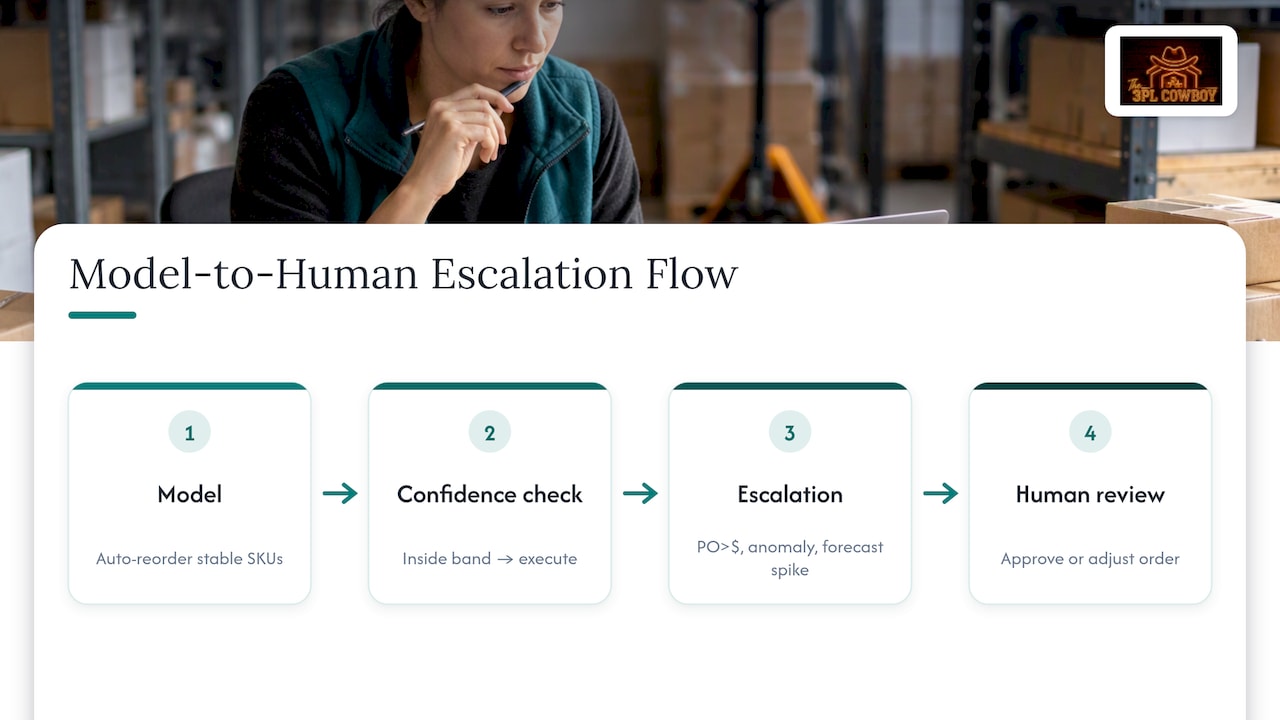
The practical split looks like this: let the model handle routine, high-volume decisions, like standard reorder timing for stable SKUs, and route anything outside a defined confidence band to a human reviewer. This is not a permanent compromise while the technology matures. Even mature OR-guided reinforcement learning frameworks are designed to respect managerial constraints rather than override them, which means the human layer is a feature of the system, not a stopgap.
Escalation rules should be specific: a purchase order above a dollar threshold, a forecast that deviates sharply from the trailing average, or a SKU flagged by anomaly detection all route to a person before execution. Teams that skip this step tend to discover the model’s blind spots only after a stockout or a write-off, which is a more expensive way to learn the same lesson. The goal is not to slow the model down, it is to catch the small number of decisions where context outweighs pattern-matching, while letting the model run the rest without a bottleneck.
Retail, manufacturing, and other industry-specific applications
Retail and e-commerce operations tend to lean on forecasting and automated replenishment because the SKU count is high and lead times are often shorter, making the transformer-based joint timing-and-quantity approach well suited to fast-moving catalogs. A large e-commerce platform’s use of an InventoryGPT-style model to jointly decide order timing and quantity, which outperformed traditional benchmarks on service level and cost, reflects that kind of environment.
Manufacturing inventory optimization looks different because raw material and component lead times are longer and more variable, and a stockout has a bigger ripple effect on production schedules than on a retail shelf. Here, OR-guided pretrain-then-reinforce frameworks fit well because they can encode hard supply constraints, like minimum order quantities from a single-source supplier, as part of the training process rather than as an afterthought.
CPG and food and beverage operators sit in between: shorter shelf life adds a perishability constraint that most generic forecasting models do not handle without modification, and promotional volume spikes are frequent enough that promotion-tagged demand history becomes a gating requirement rather than a nice-to-have. Electronics and apparel each add their own wrinkle, component shortages in one case and size-and-color proliferation in the other, both of which push toward SKU segmentation as a prerequisite step rather than an optional add-on.
Data privacy and security in AI inventory systems
AI inventory models typically ingest sales history, supplier pricing, and sometimes customer-level order data, which raises the same access-control and data-governance questions as any other system touching commercial and, in some cases, personal information. Vendor and cloud-hosted AI inventory platforms should be evaluated on where data is stored, who can access model inputs and outputs, and whether supplier-specific pricing or lead-time data is siloed from other customers sharing the same platform.
Contractual terms matter as much as technical controls: confirm data retention periods, whether your historical sales data can be used to train a vendor’s broader model, and what happens to your data if you switch providers. For operators integrating AI models directly with ERP and WMS systems, the practical risk is usually not a headline-grabbing breach but a permissions misconfiguration that lets a forecasting tool write to production order systems it should only read from. Building in read-only access during the pilot phase, as noted in the implementation checklist above, addresses this directly rather than relying on vendor assurances alone.
Where AI inventory optimization is headed next
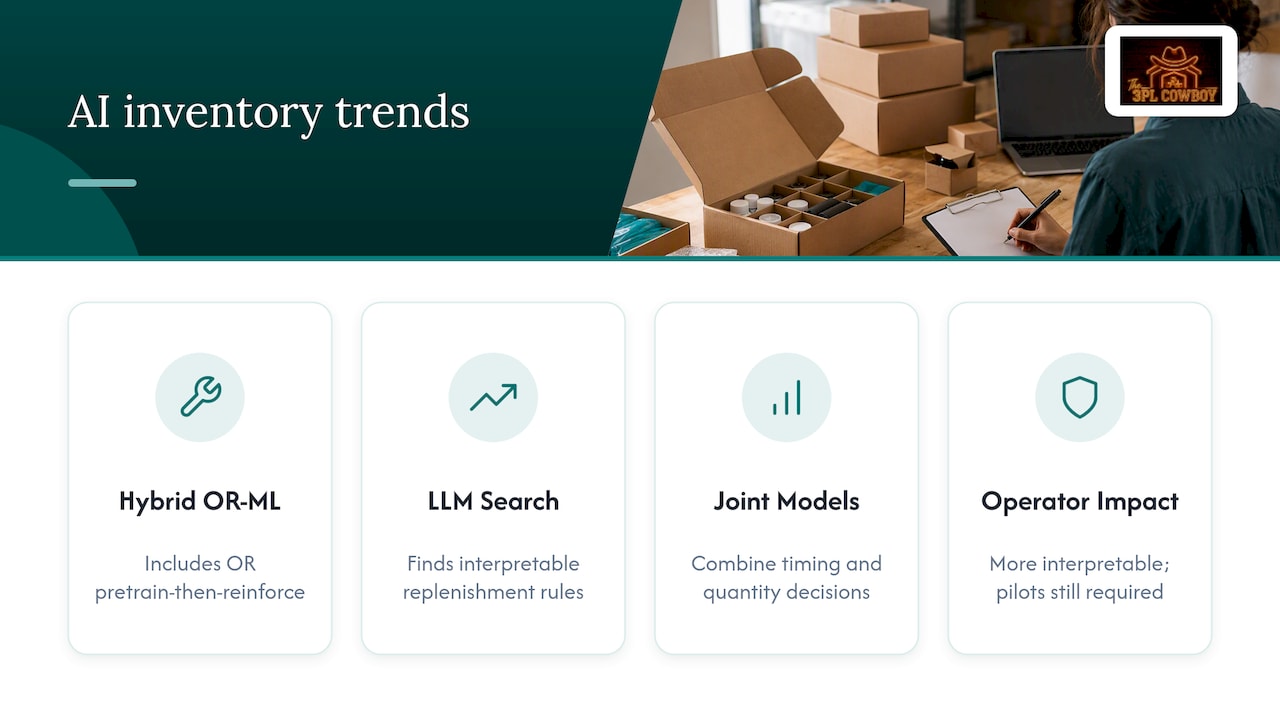
The clearest trend in the research is a shift from single-purpose forecasting models toward frameworks that combine operations-research structure with learned policies, because pure machine learning models struggle to respect hard business constraints on their own. OR-guided pretrain-then-reinforce approaches are an early example of this hybrid direction, using OR-derived decisions as a training foundation rather than treating the constraint problem and the learning problem separately.
LLM-guided policy search is the newest entrant, and it is being tested as a way to discover interpretable replenishment rules rather than opaque black-box policies, which addresses a real operator objection to prior generations of AI inventory tools. Expect more work on joint timing-and-quantity models, similar to the transformer-based approach already showing gains in empirical e-commerce studies, since separating the “when” and “how much” decisions leaves value on the table.
The practical implication for operators evaluating a program in the next planning cycle is that the technology is moving toward more interpretable, constraint-aware systems, not less. That should lower the governance burden over time, but it does not remove the need for a pilot, a holdout test, and a human approval workflow today.
Practitioner perspective: realistic timeline and investment expectations
A credible pilot-to-scale timeline runs 90 to 180 days: 90 days to validate data and run a narrow pilot, another 90 to expand scope and build monitoring. The most common blocker is not the model, it is unreconciled inventory data between ERP and WMS. Executive sponsors should fund the data cleanup phase explicitly rather than treating it as a footnote to the “AI project,” and should expect the first measurable win to come from a narrow scope, not an enterprise-wide rollout.
— Michael
How an operator-led advisory speeds up a safe rollout
Most AI inventory programs stall not on the model but on messy data, unclear integration points, and no one accountable for the pilot design. 3PL Cowboy’s 3PL Operations Advisory and Fulfillment Cost Benchmarking work map directly onto the checklist above: data readiness assessment, pilot scoping, and KPI reporting that stakeholders can actually trust.

If you are weighing a build-versus-buy decision on an AI inventory program, or need an outside read on whether your data is ready for one, our services page is the place to start scoping a diagnostic.
Sources
The ORPR study documents field results from a JD.com deployment. The stochastic optimization paper quantifies enterprise-scale inventory reductions. The INFORMS Transformer study benchmarks joint timing-and-quantity decisions. For a forecasting-specific primer, see AI supply chain forecasting.
- ORPR: An OR-Guided Pretrain-then-Reinforce Learning Model for Inventory Management
- Inventory Management with Transformer: Automated Decision Making for Order Timing and Quantity
FAQ
What is AI inventory optimization in simple terms?
AI inventory optimization applies machine learning and optimization algorithms to decide when and how much to reorder, replacing static formulas with models that adapt to changing demand and lead times. It typically targets lower days on hand, fewer stockouts, and reduced carrying costs.
How much can AI reduce inventory costs?
Reported results vary by method and deployment: stochastic constrained optimization has shown inventory reductions of 10 to 35% in large-scale enterprise use, while an OR-guided reinforcement learning deployment reported a 29.95% drop in holding costs. Your own pilot and holdout test matter more than any single published figure.
Do I need machine learning expertise in-house to start?
Not for a first pilot. Many teams start with a vendor platform or an outside advisory to scope data readiness and run a narrow pilot before building internal modeling capability.
What is the biggest risk in an AI inventory rollout?
The most common failure mode is poor data quality, especially missing lead-time distributions and untagged promotional demand, which causes the model to misestimate safety stock. Governance controls like human approval on large purchase orders reduce the downside while the model is still being validated.
How long does a typical pilot take before scaling?
A realistic pilot runs about 90 days to validate data and test a narrow SKU set in one location, followed by another 90 days to expand scope and build ongoing monitoring. Teams that skip the data validation phase tend to see slower, less trustworthy results.