Postponement strategy means delaying final product commitment, like assembly, packaging, or labeling, until demand signals are clearer, so a shared pool of semi-finished inventory can serve multiple end variants. The payoff is lower finished-goods inventory with steadier service levels, because risk pooling absorbs forecast error across variants instead of each SKU carrying its own buffer. That payoff depends on one prerequisite: a modular product or process where late finishing is cheap enough not to cancel out the inventory savings.
TL;DR:
- Only 9% of firms across surveyed sectors used postponement; strongest candidates combine high variant forecast error with lower pooled demand volatility.
- Before approving a pilot, price engineering redesign separately from added storage and handling, then compare those costs with inventory holding and lost sales savings.
- Test postponement at one distribution center with one product family, tracking inventory, fill rate, and per unit finishing cost before considering network wide rollout.
- Avoid postponement when demand across variants moves together, finishing capacity is tight, or speed to market outweighs flexibility in a fast moving category.
Table of Contents
- The Main Forms of Postponement and Where Each Fits
- Why Postponement Works: The Economics Behind the Savings
- Design and Operational Requirements You Have to Budget For
- Where in the Network to Run Postponement
- When Postponement Can Underperform
- A Decision Checklist and a Simple Breakeven Approach
- How an Operator Reads a Postponement Candidate
- Where We Fit If You’re Ready to Pilot This
- FAQ
- Sources
The Main Forms of Postponement and Where Each Fits
Postponement splits into several recognized types, and matching the type to your product is the first real decision.
- Form postponement delays final assembly or configuration until an order arrives, common in build-to-order electronics and furniture.
- Packaging and labeling postponement keeps a generic “vanilla box” product in stock and applies market-specific labels or packaging late, used heavily in consumer goods sold across regions with different language or regulatory labels.
- Logistics or time postponement holds inventory centrally and ships only once an order is confirmed, trading transportation speed for pooled stock.
- Price postponement delays the final price decision, letting a company react to demand or competitor moves before committing margin.
- Pull or purchasing postponement pushes the procurement trigger itself downstream, so components are ordered only after demand materializes rather than on a forecast.
Products with high variety, strong regional differences, or volatile pricing tend to map cleanly to one of these forms. A SKU with low variety and stable demand usually has nothing to gain from any of them.
Why Postponement Works: The Economics Behind the Savings
The core mechanism is risk pooling: when you hold one shared, undifferentiated inventory pool instead of several variant-specific pools, the combined demand variance is lower than the sum of the individual variances. That lets you carry less safety stock for the same service level, or the same stock for a better service level.
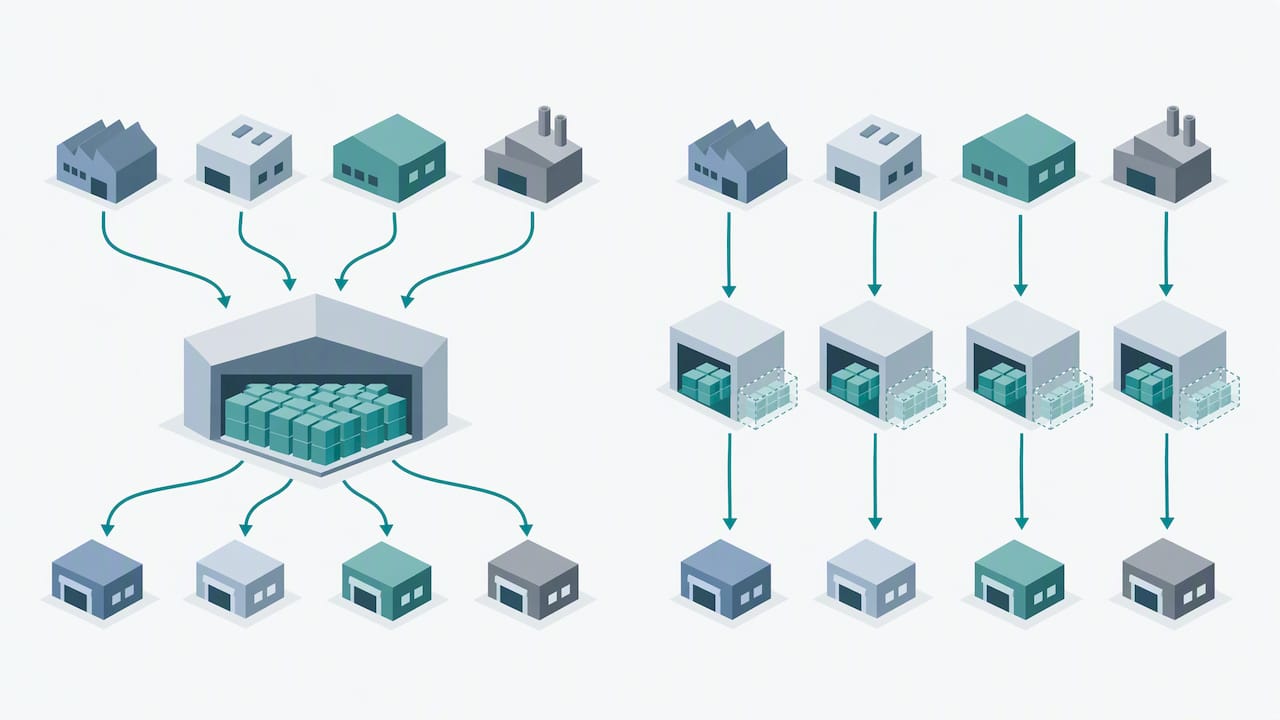
Case and modeling work on postponement strategies, built around the HP DeskJet printer redesign, found that postponement can meaningfully cut inventory and improve service, particularly once seasonality is built into the planning assumptions rather than averaged away.
Adoption remains narrow relative to the benefit case. A multi-industry study on delayed differentiation found that only 9% of firms across surveyed sectors, including aerospace, automotive, healthcare, retail, high-tech, and telecommunications, used any form of postponement. That gap between documented upside and actual adoption is worth noting before assuming your category has already figured this out.
- Pooled demand lowers the variance any single variant’s forecast has to absorb.
- Fill-rate consistency improves because stockouts on one variant can be covered by shared stock finished late.
- High forecast error and strong seasonality amplify the benefit; low-variance, steady-demand items see less upside.
Design and Operational Requirements You Have to Budget For
Postponement is not a policy change you flip on. Discrete event simulation research on a chemical plant found postponement works as a hybrid between make-to-stock and make-to-order, where semi-finished products sit in inventory and implementation costs like storage and handling have to be included in the economic case, not treated as a rounding error.
- Confirm modularity first. If final differentiation requires redesigning the base platform rather than attaching a module, postponement adds cost without adding flexibility.
- Size the semi-finished “vanilla box” inventory. This stock needs its own storage footprint, often in a different zone than finished goods, with separate cycle counting.
- Map the new material handling steps. Late finishing usually means an added pick, an added transition, and sometimes an added quality check that didn’t exist in a fully-finished flow.
- Check batch size and capacity impact. Smaller, more frequent finishing runs can erode labor efficiency even as they improve inventory turns.
- Price the engineering work. Platform redesign for modularity is often the single largest cost component and the one most frequently underestimated.
Pro Tip: Run the handling-cost delta and the engineering cost as two separate line items before pricing postponement against current operations. Blending them hides which one is actually killing the business case.
Where in the Network to Run Postponement
Choosing where postponement happens matters as much as choosing whether to do it. Finishing at the factory keeps handling simple but sacrifices speed, since finished goods still have to travel the full distribution chain after differentiation. Finishing at a regional distribution center shortens the last leg significantly and lets one DC serve several end markets from shared stock. Finishing at a final-mile hub gets closest to the customer but concentrates handling cost and labor in the most expensive part of the network.
- Buffer sizing should follow lead time segmentation: longer upstream lead times justify larger shared buffers, while short final-mile lead times need only enough stock to cover the finishing cycle itself.
- Station design needs a dedicated finishing area separate from standard pick-pack flow, with its own labor standard and throughput target.
- WMS and order-flow signals need to trigger finishing at the right node automatically, based on order attributes like region, label requirement, or configuration, not manual routing decisions.
Pro Tip: Pilot postponement at a single DC on one SKU family before touching the network. A narrow pilot with a clean before-and-after inventory and fill-rate comparison tells you more than a network-wide rollout you can’t isolate.
When Postponement Can Underperform
Postponement is not automatically the right move, and treating it as a default can cost more than it saves. In fast-moving competitive categories, early differentiation and speed-to-market often matter more than risk pooling, especially under strategic entry threats where being first to shelf with a finished product beats being flexible later, a dynamic the perils of delayed differentiation research highlights directly.
- Constrained finishing capacity can turn a pooled-inventory advantage into a bottleneck during peak demand.
- Correlated demand across variants, where everything spikes or drops together, weakens the risk-pooling math because there’s less variance to pool.
- Engineering premiums for modularity, added handling transitions, and extra quality checkpoints can quietly erode the inventory savings until the net benefit disappears.
A Decision Checklist and a Simple Breakeven Approach
Before committing engineering and operations budget, run these checks on the candidate SKU family.
- Count the derivatives. More end variants from one base platform generally means more pooling benefit.
- Measure forecast coefficient of variation. High CV per variant combined with low CV at the pooled level is the strongest signal postponement will help.
- Check product life stage. Long-life, stable products rarely justify the engineering cost; short-life or frequently refreshed products often do.
- Score modularity. Can the base platform accept late differentiation with existing tooling, or does it need redesign?
- Check capacity headroom. Is there slack to absorb smaller, more frequent finishing batches without overtime?
- Estimate the handling-cost delta. What does the added pick, transition, and check cost per unit, compared to current fully-finished flow?
For a quick breakeven, compare the inventory holding and lost-sales savings from pooled safety stock against the postponement premium, engineering cost plus added per-unit handling. If holding and lost-sales savings clear that premium within a reasonable payback window, the case is worth modeling further with a discrete-event or inventory simulation that treats the finishing policy as fixed rather than re-optimized mid-run.
| Diagnostic | Favors postponement when |
|---|---|
| Forecast CV per variant | High |
| Product derivative count | High |
| Modularity score | High |
| Capacity headroom | Available |
| Handling-cost delta | Low relative to holding savings |
How an Operator Reads a Postponement Candidate
We scope postponement the way an operator reads any inventory decision: start with a quick portfolio scan for high-derivative, high-CV SKU families, score modularity honestly, then check capacity and handling delta before anyone commits engineering hours. A scoped pilot with a clear KPI baseline, cycle count accuracy, days of finished goods saved, fill-rate delta, and cost per unit to finish, can tell you more than a model built in isolation. None of this works without sponsorship across engineering, operations, and commercial teams, since a pilot that only operations believes in rarely survives contact with a sales forecast revision.
— Michael Nooner
Where We Fit If You’re Ready to Pilot This

Postponement decisions touch the same ground we work in every week: fulfillment economics, network design, and the operational cost of moving work downstream. Our 3PL Operations Advisory and Fulfillment Cost Benchmarking services help you scope a candidate SKU family honestly before you spend on engineering, and our Distribution Network Design work maps where finishing should actually sit in your network.
An engagement can include scoping, an ROI model built on your own SKU and forecast data, pilot design with KPI baselines, and a scale plan once the pilot proves out.
- Scope the candidate SKU family and build the modularity and handling-delta picture.
- Model the breakeven against your real inventory and forecast numbers.
- Design a bounded pilot with clear success criteria before any network-wide rollout.
If you’re weighing a postponement pilot against your current fulfillment setup, our services overview is a reasonable place to start a scoping conversation.
FAQ
What is another term for postponement?
Postponement is also called delayed differentiation, since both terms describe pushing final product commitment downstream to pool demand risk. Some practitioners also use “late customization” when describing the manufacturing side of the same idea.
Can you give an example of a successful postponement strategy?
The HP DeskJet printer case, examined in postponement research from Dartmouth, is a well-known example: HP delayed country-specific power supply and packaging configuration until closer to the point of sale, pooling inventory across markets and cutting the stock needed to hit the same service levels.
What is postponement in supply chain management?
Postponement in supply chain management is a hybrid strategy between make-to-stock and make-to-order, where semi-finished products are held in inventory and finished only after an order or firm demand signal arrives, a structure described in discrete event simulation research on make-to-stock and postponement policy selection. It requires accounting for storage, handling, and process costs alongside the inventory savings.
What are the 7 C’s of supply chain management?
Definitions of concepts like the “C’s” vary across sources and aren’t tied to a single authoritative framework, so treat any specific list with caution. If you encounter one in a vendor’s materials, verify it against your own operational priorities rather than treating it as an industry standard.
Sources
- THE STRATEGIC PERILS OF DELAYED DIFFERENTIATION
- Postponement Strategies for
- Selecting make-to-stock and postponement policies for different products in a chemical plant: A case study using discrete event simulation – ScienceDirect