
A good 3PL RFP process comes down to four things: clean data, a short list of qualified bidders, one bid format everyone fills in, and a scoring model that looks past the storage rate. Do those well and you can compare providers like for like. Skip them and you will pick the best sales pitch. This guide walks through each step in order, with the traps we see most often.
TL;DR
- Plan on roughly 8 to 12 weeks from sending the RFP to a signed contract. Rushing is a common reason brands end up re-selecting a 3PL within two years.
- Send a request for information (RFI) first, then send the full RFP to 5 to 8 qualified providers, not 25.
- Give every bidder the same real order data and the same bid sheet, then convert every bid to an all-in cost per order.
- Score on more than price: delivery promise, operations, visibility and contract risk all belong in the model.
- Visit the building and call references before you negotiate, not after.
Table of Contents
- Decide first whether an RFP is the right move
- The 3PL RFP process at a glance
- Step 1: Write down the problem and the criteria
- Step 2: Build a data pack that bidders can actually price
- Step 3: Screen with an RFI and keep the list short
- Step 4: Issue one RFP with one deadline
- Step 5: Run Q&A the same way for everyone
- Step 6: Normalize every bid to an all-in cost per order
- Step 7: Score, then verify
- Step 8: Negotiate terms that protect you after the honeymoon
- Common mistakes in a 3PL RFP
- Our perspective
- Where we fit in your RFP
- FAQ
- Sources
Decide first whether an RFP is the right move
An RFP asks several providers to spend weeks building a custom quote. That only makes sense when you have enough volume to be worth the effort, a real willingness to move, and a decision-maker who will be in the room. If you are two months from peak season, or you only want leverage on your current provider, you may be better served by a benchmark of what you pay today. We cover that option in the fulfillment cost benchmarking service.
Also ask whether the answer is a 3PL at all. If you have not tested the in-house alternative, run that comparison before you write a single requirement.
The 3PL RFP process at a glance
| Step | What happens | Typical window |
|---|---|---|
| 1. Define goals | Write the problem, the outcome and the criteria | Week 1 |
| 2. Build the data pack | Orders, SKUs, profiles, seasonality, current costs | Weeks 1 to 2 |
| 3. Screen with an RFI | Cut a long list to 5 to 8 providers | Weeks 2 to 3 |
| 4. Issue the RFP | One document, one deadline, one bid sheet | Weeks 3 to 4 |
| 5. Q&A and bid prep | Answer questions to everyone the same way | Weeks 4 to 6 |
| 6. Normalize and score | Convert to all-in cost per order, apply weights | Weeks 7 to 8 |
| 7. Site visits and references | Verify what the proposals claim | Weeks 8 to 10 |
| 8. Negotiate and sign | SLAs, termination, rate increases, onboarding plan | Weeks 10 to 12 |
The windows are a planning guide, not a rule. One industry guide on 3PL RFP practices stresses that an RFP should state the issue to solve, the outcome you want and the criteria you will use to choose. Your calendar will stretch or shrink with how complete your data is.
Step 1: Write down the problem and the criteria
Start with why you are moving. Late deliveries, rising cost per order, a facility that cannot take your peak, a need for a second node on the other coast: each points to a different RFP. Write the goal in two sentences, then list the criteria you will score on and how much each is worth. Do this before bids arrive. Weights chosen after you have seen the numbers tend to favor whoever you already liked.
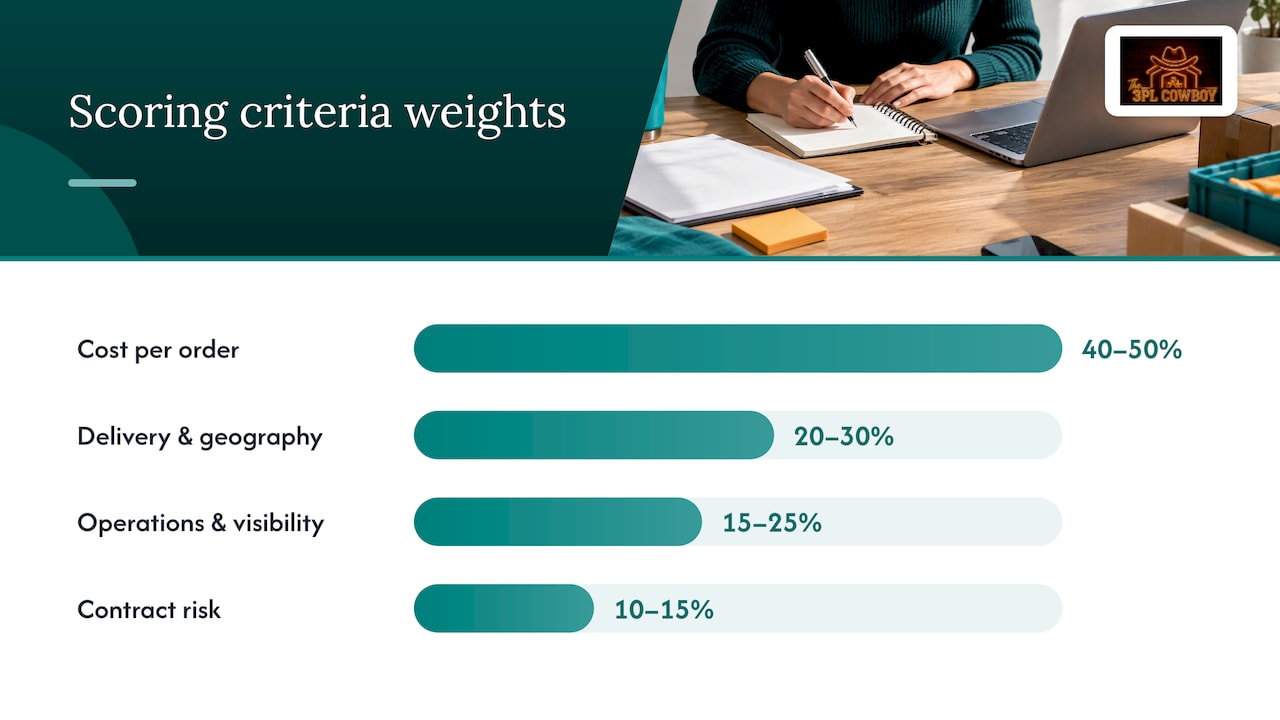
A reasonable starting split for a fulfillment bid, per a commonly used scoring template, is all-in cost per order at 40 to 50 percent, delivery promise and geography at 20 to 30 percent, operations and visibility at 15 to 25 percent, and contract risk at 10 to 15 percent. Adjust to your business. A brand with fragile or regulated products might put operations well above price.
Step 2: Build a data pack that bidders can actually price
This is where most RFPs are won or lost. Ambiguous scopes produce vague, non-comparable responses, and the fix is to standardize what you send: operating assumptions, volume data, lane-by-lane freight details and your current cost structure as a benchmark.
A solid pack includes:
- Order profile: 12 months of orders by day or week, lines per order, units per line, and the share of B2B or retail wholesale versus direct-to-consumer.
- SKU data: count, dimensions, weights, storage type, lot or expiry control, kitting and returns handling.
- Inventory: average and peak pallets or cubic feet on hand, and inbound receiving patterns.
- Shipping profile: ship-from and ship-to ZIP distribution, carrier mix, service levels, average billed weight and zone.
- Seasonality: your real peaks, including promotions, not a smoothed average.
- Systems: your e-commerce platform, ERP or OMS, and the integration you expect.
- Service requirements: order accuracy, cut-off times, dock-to-stock time, returns turnaround, reporting.
If your data sits in tools that make exports painful, fix that first. Some brands bring in a team for custom logistics software development to build the extracts and dashboards, but for many a few days with a spreadsheet is enough. Either way, bidders should receive raw data in one format, not a summary deck.
A tip from the operating side: model one full month of your own orders, including your ugliest week, and let every bidder price that month. Theoretical assumptions invite theoretical prices.
Step 3: Screen with an RFI and keep the list short
Avoid the cattle call. Practitioners advise running a preliminary RFI to screen providers and shortlist 5 to 8 qualified candidates, so that the ones you invite respond with their best capabilities and pricing instead of treating your RFP as low priority.
Your RFI can be a single page. Ask about:
- Facilities within your target geography and their current capacity
- Experience with your product category and channel mix
- Technology, including WMS and integration with your platform
- Minimum volumes or commitments
- Willingness to host a site visit
A provider that cannot show experience with your type of order, or that is full in the market you need, should drop out here. That saves them time and saves you from reading proposals you will not act on.
Step 4: Issue one RFP with one deadline
Send every shortlisted provider the same document, the same data pack and the same bid sheet on the same day. Publish the dates in the RFP itself: Q&A close, bid due date, presentation window, decision date. Give bidders a realistic window to prepare, typically a few weeks for a fulfillment bid, because a custom quote built on your real data takes real work.
Timing matters too. One RFP playbook is not the only voice suggesting you avoid launching in the middle of peak season, when providers are stretched and their best people are on the floor. Many brands aim for the first quarter, when providers are finalizing the year’s contracts and have bandwidth.
The bid sheet is the most important attachment. It should force every provider to quote the same line items:
- Onboarding and setup fees
- Storage (by pallet, bin or cubic foot, and how it is billed)
- Receiving (per pallet, per carton, per hour)
- Pick and pack (first item, additional item, per order)
- Packaging materials and kitting
- Returns processing
- Account management, technology and minimums
- Accessorials and rate-card exceptions
- Outbound freight or parcel assumptions, if they are in scope
Step 5: Run Q&A the same way for everyone
Collect questions in writing and answer all bidders with the same text. If one provider asks something that reveals a gap in your pack, fix the pack and reissue to everyone. Keep rates and names between bidders confidential. A blind process protects your leverage and keeps providers honest about their best offer.
This is also where you learn who is serious. The questions a provider asks tell you a lot about how they will run your account. Sharp questions about returns, kitting or carrier mix are a good sign. No questions at all usually means a template response is coming.
Step 6: Normalize every bid to an all-in cost per order
The biggest mistake we see is scoring on the storage rate. Storage is easy to compare, and providers know it. The margin often sits elsewhere: pick and pack, accessorials and freight markup. A bid with a low pallet rate can cost more per order than a bid that looks pricier on the first page.
To compare fairly:
- Apply each rate card to the same modeled month of your real data.
- Add every fee: setup amortized over the contract term, minimums, technology, packaging, returns.
- Standardize parcel assumptions: dimensional weight factor, carrier accessorials, and zone distribution. A guide on improving 3PL bids makes the same case for a more complete pricing evaluation method.
- Express the result as cost per order, and cost per unit shipped, for each scenario: base month, peak month and a slow month.
- Flag every assumption the provider added that you did not supply.
If you also move freight through the same provider, treat transportation as its own line. Our parcel and transportation strategy work often finds that parcel terms matter as much as warehouse rates.
Step 7: Score, then verify
Once costs are comparable, score each bidder against the weights you set in step 1. Keep the scoring sheet simple enough that two people could score independently and land close to each other. Where scores differ by more than a point, talk through why.
Visit the building
A slide deck hides operational problems. Walk the floor, watch pick and pack, look at how returns and damaged goods are handled, and talk to the people doing the work. Ask to see a client similar to you in operation. If a provider resists or limits a visit, treat that as information.
Check references before negotiating
Practitioners recommend checking references before contract talks, not after. The best questions are about bad days: How did they handle a missed carrier pickup? What happened during an unexpected volume spike? How quickly did they tell you about a problem? Steady-state performance is easy to fake. Recovery is not.
Put your own team in the room
The people who will manage the relationship every day should meet the provider’s operations leads before you sign. Outsourcing the whole selection to a third party, with no one from your team involved, is a strategic mistake. Communication style and cultural fit show up in the first hour of conversation and are rarely visible on paper. For the failure modes we weigh most heavily, see our 3PL selection criteria.
Step 8: Negotiate terms that protect you after the honeymoon
The contract is where a cheap bid can turn expensive. Focus on:
- SLAs tied to remedies: accuracy, on-time shipping and inventory accuracy targets mean little without credits or termination rights.
- Termination and notice: how long is the term, and what does it cost to leave?
- Rate increases: tied to a published index, with a cap, not at the provider’s discretion.
- Minimums and tiers: what happens if volume falls short, and does a good peak earn you a better rate?
- Data and inventory access: what happens to your data and stock if you leave?
- Onboarding plan: named owners, dates, and who pays if go-live slips.
A slow, thorough evaluation pays off. A well-run process commonly takes 8 to 12 weeks, and rushing it is cited as a major driver of poor selection and a second search within 18 to 24 months. If you are planning against a hard date, such as a lease expiry or a peak window, work backward from it and start earlier than feels necessary. Teams that need to line up systems work alongside the RFP can use the same calendar for integration scoping.
Common mistakes in a 3PL RFP
- Sending the RFP to everyone. Fifteen bidders means fifteen shallow answers.
- Using averages instead of peaks. Providers staff and price for what you tell them.
- Comparing headline rates. Compare modeled cost per order.
- Skipping the site visit. A proposal is a sales document.
- Checking references last. By then you are emotionally committed.
- Leaving out the team that will run the account. Fit is part of performance.
- Treating the RFP as the end. The first 90 days of onboarding decide whether the savings are real.
Our perspective
We run this process from the operating side, and we advise both brands and 3PL operators, so we see both halves of an RFP: what brands send and what providers read. The pattern is consistent. Brands that send rich, honest data get sharper bids. Providers that win on a rate card and then lose on execution almost always had an RFP that never tested execution.
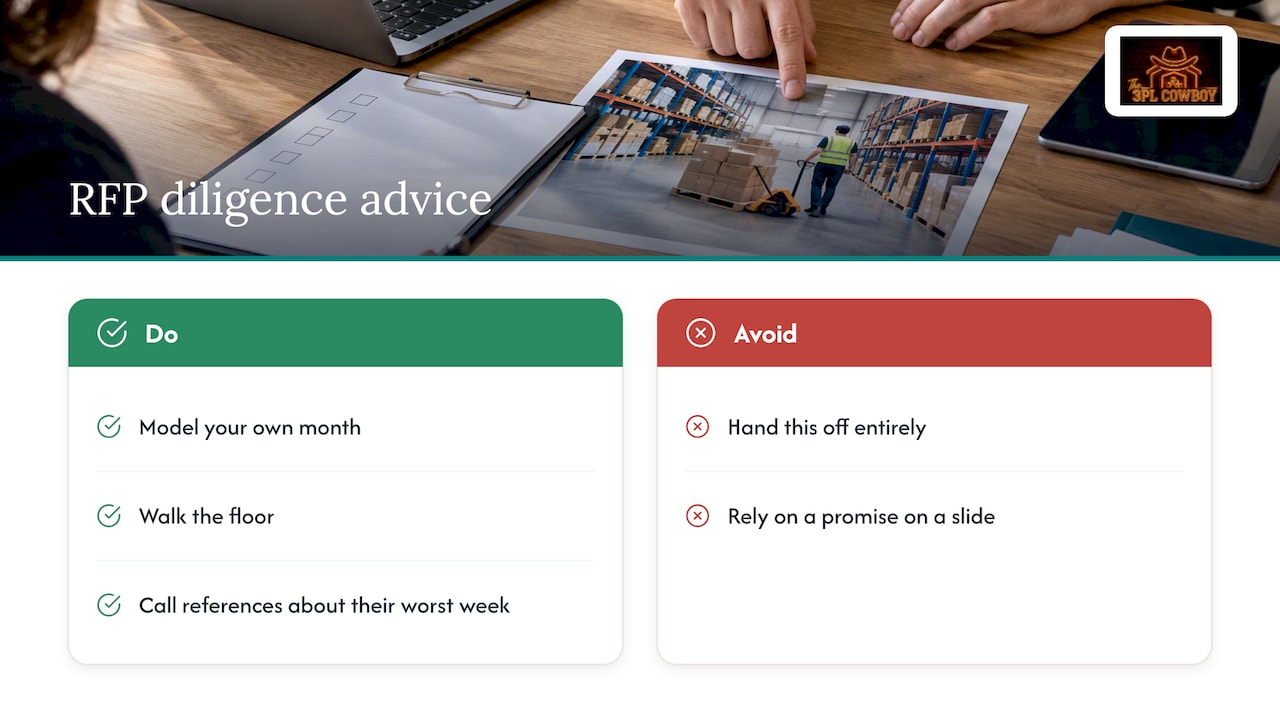
Our advice is to spend your effort where bids are weakest: the operational reality behind the price. Model your own month, walk the floor, and call references about the worst week they had. A promise on a slide cannot be audited. A floor team and a recovery story can.
The other thing we would tell any founder: do not hand this off entirely. An advisor can build the pack, normalize the bids and run the diligence, but the person who owns the relationship has to sit across from the finalists.
— Michael Nooner
Where we fit in your RFP
The 3PL Cowboy is an operator-led supply chain advisory. Michael Nooner has more than 17 years of hands-on operating experience across brands such as Nike, Walmart, DHL, FedEx, Kellogg’s and Peloton. For brands, we manage the RFP end to end through Warehouse RFP Management and the diligence behind it through 3PL Selection & Diligence. If you would like to see all options, start at our For Brands page.
FAQ
How long does a 3PL RFP take?
Plan on 8 to 12 weeks from distributing the RFP to signing a contract, with onboarding after that. Data preparation before launch can add one to two weeks. Compressing the timeline mostly cuts the verification steps, which are the ones that protect you.
How many 3PLs should I send an RFP to?
Five to 8 qualified providers is a practical range. Use a short RFI to get there from a longer list. More bidders means more noise and less effort from each one.
What should a 3PL RFP include?
Your goals, scoring criteria, timeline, order and SKU data, shipping profile, seasonality, service requirements, systems, and a standardized bid sheet. The more specific the data, the more comparable the bids.
Should I weight price most heavily?
Cost per order deserves the largest single weight, often around 40 to 50 percent, but it should not be the whole score. Delivery promise, operations, visibility and contract risk decide whether the price holds up in practice.
Do I need an advisor to run a 3PL RFP?
Not always. If you have the time, the data and someone who has run a warehouse, you can do it yourself. An operator-led advisor helps most when the decision is large, the data is messy, or you need an independent read on what the bids really mean.
Sources
- The Ultimate RFP Checklist for Shippers, Inbound Logistics
- How to Request 3PL Proposals, Inbound Logistics
- Developing Supply Chain Requests for Proposals, Ryder
- Get better 3PL bids, Supply Chain Management Review
- 3PL RFP Template for Brands, Warp

