
A data-driven parcel contract negotiation process, focused on DIM divisor corrections, accessorial caps, and surcharge protections, typically recovers significant annual shipping cost savings, with many mid-market shippers achieving double-digit percentages. Carriers walk into every negotiation with detailed analytics on your account. If you don’t match that granularity, you’re negotiating blind.
The three fastest wins:
- Audit your invoices first. Billing errors and misapplied surcharges are common, and they’re recoverable before you touch the contract.
- Quantify your DIM exposure. Calculate the gap between actual weight and billed weight across your shipment mix. That number is your opening argument.
- Cap your top three accessorials. Surcharges and accessorials can account for up to 25% of total parcel spend with major carriers.
Negotiating caps or waivers on additional handling, residential delivery, and fuel surcharges often outperforms chasing a better base rate discount.
Realistic savings range: 5–40%, with most well-prepared shippers recovering savings in the low-to-mid 20% range. Variables include spend volume, accessorial profile, DIM exposure, and how much contract language has been left unaddressed.
When to hire help: If your annual parcel spend exceeds $500K, you’re managing simultaneous UPS and FedEx agreements, or your projected savings clearly exceed advisory fees, bring in a consultant. 3plcowboy works with brands and 3PLs at exactly that inflection point, providing audit, modeling, and negotiation support so internal teams don’t have to build the capability from scratch.
Pro Tip: Don’t wait for contract renewal to start the process. Begin your shipment data audit at least six months before expiration so you arrive at the table with 12 months of clean baseline data.
Table of Contents
- Why data-driven parcel negotiation beats old-school tactics
- What does a parcel contract negotiation process look like, step by step?
- What can you actually negotiate in a parcel contract?
- When should you renegotiate, and what gives you leverage?
- Operational levers that reduce your cost before and after negotiating
- When does it make sense to hire a parcel contract consultant?
- How do you evaluate and choose a negotiation partner?
- What do realistic parcel contract savings actually look like?
- Key Takeaways
- The part of parcel negotiation most teams get wrong
- 3plcowboy helps you recover what your current contract is leaving on the table
- Useful sources and further reading
Why data-driven parcel negotiation beats old-school tactics
The old playbook was simple: threaten to switch carriers, wave a competitor quote, and watch discounts appear. That approach is far less effective today. UPS and FedEx have coordinated many of their pricing structures, including DIM weight rules, rounding conventions, and additional handling triggers, so a competitive threat alone rarely moves the needle the way it once did.
What does move the needle is showing a carrier’s pricing team exactly what their rule changes cost you, in dollars, at the shipment level.
Carriers maintain detailed analytics on every shipper account. They know your zone mix, your weight distribution, your accessorial frequency, and your revenue contribution. When you walk in without equivalent data, you’re asking for concessions you can’t quantify. That’s a weak position.
The DIM rounding example makes this concrete. Suppose UPS rounds dimensional weight up to the next whole pound on every package. For a shipper sending 50,000 packages per year averaging 0.4 lbs of rounding per package, that’s 20,000 phantom pounds billed annually. At a blended rate of $0.25 per pound, that’s $5,000 in pure rounding cost, before any rate-per-pound calculation. Quantifying that impact and presenting it as a line item shifts the conversation from “we’d like better rates” to “here’s the specific rule change that cost us $X, and here’s what a fair adjustment looks like.”
That framing works because it’s a partnership ask, not a complaint. Carrier revenue management teams respond to data. They don’t respond to frustration.
Key metrics that restore your leverage:
- Average billed weight vs. actual weight, by service level
- DIM impact percentage (billed weight increase attributable to dimensional calculation)
- Additional handling frequency as a percentage of total shipments
- Zone mix distribution and how it shifts with volume changes
- Residential delivery percentage and its accessorial cost contribution
- Surcharge spend as a percentage of total invoice
Build those numbers before you request a meeting. They’re the foundation of every ask that follows.
What does a parcel contract negotiation process look like, step by step?
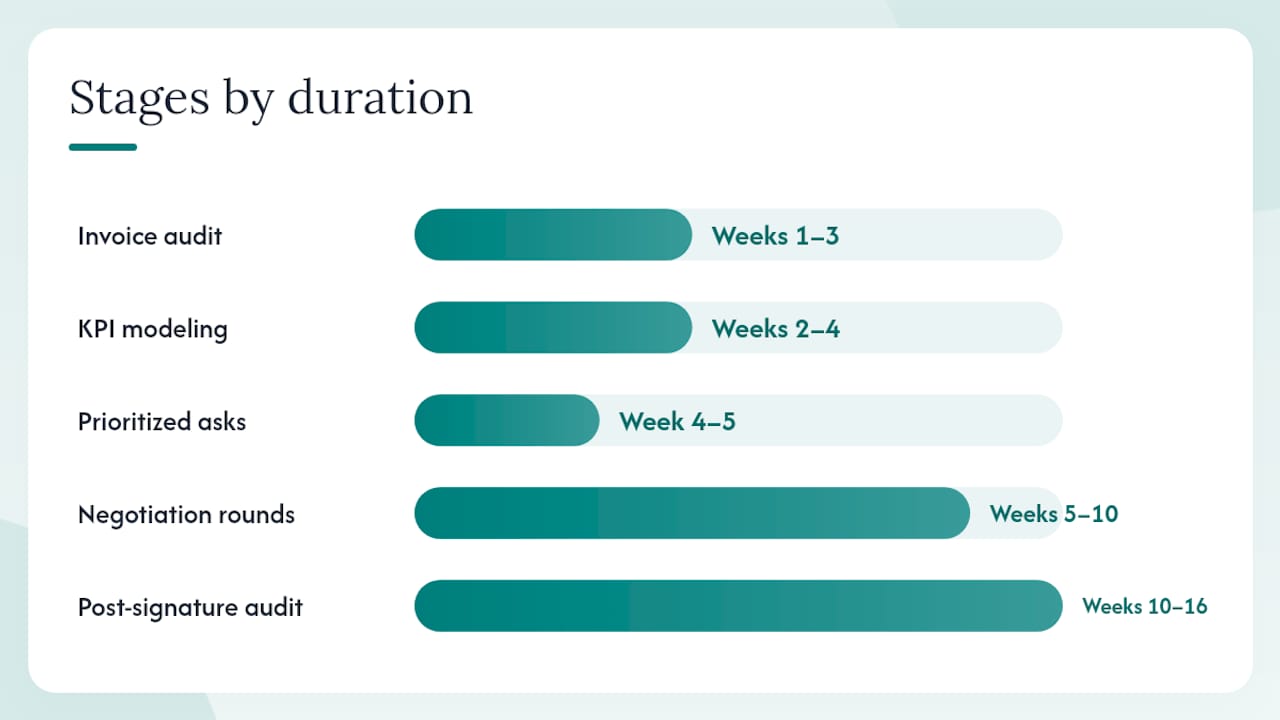
The sequence is: audit your invoices, build your baseline metrics, model the financial impact of your asks, submit prioritized requests, negotiate in rounds, then verify implementation against the new contract terms. Most engagements run several weeks from audit start to signed agreement.
Stage 1: Parcel invoice audit (weeks 1–3)
Pull 12 months of invoice data from UPS, FedEx, or your regional carriers. The goal is a clean, shipment-level dataset: zone, service type, actual weight, billed weight, each accessorial charged, and total cost per package. Flag billing errors, misapplied surcharges, and packages that triggered additional handling incorrectly. This stage often uncovers recoverable overcharges before you’ve negotiated a single term.
Stage 2: KPI modeling (weeks 2–4, overlapping)
Compute the metrics listed in the previous section. Then model the dollar impact of specific contract changes: what would a DIM divisor increase from 139 to 166 save annually? What would a 50% cap on additional handling fees recover? These models become your negotiation asks. Effective contract optimization requires historical spend analysis, contract modeling, accessorial analysis, and automated invoice auditing working together, not just a rate comparison.
Stage 3: Prioritized asks (week 4–5)
Rank your requests by dollar impact, not by ease. A DIM divisor correction might be worth $80,000 annually. A base rate discount might be worth $12,000. Lead with the larger number. Prepare a one-page impact memo for each major ask: the current rule, the financial impact, and your proposed change. Carrier reps respond to specifics.
Pro Tip: Frame every ask as a partnership question, not a demand. “We’ve modeled that the current DIM divisor adds approximately $X to our annual cost. What would it take to revisit that term?” gets further than “we need a better DIM divisor.”
Stage 4: Negotiation rounds (weeks 5–10)
Expect two to four rounds. The first response from a carrier account rep is rarely their best offer. After the initial response, counter with your modeled data, acknowledge what they’ve offered, and ask specifically about the items they haven’t addressed. If the account rep can’t move on a key item, ask to escalate to pricing or revenue management. That’s not adversarial; it’s how the process works.
Stage 5: Implementation and post-signature audit (weeks 10–16)
Once the contract is signed, run a post-implementation audit within 30–60 days. Carriers occasionally apply new terms incorrectly, particularly on accessorial caps and DIM divisor changes. Catching errors early protects the savings you just negotiated.
| Stage | Owner | Key Output | Timeline |
|---|---|---|---|
| Invoice audit | Logistics analyst | Clean shipment-level dataset | Weeks 1–3 |
| KPI modeling | Analyst + finance | Impact models per ask | Weeks 2–4 |
| Prioritized asks | Logistics manager | One-page impact memos | Week 4–5 |
| Negotiation rounds | Logistics manager (or consultant) | Revised contract terms | Weeks 5–10 |
| Post-signature audit | Analyst | Verified implementation | Weeks 10–16 |
What can you actually negotiate in a parcel contract?
More than most shippers realize. Practitioners typically work from a list of many negotiable contract items, and the items that drive the largest dollar impact are rarely the ones that get the most attention in initial conversations.
Top-10 priority items by typical dollar impact
| Contract Item | Why It Matters | Negotiation Angle |
|---|---|---|
| DIM divisor | Directly controls billed weight on lightweight, bulky packages | Request a higher divisor (e.g., 166 vs. 139) tied to volume commitment |
| Additional handling fees | Triggered by package dimensions, weight, or material; high frequency inflates costs fast | Cap per-package fee or negotiate a blanket waiver for specific SKU types |
| Residential delivery surcharge | Applies to most B2C shipments; compounds with other fees | Negotiate a flat cap or percentage reduction; explore commercial address reclassification |
| Fuel surcharge | Floats weekly; can swing total spend significantly | Negotiate a cap or a fixed offset tied to a published index |
| Base rate discount | The headline number; often overstated in value | Secure it, but don’t trade accessorial protections for a better base discount |
| Revenue tier / minimum | Minimum weekly or annual revenue commitments affect discount eligibility | Negotiate realistic minimums with a ramp provision for growth |
| Rebate structure | Volume rebates can recover 2–5% of spend if structured correctly | Tie rebates to achievable thresholds; avoid cliffs that reset at year-end |
| Termination language | Standard contracts heavily favor carriers | Negotiate a 30–60 day termination-for-convenience clause |
| Zone-based discounts | Zone 2–4 shipments often have more room than Zone 7–8 | Model your zone mix and ask for targeted zone discounts where volume is concentrated |
| Surcharge expiration dates | Base rate and surcharge terms often expire on different schedules | Align expiration dates or negotiate independent renewal rights for each |
Pro Tip: Watch for staggered expirations inside a single contract. A carrier may offer a strong base rate discount that runs 36 months while accessorial protections expire at 12 months. Read every term’s expiration date independently.
Three high-impact negotiation examples
DIM divisor trade-off. A shipper sending primarily lightweight apparel in oversized boxes might have 40% of packages billed at DIM weight rather than actual weight. Offering a 5% volume increase commitment in exchange for a DIM divisor increase from 139 to 166 can cut billed weight on those packages by 15–20%. The carrier gets revenue certainty; you get a lower effective rate per package.
Additional handling cap. If 18% of your packages trigger additional handling fees, a per-package cap negotiated at 60% of the published rate saves real money at scale. The ask is simple: “Our package profile hasn’t changed, but the AH trigger thresholds have. We’d like to cap AH at $X per package for packages within these dimensions.”
Avoiding the base rate discount trap. A 30% base rate discount sounds strong until you realize accessorials were left uncapped and now represent 45% of your total invoice. Always model the net effective rate per package after accessorials, not just the base discount percentage.
Sample calculations
DIM impact example:
- 10,000 packages per month
- Average actual weight: 3.2 lbs
- Average billed weight: 4.1 lbs
- DIM impact: (4.1 – 3.2) / 3.2 = 28%
- At a blended rate of $8.50 per package, that 28% DIM inflation adds roughly $2.38 per package, or $285,600 annually
AH frequency example:
- 2,200 AH charges per month on 12,000 shipments = 18.3% frequency
- At $16.00 per AH charge: $35,200/month, $422,400/year
- A negotiated 40% cap reduction saves approximately $169,000 annually
Benchmark reference table
| Metric | Typical Range | Negotiation Signal |
|---|---|---|
| Surcharge % of total spend | 15–25% | Above 20%: prioritize accessorial caps |
| DIM impact % | 5–30% | Above 15%: DIM divisor is a priority ask |
| AH frequency | 5–25% | Above 15%: cap or waiver negotiation warranted |
| Annual GRI impact | 5–7% | Model GRI against your profile before renewal |
| Negotiated savings range | 5–40% | Low-to-mid 20s for well-prepared mid-market shippers |
Pro Tip: Build a one-page visual summary of your key metrics before carrier meetings. A simple bar chart showing billed vs. actual weight by month, and a pie chart showing surcharge breakdown, communicates your data preparation faster than any spreadsheet.
When should you renegotiate, and what gives you leverage?
The best time to open a parcel contract negotiation is 6–9 months before your current contract expires, ideally in Q1 or Q2 when carrier sales teams have fresh annual targets and more flexibility. The worst time is during peak season (October through December), when carriers have no incentive to offer concessions.
Carriers publish annual General Rate Increases (GRIs) that typically run 5–7%. Initiating negotiations before a GRI announcement, or immediately after one, gives you a specific dollar figure to anchor your ask. “Your GRI adds approximately $X to our annual cost. We’d like to discuss how to offset that impact” is a concrete opening.
Leverage checklist:
- Annual parcel spend above $250K (meaningful enough to warrant a dedicated pricing conversation)
- Documented volume growth or a credible growth commitment
- Alternative carrier options you’ve actually explored (regional carriers, postal hybrids)
- Service failures or billing errors you’ve documented and not yet disputed
- An upcoming contract expiration within 12 months
- A shift in your shipping profile (new product line, new fulfillment center, zone mix change)
Mid-cycle renegotiation triggers are real. If your shipment volume increases by 20% or more, if you’ve added a new fulfillment location that changes your zone mix, or if a carrier has made a rule change that materially increases your costs, you have grounds to request a mid-cycle review. Document the change, quantify the impact, and request a meeting.
Timing your outreach:
- 9 months before expiration: begin invoice audit and data modeling
- 6 months before expiration: request a business review meeting with your carrier account rep
- 4–5 months before expiration: submit your formal RFP or negotiation asks
- 2–3 months before expiration: complete negotiation rounds and finalize terms
- 30 days before expiration: sign and confirm implementation timeline
Avoid letting a contract auto-renew. Carriers count on it. An auto-renewed contract is a missed opportunity to reset terms that may have drifted significantly from market rates.
Operational levers that reduce your cost before and after negotiating
Contract negotiation addresses pricing. Operational changes address the underlying cost drivers. The two work together, and some operational fixes deliver faster returns than a full negotiation cycle.
Right-sizing packaging is the highest-leverage operational move for DIM-heavy shippers. If your average package is 40% air by volume, a packaging audit and box right-sizing program can cut DIM billed weight by 10–20% before you’ve changed a single contract term. That reduction also strengthens your negotiation position: a lower DIM impact percentage means the carrier’s pricing team has less room to argue the current divisor is fair.
Operational levers to implement:
- Regional carriers: — For shipments concentrated in specific geographic areas, regional carriers frequently offer lower rates than national carriers on short-zone moves.
The decision flow: Fix packaging first, because it reduces the cost drivers that accessorials and DIM charges attach to. Then negotiate contract terms against your improved baseline. Use carrier diversification to address residual risk on specific lanes or service types where a single carrier remains uncompetitive.
Pro Tip: Run a packaging audit before your next carrier negotiation. Arriving with data showing you’ve already reduced DIM exposure by 12% signals operational discipline, and it removes a carrier’s argument that your DIM profile justifies the current divisor.
When does it make sense to hire a parcel contract consultant?
DIY negotiation works well when your spend is manageable, your contract is with a single carrier, and you have an analyst who can build the baseline data. It starts to break down when complexity, spend, or time constraints exceed what an internal team can handle.
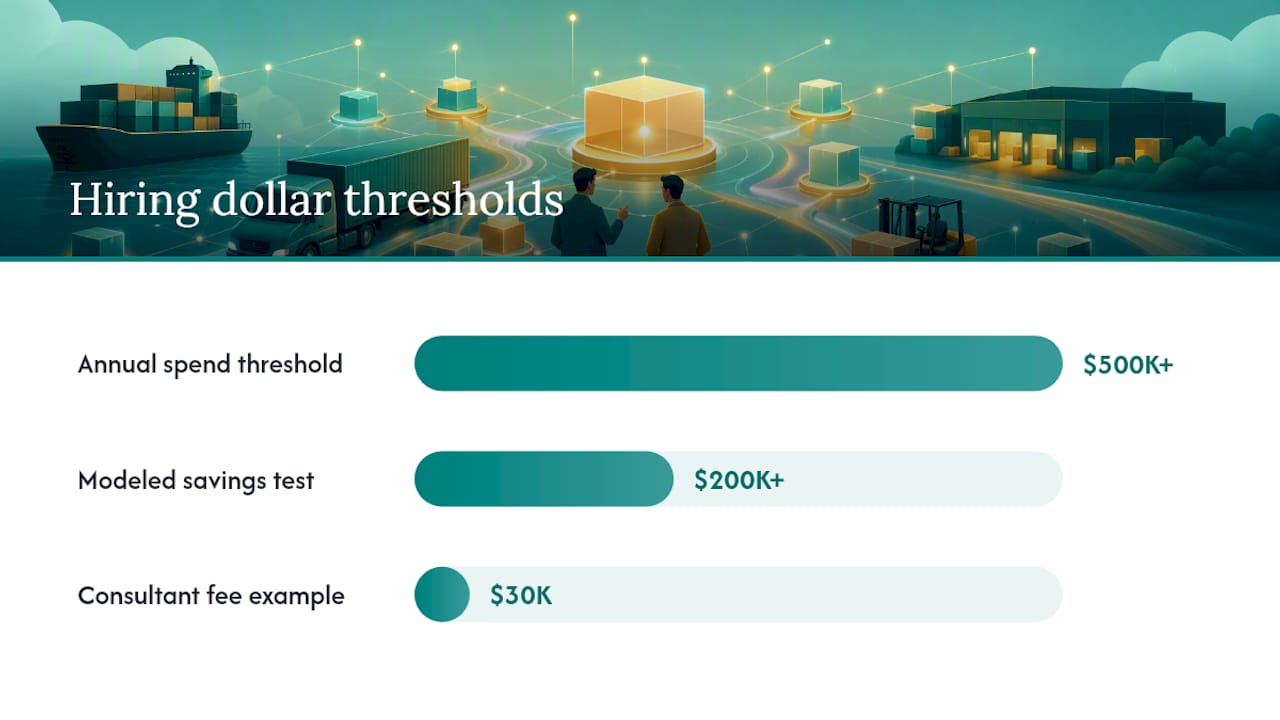
Concrete hiring thresholds:
- Annual parcel spend above $500K with UPS, FedEx, or a combination of carriers
- Simultaneous contracts with two or more national carriers requiring coordinated negotiation
- Internal team lacks the bandwidth to build 12 months of shipment-level data models
- Projected savings from a consultant engagement clearly exceed advisory fees (a reasonable test: if a consultant’s fee is $30K and your modeled savings opportunity is $200K+, the math is straightforward)
- Previous self-negotiated contract has significant gaps in accessorial protections or DIM language
- You’re managing a 3PL relationship where the carrier contract sits with the 3PL and you need independent verification
What a quality consultant should deliver:
- Full parcel invoice audit with billing error recovery
- Shipment-level baseline dataset and KPI modeling
- Modeled savings scenarios for each major contract ask
- Contract language edits and redlines (not just rate recommendations)
- Negotiation representation or coaching through carrier meetings
- Post-signature implementation audit within 60 days of contract start
- Ongoing invoice monitoring cadence
Fee model comparison:
- Fixed-fee advisory: Predictable cost; aligns consultant incentive with quality of work, not size of savings. Preferred for engagements where the scope is well-defined.
- Contingency (% of savings): No upfront cost; consultant is motivated to find savings. Watch for inflated savings claims or cherry-picked baselines that make the “before” look worse than it was.
- Hybrid: A modest fixed fee plus a smaller contingency percentage. Often the most balanced structure.
Red flags in fee offers: Any consultant who guarantees a specific savings percentage before seeing your data is working from a sales script, not an analysis. Legitimate advisors model first, then project. Also watch for revenue-reversal clauses that claw back fees if savings aren’t realized, but with no clear audit methodology to verify the baseline.
The four pillars of effective contract work are historical spend analysis, contract modeling, accessorial analysis, and invoice auditing. Any consultant who can’t demonstrate capability in all four is a partial solution.
How do you evaluate and choose a negotiation partner?
The carrier-side experience question is the most important one to ask. A consultant who has spent time in carrier pricing or revenue management understands how carriers model account profitability, which makes them far more effective at structuring asks that carriers will actually accept.
Evaluation checklist:
- Documented carrier-side or shipper-side negotiation experience (not just software access)
- Demonstrable case studies with specific savings outcomes (not just percentage ranges without context)
- Contract engineering capability: can they redline actual contract language, not just recommend rate changes?
- Invoice audit methodology: how do they identify billing errors, and what’s their recovery process?
- Technology or tooling for shipment-level data modeling
- References from clients with similar spend profiles and carrier mix
Sample interview questions:
- “Walk me through how you quantify DIM exposure for a new client. What data do you need, and what does the output look like?”
- “Show me an example of a contract redline you’ve done on accessorial language. What did you change and why?”
- “How do you handle a situation where a carrier’s account rep says a specific item is non-negotiable?”
- “What’s your post-signature audit process, and how do you verify that new terms are being applied correctly?”
- “How do you structure your fee if we don’t achieve the projected savings?”
Red flags during evaluation:
- Guaranteed savings percentages quoted before any data review
- No clear explanation of audit methodology
- Revenue-reversal clauses with vague or unverifiable baseline definitions
- Inability to show actual contract language examples (not just rate comparison spreadsheets)
Pro Tip: Ask any prospective consultant to show you a real (redacted) contract redline from a prior engagement. Rate recommendations are easy to produce. Contract language edits require genuine expertise.
Decision rubric:
- Spend under $250K, single carrier, internal analyst available: DIY with a structured process
- Spend $250K–$500K, one or two carriers, limited internal bandwidth: pilot a fixed-fee advisor for one contract cycle
- Spend above $500K, multiple carriers, complex accessorial profile: engage a full-service consultant for audit, modeling, and negotiation
What do realistic parcel contract savings actually look like?
Savings ranges vary widely because the starting point matters as much as the negotiation skill. A shipper with an unreviewed five-year-old contract and no accessorial protections has far more opportunity than one who renegotiated 18 months ago with professional help.
Anonymized case study outcomes
Mid-market apparel shipper, $1.2M annual spend. Primary issues: DIM divisor set at 139 on a lightweight, bulky assortment; additional handling triggered on 22% of packages; no fuel surcharge cap. After a full audit and two rounds of negotiation, the shipper secured a DIM divisor increase to 166, an AH cap at 65% of published rate, and a fuel surcharge offset. Realized savings: approximately 23% of prior-year spend.
Regional e-commerce brand, $380K annual spend. Single carrier (UPS), contract auto-renewed twice without review. Invoice audit identified $14,000 in billing errors recovered immediately. Negotiation focused on residential delivery surcharge reduction and a zone-based discount on Zone 2–4 shipments (representing 60% of volume). Realized savings: approximately 17% of prior-year spend, plus the $14,000 billing recovery.
B2B distributor, $2.8M annual spend across UPS and FedEx. Complex profile: mixed residential and commercial, wide zone distribution, significant oversize packages. Coordinated negotiation across both carriers with modeled cross-carrier scenarios. Key wins: DIM divisor alignment across both contracts, oversize surcharge cap, and a rebate structure tied to achievable volume thresholds. Realized savings: approximately 19% blended across both carriers.
Savings range by shipper profile
| Shipper Profile | Typical Savings Range | Primary Drivers |
|---|---|---|
| Small shipper (<$250K spend) | 5–15% | Billing error recovery, base rate improvement |
| Mid-market ($250K–$1M spend) | Low-to-mid 20% | DIM divisor, AH caps, residential surcharge |
| Large enterprise (>$1M spend) | 15–35% | Multi-carrier coordination, rebate structure, zone discounts |
| Accessorial-heavy profile | Up to 40% | Targeted accessorial caps and waivers |
Variables that pull results up: High DIM exposure, high AH frequency, unreviewed contracts older than two years, multiple carriers negotiated simultaneously, and a credible volume growth commitment.
Variables that pull results down: Recent prior negotiation, low spend volume limiting carrier incentive, limited alternative carrier options, and a shipping profile that’s already operationally optimized.
Verifying realized savings: Run a post-implementation invoice audit at 30 days and again at 90 days. Compare actual per-package costs against your modeled projections. Track your core KPIs monthly: average cost per parcel, DIM impact percentage, and AH frequency. Savings that aren’t monitored tend to erode as carriers introduce new surcharges or adjust trigger thresholds.
Key Takeaways
Data-driven parcel contract negotiation, focused on DIM divisors, accessorial caps, and surcharge protections, consistently delivers double-digit savings, with mid-market shippers typically recovering savings in the low-to-mid 20% range of annual spend.
| Point | Details |
|---|---|
| Audit before you negotiate | Pull 12 months of invoice data and build a shipment-level baseline before any carrier conversation. |
| Accessorials drive the biggest wins | Surcharges can represent a large portion of total spend; cap additional handling, residential fees, and fuel surcharges first. |
| Time your outreach carefully | Start prep 6–9 months before contract expiration; avoid peak season and never let a contract auto-renew. |
| Match carrier data granularity | Carriers analyze your account in detail; bring zone mix, DIM impact %, and AH frequency to every meeting. |
| 3plcowboy as your advisor | 3plcowboy provides audit, modeling, and negotiation support for brands and 3PLs at the complexity and spend thresholds where DIY breaks down. |
The part of parcel negotiation most teams get wrong
Most logistics teams spend the first half of a negotiation cycle chasing a better base rate discount. It’s the most visible number, it’s easy to compare, and it feels like a win when it moves. The problem is that a 25% base rate discount can be entirely offset by uncapped accessorials, a tight DIM divisor, and a fuel surcharge that floats upward every quarter.
The carriers know this. Their pricing models are built around it. A generous base discount is sometimes offered precisely because the accessorial structure more than compensates for it on the carrier’s side. That’s not cynicism; it’s how revenue management works when one party has far more data than the other.
The shift that actually changes outcomes is treating the contract as a system, not a rate card. Every term interacts with every other term. A DIM divisor change affects billed weight, which affects base rate calculations, which affects revenue tier thresholds, which affects rebate eligibility. Modeling those interactions before you ask for anything is what separates a negotiation that recovers 8% from one that recovers 24%.
The other thing teams consistently underestimate is post-signature verification. Carriers apply new contract terms manually in many cases, and errors are common. A 60-day post-implementation audit is not optional; it’s where a meaningful portion of negotiated savings either gets confirmed or quietly disappears.
3plcowboy helps you recover what your current contract is leaving on the table
Most shippers are paying more than they should, not because they haven’t tried to negotiate, but because they negotiated without the data infrastructure to do it well. 3plcowboy’s supply chain consulting engagements start with a full parcel invoice audit, build a shipment-level baseline, model the dollar impact of specific contract changes, and then support the negotiation directly, whether that means coaching your internal team or representing you in carrier meetings.

The typical client is a brand or 3PL spending $500K or more annually with UPS, FedEx, or a combination of carriers, with a contract that hasn’t been professionally reviewed in the past two years. Most see realized savings in the low-to-mid 20% range within the first contract cycle, plus billing error recoveries that arrive before the new contract even takes effect.
If your annual parcel spend, contract complexity, or internal bandwidth has reached the point where a DIY process is leaving money on the table, the next step is a conversation. Reach out through 3plcowboy.com to start with a free assessment of your current contract and shipment profile.
Useful sources and further reading
The sources below were used to build the frameworks, benchmarks, and negotiation guidance throughout this article. Each one offers deeper technical detail on specific aspects of parcel contract work.
-
Data-Driven Parcel Negotiation: How to Use Shipping Data to Regain Leverage — iDrive Logistics. Covers DIM rounding quantification and how to use shipment data to rebuild negotiating leverage after coordinated carrier rule changes.
-
Parcel Contract Negotiations Handbook — Supply Chain Dive. Documents surcharge and accessorial share of parcel spend, with practical negotiation tips and benchmarking use cases for UPS and FedEx shippers.
-
How To Negotiate Small Parcel Shipping Contracts With UPS and FedEx — Reveel. Explains why shippers need shipment-level data and provides a practical framework for modeling service-level and surcharge impact before carrier meetings.
-
Top 25 Items to Negotiate in Your UPS, FedEx, or Regional Parcel Carrier Contract — FreightWise. A prioritized list of contract items with negotiation angles for each; the most comprehensive publicly available inventory of negotiable parcel contract terms.
-
DIY Parcel Carrier Contract Negotiations: 5 Steps to Success — Reveel. A five-step DIY negotiation process with guidance on GRI modeling, common prep items, and levers available without external consultants.
-
Carrier Contract Optimization: How to Negotiate UPS and FedEx Rates with Confidence — Sifted. Summarizes the four pillars of contract optimization and what to look for in tools and advisory partners.
-
Eight Best Tips for Carrier Contract Negotiations — Reveel. Warns against the base rate discount trap and stresses negotiating accessorial protections and DIM divisor language as the highest-impact items.
-
Negotiating Small Parcel Contracts in a Volatile Market — LJM Group / American Supply Chain Summit 2026. Market context for rate volatility and the growing importance of accessorial management and dynamic pricing in current carrier agreements.