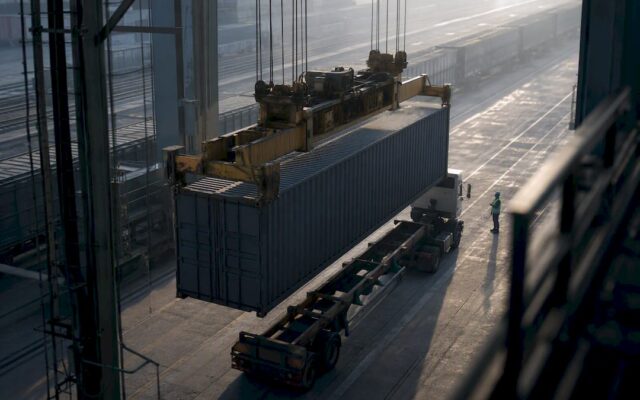
Sustainability in logistics means running transportation, warehousing, and packaging in ways that cut environmental impact while protecting cost and service. The immediate priority is measurement: find your Scope 3 transport hot spots before committing capital. Get that right and the payoff shows up as lower freight spend, fewer compliance surprises, and stronger standing with customers who track supplier emissions.
TL;DR:
- Focus on identifying Scope 3 transport hot spots through spend, ton-miles, and distance before investing in equipment or new technology.
- Prioritize pilots on lanes with the worst utilization, such as low fill rates or high empty miles, to achieve the fastest cost and emission reductions.
- Use standardized tools like the EPA SmartWay Shipper Tool and GHG Protocol methods to build credibility and track emissions data over time.
- Elect to pilot electrification primarily on short, predictable routes where lower costs and charging infrastructure are manageable.
- Engage carriers and suppliers early by integrating sustainability metrics into onboarding processes and contracts, fostering long-term partnerships.
Table of Contents
- What sustainable logistics actually covers
- Why sustainability in logistics matters now
- Key trends shaping logistics decarbonization
- High-impact operational tactics to deploy this year
- Measure first: building a transport emissions inventory
- Implementation roadmap across three horizons
- Barriers and how to work around them
- What operator-led diagnostics reveal about sustainability gaps
- Getting suppliers, carriers, and internal teams aligned
- Where blockchain and IoT fit beyond routing software
- How regulation is reshaping freight and warehouse decisions
- Paying for it: incentives, funding, and investment structures
- Building the internal capability to make it stick
- Three moves to make this quarter
- How 3PL Cowboy approaches sustainable logistics advisory
- FAQ
- Sources
What sustainable logistics actually covers
Sustainable logistics rests on three pillars: environmental impact, economic viability, and social responsibility. A program that only cuts emissions while bleeding margin will not survive a budget cycle, and one that ignores labor and community effects will not survive scrutiny.
Corporate accounting ties these efforts to a common framework. Most companies track emissions in three scopes, and freight sits mostly in Scope 3, specifically categories 4 (upstream transportation and distribution) and 9 (downstream transportation and distribution). The GHG Protocol defines these categories and the methods for calculating them, which matters because freight emissions purchased from carriers rarely show up anywhere else in a company’s inventory.
- Environmental pillar: fuel use, emissions, packaging waste, and material sourcing.
- Economic pillar: cost per mile, cost per unit shipped, and capital efficiency.
- Social pillar: labor conditions, community impact near distribution hubs, and driver safety.
- Scope 3, categories 4 and 9: the transport and distribution emissions a company does not own but does purchase, and the ones EPA SmartWay was built to help shippers quantify.
Why sustainability in logistics matters now
Three forces are converging on logistics leaders at once. Operational efficiency programs that reduce empty miles, improve fill rates, or right-size fleets tend to cut cost and emissions simultaneously, which is why they are the easiest sustainability wins to justify internally. Regulatory and disclosure expectations are also tightening, with more buyers and investors asking suppliers to report Scope 3 data they previously never collected. Customer and investor signals round out the picture: procurement teams increasingly screen suppliers on carbon intensity before price negotiations even start.
- Cost and emissions often move together: better load utilization reduces both fuel spend and CO2e per shipment.
- Disclosure pressure is rising: more customers ask suppliers for category 4 and 9 data as part of vendor onboarding.
- Market signals favor lower-carbon partners: carbon intensity is becoming a procurement screen, not an afterthought.
None of this requires a sustainability department to act on. It requires a clear-eyed look at where freight dollars and emissions overlap, and a willingness to fix the overlap first.
Key trends shaping logistics decarbonization
A handful of trends are pulling investment dollars and pilot programs right now, and they are not equally mature.
- Fleet electrification is becoming cheaper to justify. DOE data shows battery and component costs declining, which improves the total-cost-of-ownership case for electrified vehicles across several vehicle classes.
- AI-driven routing and visibility tools are cutting empty miles. Better routing software reduces deadhead runs and tightens delivery windows without adding trucks.
- Modal shift toward rail and intermodal is gaining traction where distance and volume justify the transfer, trading a few days of transit time for a meaningful emissions reduction.
- Packaging optimization is shifting from material swaps to cubic efficiency, since poor dimensional design can erase the benefit of a lighter material.
- Reverse logistics and circular-economy pilots are turning returns processing into a cost-recovery and waste-reduction function rather than a dead loss.
Leaders do not need to chase every trend at once. Pick the one or two that intersect with your highest freight spend and your worst utilization numbers, and pilot there first.
High-impact operational tactics to deploy this year
Some levers pay back in a single shipping cycle, others take longer, but none require a full sustainability function to start.
- Route and load optimization: choose software that scores carriers on fill rate and empty-mile percentage, not just on-time delivery, and run a 90-day pilot before a full rollout.
- Fleet strategy: right-size vehicle classes to actual load profiles, pilot electrification on short, predictable routes, and retrofit aerodynamic or fuel-efficiency kits on the rest of the fleet.
- Network and modal design: map lanes over 500 miles for rail or intermodal conversion, since those lanes usually carry the best cost and emissions trade-off.
- Green warehousing: upgrade lighting and HVAC controls, and pair that with slotting and pick-path redesign to cut both energy use and labor miles walked.
- Packaging optimization: redesign carton dimensions before swapping materials, and test reusable shipping systems on closed-loop routes first.
Pro Tip: Run your first sustainability pilot on the lane or facility with the worst utilization numbers, not the one with the most visibility, because that is where the fastest payback hides.
Route software selection deserves its own checklist: confirm it reports fill rate and empty-mile percentage, integrates with your transportation management system, and lets you benchmark carrier performance over time. A comparison of route optimization platforms is a reasonable starting point for narrowing vendor options before a trial.
Measure first: building a transport emissions inventory
Guessing at emissions numbers invites both bad decisions and credibility problems later, so screening comes before anything else.
- Screen for hot spots using spend, ton-miles, and distance before collecting granular data everywhere.
- Apply GHG Protocol methods for Scope 3 categories 4 and 9, using supplier-provided activity data where it exists and hybrid estimation where it does not.
- Use the EPA SmartWay Shipper Tool to estimate CO2, NOx, and particulate emissions by mode and to compare carrier performance against SmartWay’s performance bins.
- Track a short KPI set: CO2e per ton-mile, fill rate, and percentage of volume moved on SmartWay-rated carriers.
SmartWay’s emission factors cover truck, rail, air, and barge transport, giving shippers a standardized way to compare carriers and modes. That standardization matters more than any single number, since it lets you track the same metric quarter over quarter instead of restarting your methodology every time a vendor changes. The SmartWay Shipper Tool technical documentation lays out the specific emission factor tables and performance-bin methodology behind those comparisons.
Downstream emissions in category 9 are usually the hardest to pin down, since they depend on what happens after a shipment leaves your dock. A mixed approach, using carrier-provided data where available and transparent estimation ranges where it is not, beats waiting for perfect data that may never arrive.
Implementation roadmap across three horizons
Sustainability programs fail most often when every decision gets treated as urgent and strategic at once. Separating decisions by horizon keeps capital commitments and daily dispatch rules from competing for the same attention.
- Strategic (3 to 5 years): network design, major capital decisions like fleet electrification or facility relocation, and formal target-setting tied to Scope 3 categories 4 and 9.
- Tactical (6 to 24 months): supplier and carrier onboarding with sustainability data requirements, pilot programs on specific lanes, and renegotiated carrier agreements.
- Operational (daily and weekly): dispatch rules that prioritize fill rate, load-building standards, and slotting changes that reduce picking distance.
- Governance and contracting: write emissions KPIs directly into carrier and supplier contracts, and treat long-term partnerships as joint investments rather than annual bidding exercises.
Matching the decision to its horizon prevents a warehouse team from being asked to solve a network-design problem, or a procurement team from being blamed for an operational issue a dispatcher could have fixed that week.
Barriers and how to work around them
Capital cost is the most common objection to electrification and equipment upgrades, and phased pilots with shared investment from carriers or suppliers reduce the upfront exposure. Data gaps are the second-biggest obstacle: supplier questionnaires, estimation hierarchies for missing data, and periodic verification sampling close most of the gap without demanding perfect reporting from day one.
- Financing: phase pilots and share costs with carriers or suppliers instead of funding everything internally.
- Data gaps: use supplier questionnaires and estimation hierarchies, then verify a sample rather than chasing full coverage.
- Procurement misalignment: rewrite contracts to include sustainability KPIs and longer terms instead of annual lowest-bid cycles.
- Net-negative swaps: check that a material change does not increase shipment volume or empty space, since a lighter package that ships less efficiently can raise transport emissions despite a better material score.
What operator-led diagnostics reveal about sustainability gaps
Operational audits consistently surface the same pattern: facilities and lanes with the worst utilization numbers are also the ones with the most room to cut both cost and emissions.
Diagnostics that prioritize interventions by utilization and spend, rather than by visibility or trend appeal, tend to surface the fastest payback opportunities first. A pallet-program redesign, a slotting-first pick-path project, or a warehouse management system rollout are not marketed as sustainability initiatives, but they move the same CO2e-per-unit needle that a packaging redesign or electrified fleet would.
- Scope the data first: freight spend by lane, ton-miles, current fill rates, and existing carrier contracts.
- Set a realistic timeline: a focused diagnostic typically runs 30 to 60 days before pilot recommendations are ready.
- Watch for ROI signals early: fill-rate improvement, reduced empty miles, and lower cost per unit shipped are the first indicators a pilot is working.
Getting suppliers, carriers, and internal teams aligned
Sustainability targets fail when they stay inside a compliance team’s spreadsheet. Freight emissions reductions require cooperation from carriers who control routing decisions, suppliers who control packaging specifications, and internal teams who control purchase orders and dispatch rules, so alignment has to happen across all three before a target means anything operationally.
Start with carriers, since they hold the data needed for categories 4 and 9 reporting and the operational levers to act on it. Ask for SmartWay performance data or equivalent emissions reporting as a standard part of onboarding and renewal, not as a special request reserved for your biggest accounts. Suppliers come next: packaging specifications, material sourcing, and inbound shipment consolidation all originate upstream, and a supplier scorecard that includes sustainability metrics alongside price and on-time delivery sends a clearer signal than a separate sustainability survey ever will.
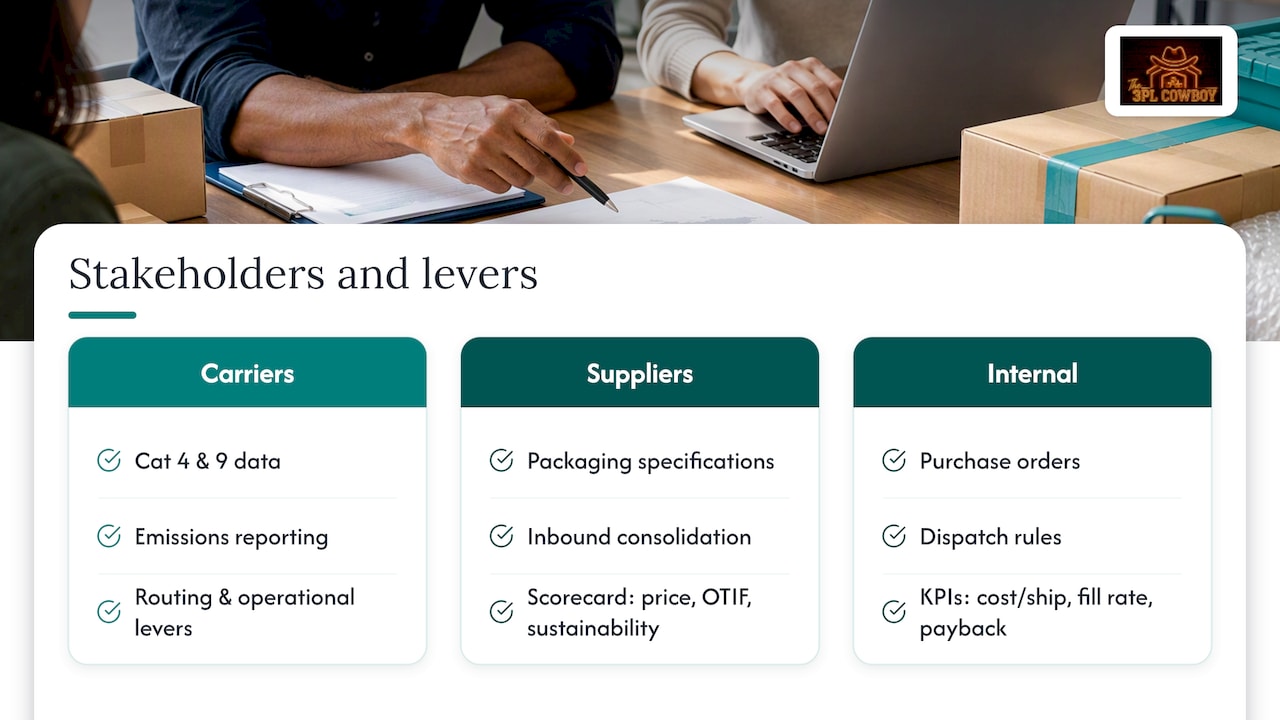
Internal alignment is often the hardest part, since procurement, operations, and finance teams rarely share the same incentives. Procurement is measured on unit cost, operations on service levels, and finance on capital efficiency, and a sustainability initiative that only speaks to one of those functions tends to stall. Framing pilots in terms all three teams recognize, cost per shipment, fill rate, and capital payback, keeps the conversation moving instead of getting stuck in a values debate.
Joint investment works better than one-sided pressure. Sharing the cost of a pilot with a key carrier or supplier, splitting the upside of fuel savings, or co-funding a packaging redesign builds the kind of long-term relationship that survives a single bad quarter, which annual lowest-bid contracts rarely do.
Where blockchain and IoT fit beyond routing software
AI-driven routing and visibility tools get most of the attention, but two other technologies are changing how transport emissions data gets collected and verified. Blockchain-based tracking creates a shared, tamper-resistant record of custody and transit data across multiple carriers and intermediaries, which matters for category 4 and 9 reporting because it reduces the back-and-forth needed to reconcile conflicting shipment records between a shipper and its carriers.
IoT sensors on trailers, containers, and even individual pallets provide real-time fuel consumption, location, and idle-time data instead of the estimated averages most emissions inventories rely on. That granularity turns a quarterly estimate into something closer to an actual measurement, and it surfaces inefficiencies, like excessive idling or underutilized trailer space, that a spend-based screening approach would never catch.
Neither technology replaces the measurement framework described earlier. Blockchain and IoT improve the quality and verifiability of the activity data that gets fed into GHG Protocol calculations, but the calculation methods themselves still come from the Protocol’s Scope 3 guidance. Leaders evaluating these tools should treat them as data infrastructure investments that make existing Scope 3 reporting more accurate, not as sustainability programs in their own right. A mid-size shipper with a handful of core lanes may get more value from a focused IoT pilot on its highest-volume trailers than from a broad blockchain rollout across every supplier relationship.
How regulation is reshaping freight and warehouse decisions
Disclosure requirements are tightening in multiple jurisdictions, and the direction is consistent even where the specifics differ: more companies are being asked to report Scope 3 emissions, including the transport and distribution categories that logistics teams control. Some of that pressure comes directly from regulators, and some comes indirectly, through customers who face their own disclosure obligations and pass the data request down their supply chain.
For logistics leaders, the practical effect is the same regardless of which rule triggers it: carrier and supplier data requests are becoming standard parts of contract renewal, not occasional audits. Building a Scope 3 measurement process now, using the GHG Protocol’s category 4 and 9 methods and tools like the SmartWay Shipper Tool, puts a company ahead of a disclosure request rather than scrambling to produce one under deadline.
Regional rules vary enough that leaders should treat this section as a signal to watch, not a compliance checklist to follow blindly. The safest approach is building measurement capability that satisfies the most rigorous disclosure framework a company might face, since a robust Scope 3 inventory built on recognized methodology tends to satisfy lighter requirements automatically. Leaders operating across multiple regions should confirm current requirements with legal counsel or a compliance specialist rather than relying on general guidance, since rules continue to evolve and enforcement varies by jurisdiction.
Paying for it: incentives, funding, and investment structures
Capital cost is the most common reason sustainability pilots stall before they start, and the good news is that fewer of them require full self-funding than leaders assume. Vehicle electrification costs, in particular, are trending down: DOE’s incremental cost analysis documents falling battery and component costs that improve the total-cost-of-ownership math for electrified fleets across several vehicle classes, which changes the payback timeline leaders should expect when they model a pilot today versus two years ago.
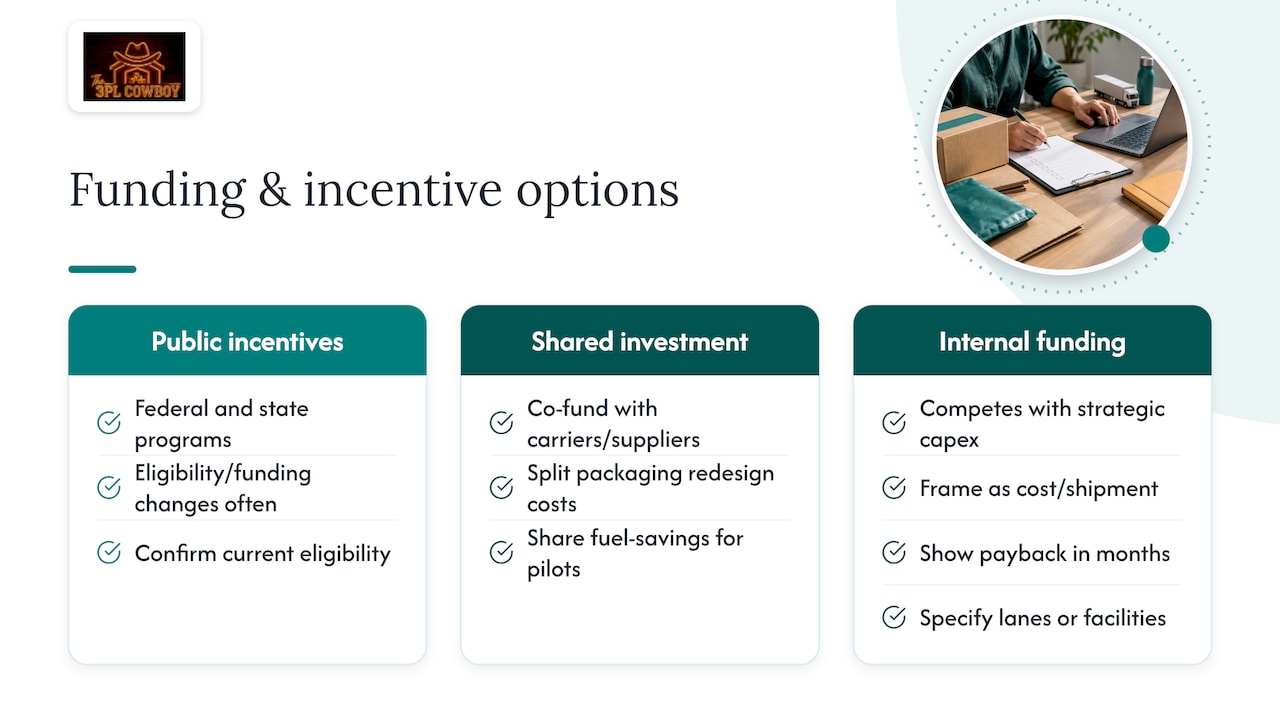
Government incentive programs for clean vehicles and infrastructure exist at federal and state levels in the United States, though eligibility and funding levels change frequently enough that leaders should confirm current program details directly with the relevant agency before building a pilot budget around them. Beyond public incentives, shared investment structures with carriers and suppliers reduce the capital a single company needs to commit. Splitting the cost of a packaging redesign with a key supplier, or co-funding a route optimization pilot with a core carrier in exchange for a share of the fuel savings, spreads risk without requiring either party to carry the full bet.
Internal capital allocation matters just as much as external funding. Pilots that get compared against the full capital budget of a strategic initiative often lose out to projects with clearer, faster payback. Framing a sustainability pilot in the same terms, cost per shipment saved, payback period in months, and the specific lanes or facilities involved, gives it a fair chance against competing capital requests instead of getting filed under a separate sustainability budget line that disappears in a tight year.
Building the internal capability to make it stick
A sustainability program built entirely around new software or new equipment will stall without people who understand why the changes matter and how to execute them correctly. Dispatchers who do not understand why fill rate matters will keep optimizing for on-time delivery alone. Warehouse teams who were never trained on a new slotting system will drift back to old habits within a few weeks.
Training works best when it is tied to the specific operational change rather than delivered as a general sustainability briefing. A dispatcher learning a new routing tool needs to understand the fill-rate and empty-mile metrics the tool reports, not an abstract explanation of Scope 3 categories. A warehouse team adopting a new pick-path design needs hands-on practice on the actual floor, not a slide deck.
Change management matters as much as the training content itself. Pilots that launch without a clear owner, a defined timeline, and a way to measure early results tend to lose momentum once the initial enthusiasm fades. Assigning a single accountable owner for each pilot, reviewing results on a fixed cadence, and publicizing early wins internally, even small ones like a 2% fill-rate improvement on one lane, builds the internal case for scaling the next pilot. Guidance on decommissioning legacy workflows covers the practical steps for retiring old processes without disrupting service during the transition.
Culture change follows capability change, not the other way around. Teams that see a pilot produce a measurable cost or emissions improvement become advocates for the next one; teams that sit through sustainability messaging without seeing operational follow-through tend to tune it out.
Three moves to make this quarter
Screen your lanes for Scope 3 hot spots using spend and ton-miles. Pick one operational lever, load optimization or a packaging redesign, and pilot it on your worst-performing lane. Bring one or two carriers into the conversation for performance data and set a 90-day fill-rate or empty-mile target.
— Michael
How 3PL Cowboy approaches sustainable logistics advisory
We treat sustainability pilots the same way we treat any operational diagnostic: find the lanes and facilities with the worst utilization first, because that is where cost and emissions improvements overlap. Our work in 3PL selection and diligence, distribution network design, parcel and transportation strategy, and fulfillment cost benchmarking comes from 17-plus years running operations for brands like Nike, Walmart, and Kroger, not from theory.

Because we carry no warehouse to fill and no listings to move, our recommendations are built around what actually reduces cost and risk for your freight and fulfillment network. If you are ready to scope a pilot or a network redesign, visit our services page to see where we can help.
FAQ
What is the fastest first step toward sustainability in logistics?
Screen your freight lanes by spend, ton-miles, and distance to find your Scope 3 hot spots before investing in any new equipment or software. This screening step, based on GHG Protocol category 4 and 9 methods, tells you where a pilot will produce the biggest return.
How do Scope 3 categories 4 and 9 apply to logistics?
Category 4 covers upstream transportation and distribution, while category 9 covers downstream transportation and distribution, both representing freight a company purchases rather than operates directly. The GHG Protocol provides the calculation methods for both.
What tools help estimate transport emissions?
The EPA SmartWay Shipper Tool provides emission factors for truck, rail, air, and barge transport and lets shippers compare carrier performance using standardized bins. Many companies pair SmartWay data with GHG Protocol methods to build a credible transport emissions inventory.
Is fleet electrification worth the cost right now?
Electrification economics are improving: DOE’s incremental cost report documents battery and component cost declines that improve the total-cost-of-ownership case across several vehicle classes. It tends to make the most sense on short, predictable routes where charging infrastructure is manageable.
How can a logistics consultant help with sustainability goals?
An operator-led advisory can run diagnostics that prioritize sustainability interventions by utilization and spend, the same way any cost or efficiency audit would. Services like 3PL selection and diligence and distribution network design help identify where emissions and cost reductions overlap before committing capital.
Sources
- Scope 3 Calculation Guidance (GHG Protocol)
- EPA SmartWay program
- DOE incremental cost report for clean vehicles (2025)
- 2024 SmartWay Online Shipper Tool: Technical Documentation (U.S. Version 1.0)