Three things decide whether cross border ecommerce shipping works: clean compliance data, a freight mode that matches your SKU economics, and real landed-cost visibility before you quote a price. Get those wrong and customs delays, margin leaks, and angry WISMO tickets follow. We built this playbook from years running inventory and transportation operations inside brands like Nike and Walmart, not from vendor marketing.
TL;DR:
- Section 321 aggregates parcels sent to one consignee per day, and ACE warnings introduced in January 2025 flag shipments that appear to exceed $800.
- Exporters generally must file Electronic Export Information through AES when a Schedule B value exceeds $2,500; an authorized broker can file on their behalf.
- DDP includes duties and taxes at checkout, preventing delivery surprises; DDU lowers the listed price but leaves customers paying charges on delivery, raising refusal risk.
- Before scaling in a new market, run a 50 to 100 order pilot and track clearance time, delivery timeliness, and WISMO ticket rates.
- Audit the last twenty international shipments across invoice descriptions, HTS codes, and consignee details; mismatches point to clearance risk before volume grows.
Table of Contents
- Shipping Modes and Delivery Options: Air, Ocean, Parcel, and Multimodal
- Customs, Duties, and the Section 321 Changes Reshaping Cross Border Volume
- Documentation and Filings: EEI, Invoices, HTS Codes, and Where Shipments Get Stuck
- Cost Drivers and Landed Cost: Pricing Internationally Without Guessing
- Launching Cross Border Shipping: An Operator’s Step-by-Step Setup
- Packaging and Labeling Requirements for Cross Border Shipments
- Risk Management: Insurance and Liability in Cross Border Shipping
- Warehouse and Fulfillment Location Strategy for Cross Border Operations
- Inventory Positioning to Cut International Shipping Time and Cost
- International Shipping Regulations and Compliance Management
- Common Mistakes We See and the Operator Fix
- How We Help Brands Get Cross Border Shipping Right
- FAQ
- Sources
Shipping Modes and Delivery Options: Air, Ocean, Parcel, and Multimodal
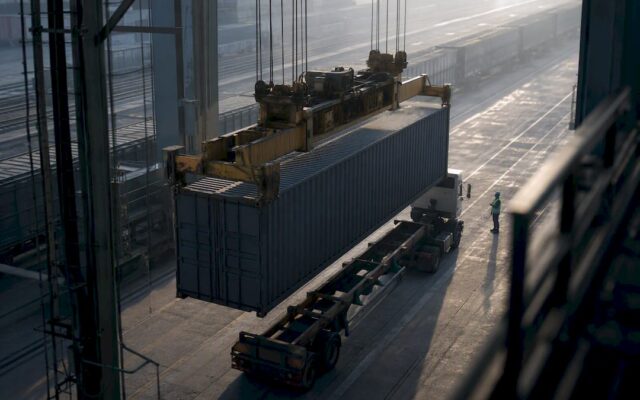
Freight choice is a math problem, not a preference. Ocean freight costs the least per unit but takes weeks, which makes it a fit for restocking bulky, low-margin goods where you can forecast demand. Air freight cuts transit to days at a steep premium, and it earns its cost on high-value, lightweight SKUs or launch inventory where stockouts hurt more than the freight bill. Parcel and express courier networks sit in between: fast, trackable, and priced per shipment, which works for direct-to-consumer orders but gets expensive fast at volume.
Multimodal strategies blend these: ocean for base inventory, air for replenishment spikes, parcel for the final customer-facing leg.
- Ocean becomes cost-effective once shipment size clears a full or partial container and lead time tolerance exceeds two to four weeks.
- Air earns its premium for SKUs with high value density or when a stockout costs more than the freight differential.
- Parcel and courier services fit direct-to-consumer volume but require a local last-mile partner to avoid tracking gaps once the package leaves the originating carrier’s network.
Protect tracking continuity at every handoff. A shipment that disappears from visibility between the international carrier and the local courier is the single biggest driver of “where is my order” tickets.
Customs, Duties, and the Section 321 Changes Reshaping Cross Border Volume
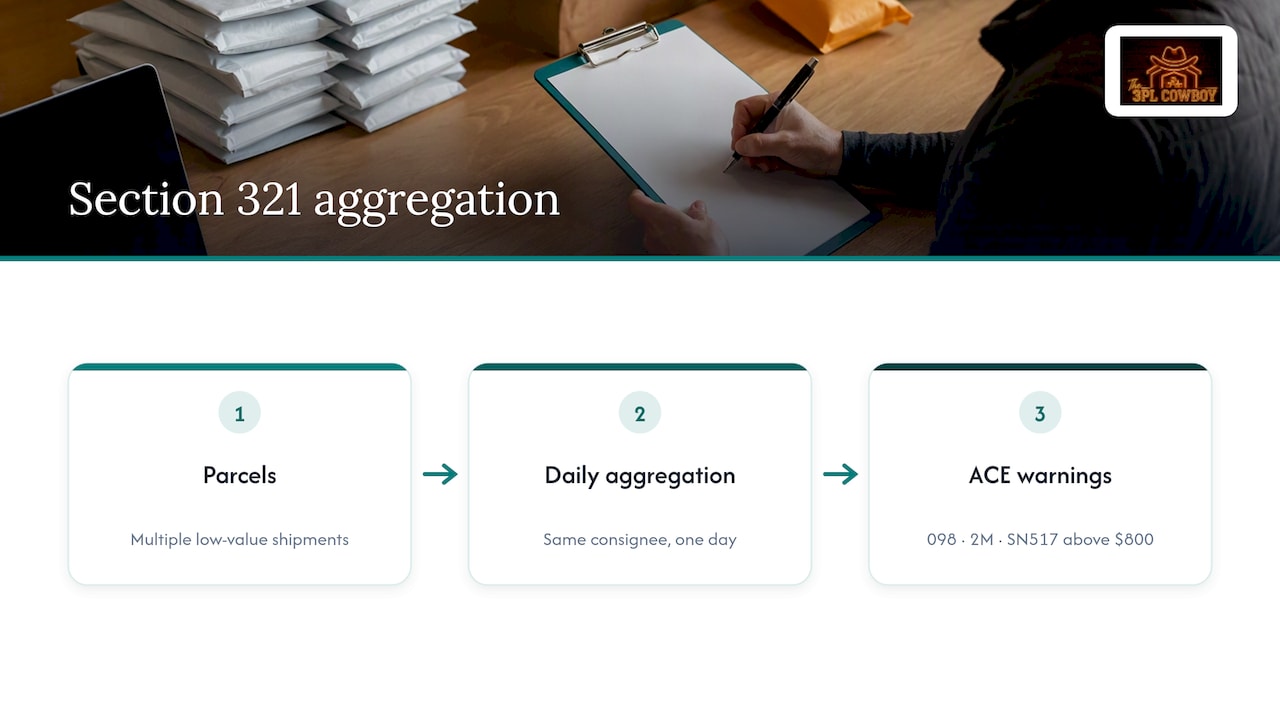
Section 321 sets the de minimis exemption that allows goods valued at $800 or less, per person per day, to enter the United States duty-free. That threshold sounds generous until you realize it aggregates: multiple low-value parcels sent to the same consignee in one day can trip the limit even when each individual shipment looks compliant.
CBP’s ACE Release 2 update now issues warning codes, including Warning Code 098, Disposition code 2M, and SN517, when aggregated de minimis shipments appear to exceed that $800 threshold, and these warnings reached ACE production in January 2025. A later release is expected to allow outright withholding in some cases, which raises the operational stakes for merchants shipping high volumes of small parcels to the same address or through the same forwarder.
The practical fix is unglamorous but effective: monitor how your fulfillment and parcel partners aggregate shipments to a single consignee, coordinate filing practices with your broker or carrier so each entry is annotated correctly, and treat repeated warnings as a signal to audit your consignee data rather than a one-off glitch. Brands running high parcel volume into the same market should build this check into weekly operations, not an annual compliance review.
Documentation and Filings: EEI, Invoices, HTS Codes, and Where Shipments Get Stuck
Most clearance delays trace back to paperwork gaps, not freight problems. Four checks cover most of the risk.
- File Electronic Export Information through AES when a shipment’s value per Schedule B number exceeds $2,500 or another mandatory filing condition applies; a freight forwarder or customs broker can file on your behalf when you authorize it.
- Build a complete commercial invoice and packing list with accurate product descriptions, correct HS or HTS codes, true transaction values, and a stated country of origin for every line item.
- Confirm whether any SKU falls under a Partner Government Agency requirement or needs a certificate of origin before it ships, since missing certificates are a common cause of holds.
- Cross-check HTS classifications against the current Harmonized Tariff Schedule rather than reusing an old code, since misclassification triggers both duty disputes and delays.
Trade outlines the standard set of forms exporters rely on, and matching that list against your own paperwork before the first shipment leaves the warehouse catches most errors early. Document automation tools, including platforms like Docupow’s customs clearance automation, can also reduce the manual entry errors that cause mismatched invoices and filings.
Cost Drivers and Landed Cost: Pricing Internationally Without Guessing
Landed cost is the real number that determines whether an international order is profitable, and it has more moving parts than most merchants budget for.
- Duties and tariffs vary by HS code and destination market, and tools like the Customs Info Database let you check applied rates before you commit to a price.
- VAT or GST applies in most destination markets and changes who is responsible for collection depending on the shipment value and the import model you choose.
- Brokerage and clearance fees add a flat or percentage cost per shipment, and these compound quickly on high parcel volume.
- Dimensional weight and packaging affect freight cost directly, since carriers bill on whichever is greater: actual weight or dimensional weight.
Choosing between Delivered Duty Paid and Delivered Duty Unpaid incoterms is a customer experience decision as much as a financial one. DDP bakes duties and taxes into the checkout price, which avoids surprise charges at delivery and tends to convert better. DDU shifts that cost and complexity to the customer, which lowers your upfront price but raises abandonment risk when the duty bill arrives at the door.
Pro Tip: Run a landed-cost test shipment to each target market before launch, and price your listing off that number, not off your domestic cost plus a flat markup.
Launching Cross Border Shipping: An Operator’s Step-by-Step Setup
Treat international expansion as a sequence, not a single decision.
- Pick one target market based on existing demand signals, not aspiration, and validate that a real customer base already wants the product there.
- Run a landed-cost test on your top SKUs for that market before you commit to pricing or inventory.
- Select a fulfillment approach: ship from your domestic warehouse, use a regional 3PL, or hold forward inventory, based on volume and margin, not convenience.
- Onboard a freight forwarder and customs broker who can speak specifically to your HS code mix and the destination market’s Partner Government Agency requirements.
- Run a small pilot of 50 to 100 orders before scaling, and track clearance time, on-time-in-full delivery, and WISMO ticket rate as your core KPIs.
When vetting a forwarder or broker, ask how they handle ACE filing errors, what their average clearance time looks like for your product category, and whether their systems integrate with your order management platform through EDI or an API rather than manual email updates. Our 3PL selection criteria framework covers the failure modes worth asking about directly.
Pro Tip: Require any forwarder or broker to show you their ACE readiness and HTS lookup process before you sign, not after your first shipment gets flagged.
A multi-carrier platform with HTS lookup built in reduces the manual classification errors that cause most holds, and it gives you one dashboard instead of five logins when something goes wrong mid-transit.
Packaging and Labeling Requirements for Cross Border Shipments
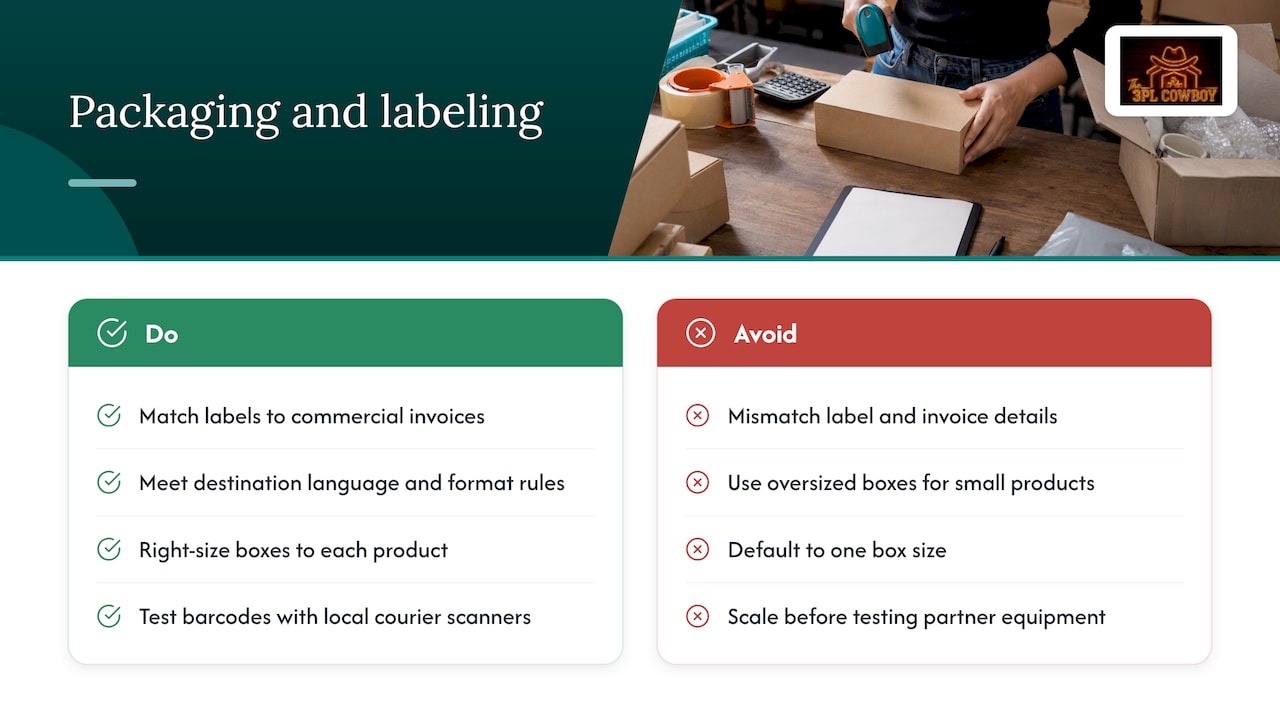
Packaging and labeling mistakes cause a disproportionate share of clearance holds relative to how simple they are to fix. Every international shipment needs a label that matches the commercial invoice exactly: product description, country of origin, weight, and consignee information all have to agree across every document attached to the shipment.
Labels also need to meet the destination market’s language and format requirements, which can include specific text for regulated categories like cosmetics, supplements, or electronics. A mismatch between what the label states and what the invoice declares is one of the fastest ways to trigger a manual customs review.
Packaging itself affects cost as much as compliance. Carriers bill on dimensional weight, so oversized boxes for small products inflate freight cost on every single shipment, not just the occasional one. Right-sizing packaging to the product, rather than defaulting to one box size across your catalog, is one of the more overlooked levers for reducing per-unit freight spend at scale.
Barcode placement and scan readability also matter more internationally than domestically, since a barcode that a local courier’s handheld scanner cannot read forces a manual lookup that slows the last mile. Testing your packaging and labeling against the actual equipment your last-mile partner uses in a target market, before you scale volume there, catches this before it becomes a pattern.
Risk Management: Insurance and Liability in Cross Border Shipping
Liability in cross border ecommerce shipping splits across more parties than a domestic shipment ever does: the originating carrier, the freight forwarder, the customs broker, and the last-mile courier each hold responsibility for a different leg. Knowing where one party’s liability ends and the next begins matters before a shipment is lost or damaged, not after.
Cargo insurance is worth carrying separately from whatever liability a carrier’s standard terms offer, since most carrier liability caps are set low relative to the actual value of a typical e-commerce shipment. Review your freight forwarder’s contract for how claims are handled and what documentation they require, because a claim without a complete commercial invoice and proof of value is far harder to collect on.
Returns add another layer of risk. A damaged or undeliverable international return can cost more to bring back than the product is worth, so building a clear policy for when to abandon, donate, or dispose of a return in-market, rather than ship it home automatically, protects margin on the back end of the transaction.
Sanctions and restricted-party screening belong in this same risk conversation. Screening both your customer list and any new distribution partner against restricted-party lists before shipping is a basic safeguard, not an optional step, especially as you expand into new markets with less familiar regulatory exposure.
Warehouse and Fulfillment Location Strategy for Cross Border Operations
Where you hold inventory shapes your cross border shipping economics more than almost any other single decision. A warehouse positioned near a major port, rail hub, and highway corridor shortens the first mile into international freight lanes and gives you more carrier options at better rates.
Forward-positioning inventory inside or near your target market, rather than shipping every order from a domestic facility, cuts transit time dramatically and often reduces per-unit freight cost once volume justifies the fixed cost of a forward location. The tradeoff is working capital: inventory sitting in a forward warehouse is cash tied up before a sale happens, so this decision depends on your order volume and demand predictability in that market.
Evaluating a market for a forward fulfillment location means weighing port access, rail and highway connectivity, labor availability, and the warehouse fundamentals of the local real estate market, the same framework we apply when assessing any of the distribution markets we cover across the United States, Canada, and Mexico. A location decision made for a different reason, like chasing the lowest warehouse rate, often costs more later in degraded transit times and higher parcel surcharges.
Inventory Positioning to Cut International Shipping Time and Cost
Inventory positioning and freight mode are two sides of the same decision. Holding safety stock closer to demand lets you shift volume from air to ocean or ground, which lowers cost without sacrificing delivery speed, because the shorter last-mile distance absorbs the slower long-haul transit time.
Segmenting SKUs by velocity and value helps here: fast-moving, lower-margin products benefit most from forward positioning since freight savings compound across volume, while slow-moving or highly customized SKUs may stay centralized and ship on demand without the carrying cost of distributed inventory. Running this analysis by SKU, rather than applying one network design across the whole catalog, usually surfaces meaningful savings that a blanket policy misses.
Demand forecasting accuracy matters more once inventory is distributed across multiple locations, since a stockout at a forward location forces an expensive expedited transfer or a slower fallback shipment from the home market. Building that forecasting discipline before expanding to a second or third forward location prevents a common and costly mistake: a network that looks efficient on paper but behaves like three separate inventory problems in practice.
International Shipping Regulations and Compliance Management
Compliance in cross border ecommerce shipping covers more than duties and documentation. Restricted and prohibited goods lists vary by destination market, and a product that ships freely domestically can be flagged, held, or seized entirely in another country, which makes a per-market restricted goods review a standard step before listing any SKU internationally.
Trade sanctions add a layer that changes faster than most merchants track. Screening customers, distribution partners, and even the countries you route shipments through against current sanctions programs protects you from inadvertent violations that carry real legal exposure, not just a delayed shipment.
Regulatory requirements also shift over time. CBP’s e-commerce guidance notes changes to mail informal entry processing and new entry type testing that affect how low-value parcels move through postal channels, which means a compliance process built once and never revisited tends to drift out of date. Building a quarterly review of the regulations touching your top shipping lanes, rather than treating compliance as a one-time setup task, keeps your filings and classifications aligned with current rules instead of last year’s.
Common Mistakes We See and the Operator Fix
The most common failure is a mismatched commercial invoice: a description or value that does not match the HS code filed. The fix is a data-integrity audit, not a new vendor. Run one audit this week: pull your last twenty international shipments and check invoice, HTS code, and consignee data against each other. If more than a couple mismatch, that is your biggest clearance risk today.
— Michael
How We Help Brands Get Cross Border Shipping Right
Cross border shipping decisions, from freight mode to forward inventory to broker selection, compound fast, and getting one piece wrong usually means paying for it on every shipment afterward. We work directly with brands on International Expansion and Parcel & Transportation Strategy, applying the same underwriting-grade diligence we’d use evaluating a domestic 3PL to the specific risks in Section 321 readiness, broker fit, and network design.

If you are weighing a new market, a new forwarder, or whether your current setup can handle the volume you are planning, see our full services and book a conversation before your next peak season, not after it.
FAQ
What is the de minimis threshold for cross border shipping?
The de minimis exemption under Section 321 allows goods valued at $800 or less, per person per day, to enter duty-free. Multiple shipments to the same consignee in one day count toward that total, so high parcel volume to one address can exceed the threshold even if each parcel looks compliant on its own.
When is EEI filing required for an export shipment?
Electronic Export Information filing through AES is commonly required when the value per Schedule B number exceeds $2,500, or when another mandatory filing condition applies. A freight forwarder or customs broker can file on your behalf once you authorize them to do so.
Should I use DDP or DDU for international ecommerce orders?
Delivered Duty Paid bakes duties and taxes into the checkout price, which avoids surprise charges at the door and tends to improve conversion and delivery satisfaction. Delivered Duty Unpaid shifts that cost to the customer at delivery, which lowers your listed price but raises the risk of refused packages and abandoned orders.
What causes most customs delays in ecommerce shipments?
Mismatches between the commercial invoice, the HS or HTS code filed, and the declared value cause the majority of holds. Reviewing invoice accuracy and HTS classification against the current tariff schedule before shipping resolves most of this risk before it reaches a border.
How do I calculate landed cost for a new international market?
Landed cost adds duties, taxes like VAT or GST, brokerage fees, and freight to your product cost, and tools like the Customs Info Database let you check applicable rates for a specific market. Running a real test shipment before launch gives a more reliable number than estimating from a spreadsheet alone.