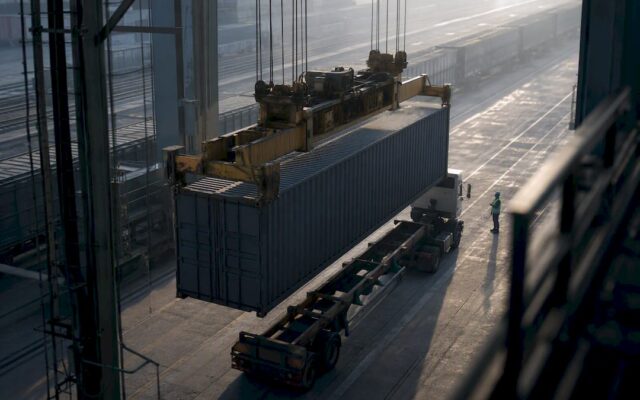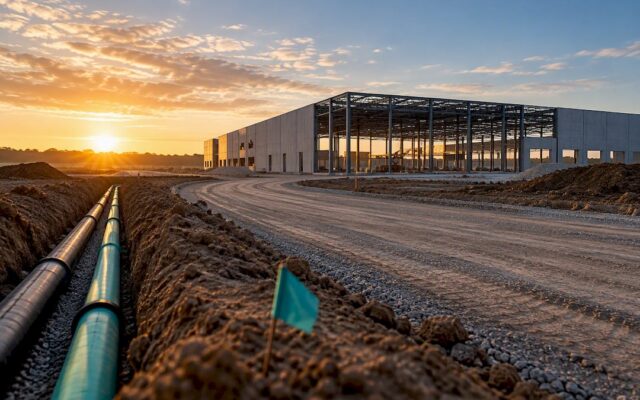
A micro fulfillment center is a compact, software-driven node, usually under 15,000 square feet, that stashes your top-selling SKUs close to dense customer clusters so orders ship same-day or next-day instead of riding a truck across the region. It earns its keep when ZIP-level order density and SKU velocity are both high; below that threshold, a traditional distribution center still wins on cost.
TL;DR:
- Micro fulfillment centers are most effective in densely populated ZIP codes with high order volume and fast-moving SKUs, typically supporting small, high-velocity product categories.
- Automation choices, such as fixed AS/RS or robots-to-goods systems, require real-time WMS-WCS integration, making software orchestration critical for operational success.
- Cost savings of around 40% on last-mile delivery and faster shipping times significantly boost order conversion rates and repeat purchases in high-demand markets.
- Site selection based on ZIP-level demand data is essential, as building in less dense areas or for long-tail SKUs can result in poor ROI and stranded inventory.
- Successful MFC deployment involves careful sequencing, rigorous testing of automation and integration, and starting smaller with at least one full peak cycle to validate unit economics.
Table of Contents
- What Are Micro Fulfillment Centers, and How Big Are They?
- How Do Micro Fulfillment Centers Actually Work?
- What ROI Should You Expect From an MFC?
- When Should You Use a Micro Fulfillment Center (and When Should You Skip It)?
- How Do You Roll Out and Scale a Micro Fulfillment Center?
- What Do Real MFC Rollouts Actually Teach You?
- What Are the Biggest Risks in Running an MFC?
- Where Have Micro Fulfillment Centers Actually Worked?
- What’s Next for Micro Fulfillment Technology?
- Who Are the Key Players Building Micro Fulfillment Infrastructure?
- Pilot Sequencing and the Three Red Flags That Should Stop a Rollout
- How 3PLCowboy Helps You Get MFC Rollouts Right the First Time
- Sources
- FAQ
What Are Micro Fulfillment Centers, and How Big Are They?
A micro fulfillment center runs a fraction of the footprint of a regional DC. Most fall between 3,000 and 15,000 square feet, and they carry a curated slice of a catalog rather than the full assortment sitting in your main warehouse per City National Bank. That size ceiling is the point. You’re not building a warehouse. You’re building a forward cache for the 200 to 2,000 SKUs that actually move.
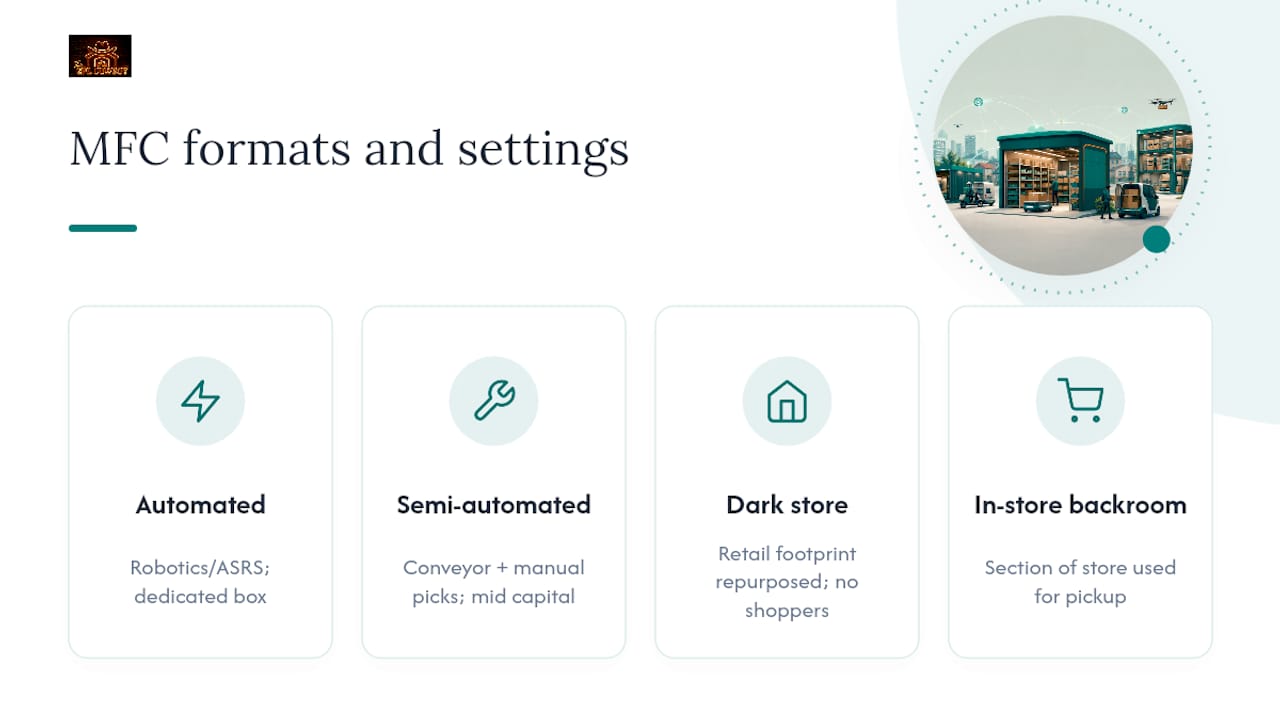
You’ll see three common variants in the field. Automated MFCs run robotics or fixed automated storage and retrieval systems (AS/RS) inside a dedicated box, often tucked behind a grocery store or in a light industrial park. Semi-automated MFCs pair conveyor or pick-to-light systems with manual labor, splitting the difference on capital cost. Dark stores repurpose a retail footprint entirely for fulfillment, no shoppers allowed, while in-store backroom MFCs carve out a section of an existing retail floor plan, which is the model Walgreens and several grocery chains have leaned on for pharmacy and grocery pickup.
The inventory profile is the real tell. An MFC typically holds only 24 to 48 hours of stock for its top-velocity items and depends on daily or near-daily small-batch replenishment from a regional DC, according to ShipBob. That’s a fundamentally different rhythm than a traditional facility running weekly or biweekly truckload replenishment. If your team is used to palletized inbound freight on a two-week cadence, an MFC will feel like running a bodega instead of a Costco.
How Do Micro Fulfillment Centers Actually Work?
The automation layer is where most of the money and most of the risk live. You have three basic architectures to choose from, and they trade flexibility for throughput in different ways.
- Goods-to-person (fixed AS/RS): Cube storage systems bring totes to a picker at a fixed station. High throughput per square foot, but the racking is bolted down and hard to reconfigure when your SKU mix shifts.
- Robots-to-goods (AMR/R2G): Mobile robots navigate to inventory pods and bring them to pickers or pack stations. Locus Robotics notes that R2G fleets preserve flexibility because you can add or remove robots and reslot inventory without ripping out infrastructure, which matters when a promotional SKU spikes for six weeks and then disappears.
- Conveyor and pick-to-light systems: Lower upfront cost, decent throughput, but scaling usually means physical construction, not a software update.
None of that automation is worth much without the orchestration layer underneath it. A warehouse management system (WMS) handles inventory logic and order allocation; a warehouse control system (WCS) talks directly to the robots or conveyors. Exotec makes the case bluntly: MFC operations succeed or fail based on whether the WMS and WCS integrate in real time, because a system that rebalances inventory and reroutes tasks a few minutes late creates a backlog that snowballs during peak hours. If you want a deeper primer on how that inventory visibility should work across multiple nodes, USI Prep’s breakdown of cross-facility tracking is worth the read before you sign a vendor contract.
Throughput scales differently depending on the architecture: a well-tuned R2G fleet in a 10,000 square foot box can typically outpace a comparably sized conveyor system on order variability, though fixed AS/RS still wins on raw picks-per-hour for a stable, narrow SKU set.
What ROI Should You Expect From an MFC?
The business case rests on three levers: last-mile cost, delivery speed, and inventory efficiency. Move any one of those and your unit economics change fast.
The numbers that matter: Brands running MFC networks with disciplined, data-driven site selection report last-mile cost reductions averaging around 40%, alongside delivery windows that shrink from multi-day to same-day, according to industry coverage of MFC economics.
That cost reduction isn’t abstract. Last-mile delivery is routinely the most expensive leg of the fulfillment chain, and shaving 40% off it changes whether same-day delivery is a loss leader or a margin driver. Faster delivery also tends to lift conversion and repeat purchase rates on category pages where shoppers compare delivery promises before checkout.
The KPIs worth tracking from week one:
- Cost per order, isolated by node so you can compare the MFC against your regional DC on an apples-to-apples basis.
- Order-to-door time, measured from click to doorstep, not click to ship.
- Inventory turns, which should run considerably higher in an MFC than in a DC given the 24 to 48 hour holding window.
Setup costs vary enormously with automation choice and real estate. Industry estimates put a full build somewhere between $180,000 and $650,000 per location depending on how much robotics you install and what the local lease market looks like, per that same industry analysis. A fulfillment cost analysis that models your actual order density and per-unit shipping cost against that capital range will tell you faster than any vendor pitch whether the payback math works for your catalog.
When Should You Use a Micro Fulfillment Center (and When Should You Skip It)?
Density beats proximity every time. The strongest ROI signal isn’t “close to a lot of customers.” It’s a market where population density exceeds roughly 2,000 people per square mile and your order volume in that ZIP code is genuinely high, according to the same MFC economics research. Plenty of suburban markets look dense on a map and still can’t support a node once you pull the actual order-per-ZIP data.
Run this checklist before you commit real estate dollars:
- Demand density: Pull ZIP-level order heat maps, not just census population figures, before picking a site.
- SKU velocity and size: MFCs favor small, fast-moving units, think beauty, apparel basics, health and wellness, and grocery staples, not bulky furniture or pallet-scale CPG.
- Category fit: High-return categories, items under warranty programs, and B2B bulk orders usually still belong in a traditional DC where reverse logistics and case-pick operations are already built out.
- Order frequency, not just order count: A market with 500 sporadic orders a month behaves very differently than 500 orders concentrated in three ZIP codes.
If your catalog leans long-tail or your average order includes six different categories, an MFC will strand inventory rather than move it. A proper distribution network design exercise, mapping every node against real ZIP-level demand rather than a gut-feel map, catches that mismatch before you sign a lease.
How Do You Roll Out and Scale a Micro Fulfillment Center?
Sequencing matters more than most teams expect. Skip a step here and you’ll find out during peak season, which is the worst possible time to discover it.
- Choose real estate: build versus retrofit. A retrofit of existing backroom or dark-store space is faster and cheaper to launch; a purpose-built box gives you cleaner automation integration but takes longer to permit and construct.
- Set replenishment cadence and safety stock rules. Design reorder points around 24 to 48 hours of on-hand inventory, not the multi-day buffer your regional DC uses, since MFC replenishment runs on daily small-batch shipments rather than palletized truckloads.
- Vet automation and software vendors hard. Test WMS-WCS integration under real order volume before you sign, confirm SLA commitments in writing, and compare CapEx-heavy fixed automation against robotics-as-a-service models that lower upfront cost and speed deployment, per NetSuite’s warehouse automation overview. A structured warehouse RFP process keeps vendors honest during this stage.
- Build cutover and peak controls. Run phantom inventory test scenarios before go-live, document a rollback plan, and stress-test the peak scaling plan against last year’s highest order day, not an average week.
Pro Tip: Run your first cutover test with WMS and WCS reconciliation reports side by side for at least 72 hours before flipping live orders. Discrepancies that look like rounding errors on day one usually turn into phantom stock by day thirty, and that’s exactly where ERP-WMS integration gaps tend to hide.
What Do Real MFC Rollouts Actually Teach You?
Numbers from the field beat vendor slide decks every time. It happened because someone audited the reconciliation process line by line. A pallet-program redesign that delivered $6 million in annual savings for Kroger came from the same instinct: question the default, model the actual flow, don’t trust the pitch deck.
Ask any MFC vendor or 3PL these questions before signing:
- What’s your actual WMS-WCS integration latency under peak load, not average load?
- Can you show a live reconciliation report from a comparable SKU count to mine?
- What happens to my replenishment cadence if my top 20 SKUs change next quarter?
The pattern that repeats: pilots succeed when the software integration gets tested under real volume before go-live, and they stall when a team assumes the automation vendor’s default WMS connector “just works.” An 8-month WMS rollout across 60-plus Sysco sites reinforced one lesson above all others: integration testing is never the step to rush.
What Are the Biggest Risks in Running an MFC?
Space constraints hit first. A 5,000 square foot box leaves almost no margin for error in slotting, and a single miscalculated SKU velocity forecast can leave you overstocked on slow movers while your fast movers stock out mid-week. Because MFCs run lean on square footage, there’s rarely room to just add a shelf.
Labor is the second friction point. Semi-automated MFCs need workers comfortable moving between manual picking and machine-assisted stations, and that skill set isn’t the same as traditional warehouse labor. Turnover in a small facility hits harder than turnover in a 500,000 square foot DC, because there’s no depth on the bench to absorb it.
Technology integration is where most timelines slip. A WMS that talks cleanly to your ERP in your main DC may choke on the real-time rebalancing demands of an automated MFC, especially if the automation vendor’s WCS wasn’t designed with your specific WMS in mind. That mismatch rarely shows up in a demo. It shows up three weeks into live operations when inventory counts drift.
Then there’s the density risk nobody likes to say out loud: build in the wrong ZIP code and you’ve built a very expensive, very small warehouse with regional DC problems and none of the last-mile upside. Site selection mistakes are expensive to unwind because the automation inside is rarely portable without significant cost.
Where Have Micro Fulfillment Centers Actually Worked?
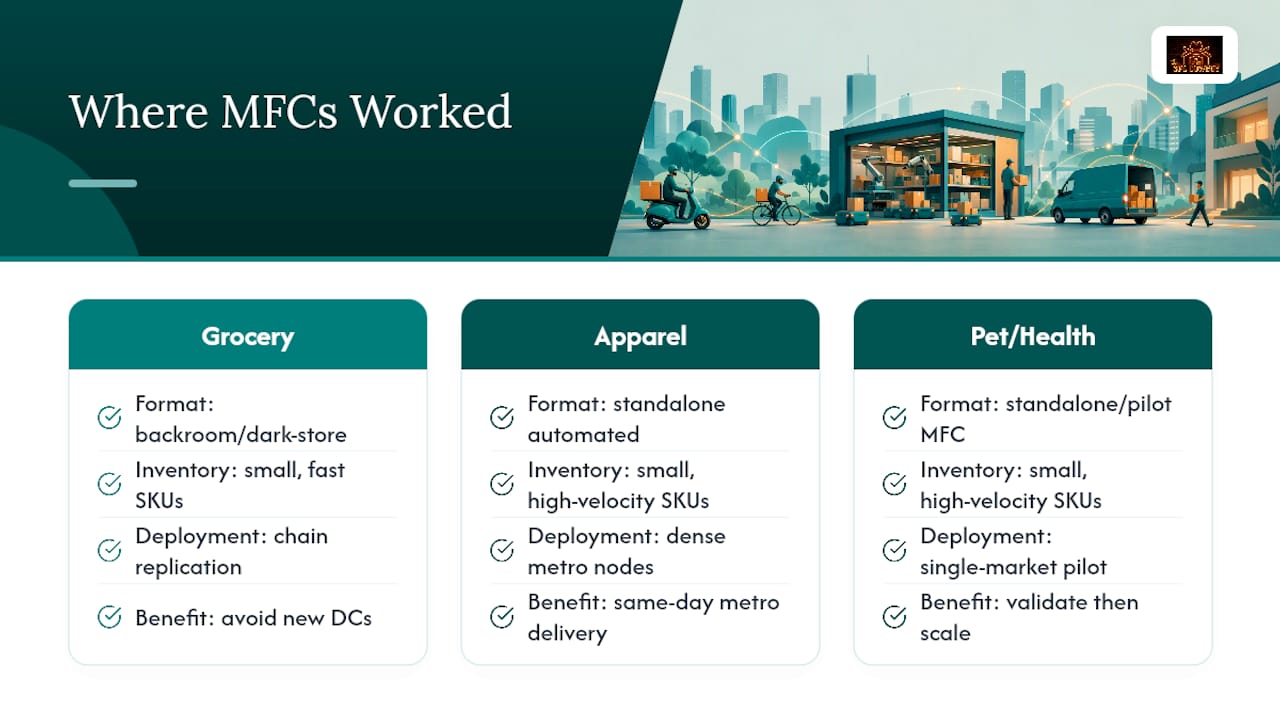
Grocery and pharmacy retail moved first and moved hardest. Backroom and dark-store MFC formats let chains fulfill online grocery and pharmacy orders from existing real estate instead of building new distribution capacity from scratch, which is largely why the model spread through that sector faster than through general retail.
Apparel and beauty brands have leaned on standalone automated MFCs sited in dense metro markets, betting on small-unit, high-velocity SKUs, exactly the profile that plays to an MFC’s strengths. A beauty brand carrying a tight core assortment of best-sellers can hold 24 to 48 hours of that assortment in a compact automated node and hit same-day delivery in a metro area without touching its main DC’s slower-moving long-tail inventory.
Pet and health and wellness brands have followed a similar path, often piloting a single MFC in their highest-density metro before deciding whether to scale the network. That single-market pilot approach shows up again and again as the pattern that works: prove the unit economics in one dense ZIP cluster, then replicate the playbook rather than building five nodes simultaneously on a hope.
The common thread across every sector that’s made this work isn’t the automation brand or the building size. It’s that the category fit, small, fast-moving, low-return SKUs, matched the format from day one.
What’s Next for Micro Fulfillment Technology?
AI-driven demand forecasting is moving from a nice-to-have to table stakes for MFC replenishment. Because these nodes hold only 24 to 48 hours of stock, a forecasting miss shows up as an out-of-stock within a day or two, not a week, which is pushing operators toward tighter, more automated reorder triggers than a traditional DC ever needed.
Robotics are also getting more modular. The R2G approach that already beats fixed AS/RS on flexibility is trending toward smaller, cheaper robot fleets that a mid-size brand can afford without the capital commitment that automated MFCs required just a few years ago. Robotics-as-a-service commercial models are accelerating that shift by turning a large upfront purchase into an operating expense.
Omnichannel integration is the other clear direction. The line between a dark store, a backroom MFC, and a curbside pickup point is blurring, with more retailers designing a single node to serve ship-to-home, buy-online-pickup-in-store, and same-day delivery out of the same small footprint. That flexibility raises the bar on software orchestration, since one facility now has to juggle three fulfillment paths instead of one, which is exactly where WMS-WCS integration quality will separate the operators who scale cleanly from the ones who stall.
Who Are the Key Players Building Micro Fulfillment Infrastructure?
The MFC ecosystem splits into a few functional categories, and understanding which one you’re evaluating matters more than any single vendor name. Robotics providers build the physical automation, whether that’s fixed AS/RS cube storage or mobile robot fleets like the R2G systems Locus Robotics builds. WMS and WCS software providers build the orchestration layer that tells the robots what to do and reconciles inventory in real time, a category Exotec operates in alongside dedicated warehouse software vendors.
Real estate and site selection firms round out the picture, since finding the right small-footprint industrial or retail-adjacent space in a dense ZIP code is its own specialized skill, distinct from either the robotics or the software side.
No single vendor category covers all three functions well, which is exactly why so many MFC rollouts stumble: a brand picks a strong robotics partner and assumes the software integration will be simple, or picks strong WMS software and underestimates the real estate search timeline. Running a structured warehouse RFP that scores vendors across all three categories, rather than falling for whichever one pitches hardest, is the difference between a coordinated rollout and a stitched-together mess.
Pilot Sequencing and the Three Red Flags That Should Stop a Rollout
Start smaller than feels comfortable. One MFC, one dense metro, a measurement window of at least one full peak cycle, not just a quiet quarter, tells you more than five simultaneous pilots ever will.
Three things should stop a rollout cold: fixed automation locked into a SKU mix that changes quarterly, no real-time inventory visibility between the MFC and your regional DC, and vendor SLA language too vague to hold anyone accountable. Any diligence process should preserve the option to walk away before capital gets committed, not after.
— Michael
How 3PLCowboy Helps You Get MFC Rollouts Right the First Time
An experienced supply chain advisory is the difference between piloting an MFC on a vendor’s sales promises and piloting one on numbers you’ve actually stress-tested. Most brands evaluating micro fulfillment centers get their site selection, automation comparisons, and cost models from the same people trying to sell them the equipment.

3plcowboy runs this diligence from the other side of the table, with operator experience across Nike, Walmart, DHL, FedEx, Kellogg’s, and Peloton informing every recommendation. That means 3PL selection and diligence work that stress-tests a vendor’s WMS-WCS integration claims before you sign anything, plus distribution network design that models your actual ZIP-level order density instead of guessing at it from a map. A typical MFC diligence engagement runs through site economics, automation fit, and vendor SLA review before you commit capital, providing a documented case instead of a gut call. If you’re weighing a pilot MFC against your current network, start with a conversation about 3PL selection and diligence to see where the real numbers land.
Sources
- What Are Micro Fulfillment Centers? | City National Bank
- Locus Array – Locus Robotics
- Everything to know about micro-fulfillment automation | Exotec
- Micro-Fulfillment Centers Are Reshaping Last-Mile Economics in 2026 – Online Store News
FAQ
What Is a Walgreens Micro Fulfillment Center?
Walgreens has used in-store backroom MFC formats to fulfill pharmacy and grocery-adjacent online orders directly from existing retail locations, avoiding the cost of building separate distribution capacity.
What Does a Fulfillment Center Do?
A fulfillment center receives, stores, picks, packs, and ships customer orders on behalf of a retailer or brand, functioning as the operational hub between inventory and the customer’s doorstep.
What Is an FC at Amazon?
At Amazon, “FC” refers to a fulfillment center, a large facility that stores broad inventory and processes customer orders; it’s distinct from the compact, high-velocity model of a micro fulfillment center.
What’s the Difference Between a Warehouse and a Fulfillment Center?
A warehouse primarily stores inventory for extended periods, while a fulfillment center is built around processing and shipping individual customer orders quickly, which is the same order-centric logic that drives micro fulfillment center design at a smaller scale.
How Do I Know if My Business Is Ready for an MFC Pilot?
You need high order density in a specific ZIP cluster and a catalog of small, fast-moving SKUs; a supply chain assessment can confirm whether your data actually supports the investment before you commit to real estate or automation.