
Walmart’s commonly cited OTIF thresholds are 98% for Collect Ready shipments, 90% for Prepaid on-time delivery, and 95% In-Full, with non-compliant cases typically hit at 3% of applicable cost of goods sold. A key improvement is automating the WMS/ERP-to-EDI pipeline to ensure accurate and timely ASNs, combined with strict policies to confirm purchase orders only when inventory is physically available. Every supplier’s exact numbers and penalty terms live in Retail Link, and that’s the only place to confirm what applies to your account.
TL;DR:
- Automate ASN generation through WMS and ERP systems to prevent late or incorrect ASNs, which are a leading cause of OTIF failures.
- Enforce strict PO confirmation rules based on real-time inventory to eliminate phantom confirmations and reduce in-full penalties.
- Review OTIF scorecards weekly by split categories and cross-reference with documentation logs to quickly identify root causes of failures.
- Prioritize fixing the highest-dollar root causes, such as ASN automation and PO confirmation, within the first six weeks for rapid improvement.
- Dispute chargebacks promptly with comprehensive documentation, focusing on cases where delays are outside your control to maximize win chances.
Table of Contents
- What Walmart OTIF Compliance Actually Measures
- Why OTIF Failures Cost More Than the Penalty Line Item
- Common Causes of OTIF Failures and How to Diagnose Them
- The Prevention Checklist That Actually Moves the Scorecard
- How to Dispute an OTIF Chargeback and Actually Win
- Supplier Audits and What Your Color Rating Means
- Tracking OTIF Performance Inside Retail Link, Step by Step
- Beyond Documentation: Winning the Appeal, Not Just Filing It
- Getting Logistics, Warehouse, and Sales on the Same OTIF Page
- A Sample OTIF Improvement Plan That Shows Real Movement
- Practitioner Perspective: Quick Wins and Blind Spots
- How 3PL Cowboy Cuts Through OTIF Penalty Chaos
- Sources
What Walmart OTIF Compliance Actually Measures
OTIF compliance runs on binary case-level logic. Each case on a purchase order either arrives on time and in full, or it doesn’t. There’s no partial credit inside a shipment. Walmart tracks this two different ways depending on how the freight moves.
Collect Ready shipments, where Walmart’s carrier picks up from your dock, get measured at pickup readiness. If your product isn’t staged and confirmed by the appointment window, it’s late, regardless of when the truck eventually shows up.
Prepaid shipments, where you control the carrier, get measured against the Must Arrive By Date (MABD) at the destination. Arrive after that date and the case is late. Arrive too early, and depending on the DC’s receiving rules, that can also flag as noncompliant because it disrupts dock scheduling.
In-Full gets measured at the case level against the confirmed quantity on the PO, not the original order quantity. That’s why PO confirmation discipline matters as much as the physical shipment itself.
Why OTIF Failures Cost More Than the Penalty Line Item
A miss on OTIF triggers a penalty commonly cited at 3% of the cost of goods sold on the noncompliant cases, and that number compounds fast across high-volume POs. A single late truck on a $200,000 order isn’t a rounding error. It’s real money, applied automatically, with no manual review before the deduction hits.
The scorecard risk runs deeper than the chargeback itself. Repeated misses accumulate into strikes, and Walmart’s Standards for Suppliers treat sustained non-compliance as grounds for suspension or termination. OTIF rarely fails in isolation, either. A late or malformed ASN can simultaneously trip SQEP flags and ASN accuracy penalties, so one operational gap stacks three separate deductions on the same shipment.
Common Causes of OTIF Failures and How to Diagnose Them
Every OTIF miss has a fingerprint. Match the chargeback type to the operational failure, and the fix is usually obvious.
- Late or manually keyed ASNs: even a truck that arrives on schedule can register as an on-time failure if the ASN goes out late or contains bad data. Fix: automate ASN generation straight from your WMS and log every transmission timestamp.
- Confirming POs against phantom inventory: sales or customer service confirms a quantity the warehouse can’t actually pull. Fix: lock PO confirmation to a real-time inventory feed, no exceptions.
- Pickup readiness failures on Collect POs: product isn’t staged when the carrier arrives. Fix: written carrier SLAs, a staging checklist, and timestamped photos or scans as proof.
- Carrier transit delays and routing errors: freight moves late or gets misrouted after it leaves your dock. Fix: build transit-time cushions into MABD planning and score carriers on a rolling basis.
- Receiving and DC scanning errors: the shipment arrived fine but the DC’s scan data disagrees with your paperwork. Fix: regular receiving audits and BOL/POD reconciliation.
Pro Tip: Pull your last 90 days of OTIF deductions and tag each one by root cause before you fix anything. Most teams find that two or three causes drive 80% of the dollars, and that’s where the fix belongs first.
The Prevention Checklist That Actually Moves the Scorecard
Fixing OTIF isn’t about working harder. It’s about closing the specific gaps that generate deductions, in order of dollar impact.
- Integrate WMS/ERP with EDI so ASNs generate automatically the moment a shipment is picked, packed, and sealed. Manual ASN entry is the single most avoidable cause of on-time misses.
- Enforce a strict “do not confirm unless physically available” rule on every PO. This one policy change eliminates a huge share of in-full penalties before they happen.
- Review the Retail Link OTIF scorecard weekly, not monthly. The dispute window closes fast, and weekly reviews catch patterns before they repeat across three more POs.
- Follow TSCP/Confirm Shipment timing rules for Collect orders, confirming by the documented deadline (commonly 4:00 PM Central time the next calendar day) and automating that confirmation wherever your systems allow.
- Build staging and pickup accountability, with timestamped evidence for every Collect shipment and a documented contingency plan for overflow volume.
- Run a cycle-counting program tied directly to PO confirmation logic, so the number sales confirms matches what’s actually on the shelf.
- Assign clear ownership through a RACI structure for confirmations, staging, dispute filing, and root-cause follow-through, so no chargeback falls into a gap between departments.
Pro Tip: If you only fix one thing this quarter, fix the confirmation rule. It’s the cheapest control on this list and it prevents both in-full misses and the phantom-inventory disputes that eat weeks of admin time.
How to Dispute an OTIF Chargeback and Actually Win
Suppliers generally have a limited timeframe to dispute OTIF deductions through the applicable dispute portal in Retail Link. Miss that window and the deduction stands, no matter how strong your evidence is.
Documentation wins disputes, and specific documentation wins them faster:
- The original purchase order with the confirmed quantity
- A signed BOL or POD with legible timestamps
- Appointment confirmation records for Collect shipments
- Carrier pickup and delivery scan history
- ASN/EDI transmission logs showing send time and content
The strongest disputes show the miss was outside your control, like a carrier delay despite an on-time appointment. Build a habit of auto-linking every deduction to its shipment file the day it posts, prioritize disputes by dollar value first, and feed every resolved case back into your root-cause log so the same miss doesn’t happen twice.
Supplier Audits and What Your Color Rating Means
Suppliers are responsible for scheduling and paying for Supply Chain Security audits, whether through Walmart’s own program or an approved third party. Facilities land in one of three color ratings: Yellow for minor findings, Orange for moderate risk requiring faster remediation, and Red for serious violations that can pause production approval entirely.
Your rating sets your re-audit cadence. A Red facility gets re-checked far sooner than a Yellow one, and repeat findings escalate consequences under the Standards for Suppliers. Staying audit-ready year-round, not just before a scheduled visit, is the only way to avoid a surprise inactivation that stalls shipments right when your OTIF numbers are already under pressure.
Tracking OTIF Performance Inside Retail Link, Step by Step
Retail Link is where the real numbers live, and most suppliers under-use it. Here’s the workflow that actually keeps you ahead of penalties instead of reacting to them.
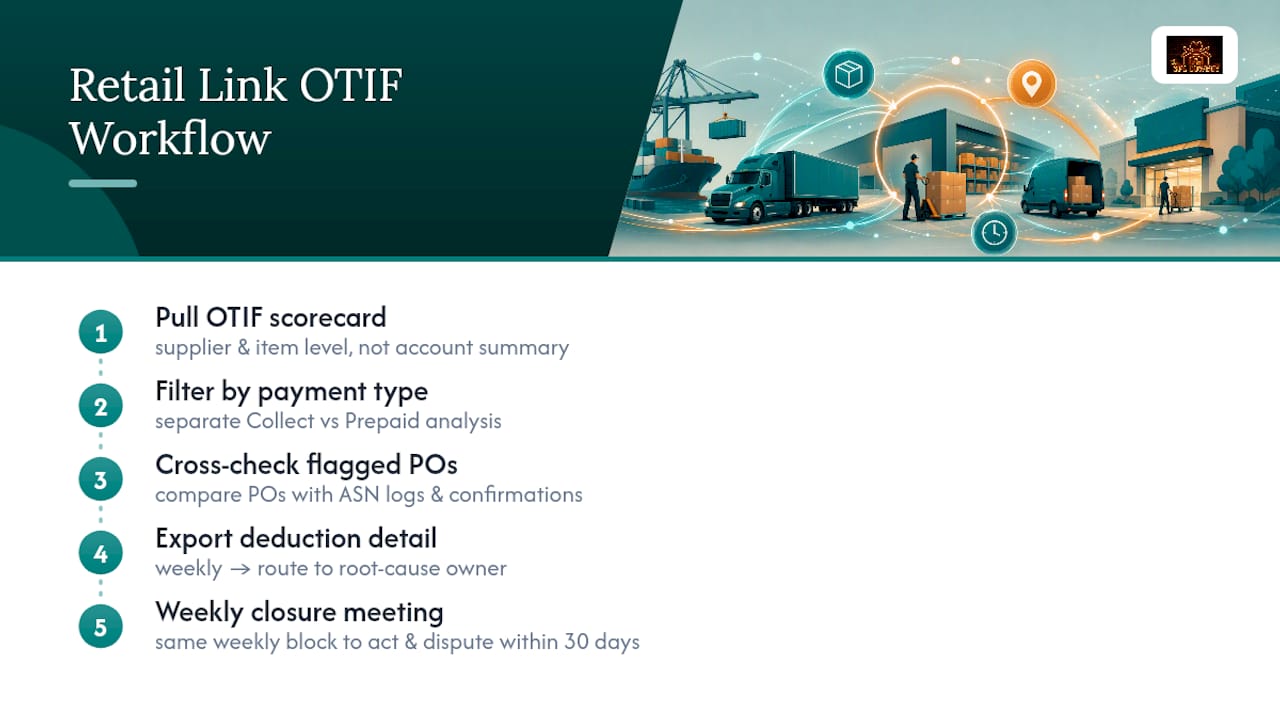
Step one: Log into Retail Link and pull the OTIF scorecard at the supplier and item level, not just the account-wide summary. Aggregate numbers hide which DC or product line is actually dragging performance down.
Step two: Filter by Collect versus Prepaid separately. Because the thresholds and failure modes differ, blending them into one number obscures whether your problem is staging or transit.
Step three: Cross-reference flagged POs against your ASN transmission logs and confirmation records. This is where you catch whether a miss was a documentation error or a real operational failure.
Step four: Export the deduction detail weekly and route it to whoever owns that root cause, warehouse ops, transportation, or sales. A scorecard nobody acts on is just a report.
Step five: Set a recurring calendar block, ideally the same day every week, to close the loop between what the scorecard shows and what corrective action actually happened. Suppliers who treat this as a monthly task routinely miss the 30-day dispute window on chargebacks that were genuinely winnable.
Beyond Documentation: Winning the Appeal, Not Just Filing It
Good documentation gets a dispute considered. Timing and escalation get it approved. File the moment a deduction posts rather than batching disputes at month-end. APDP processes in the order it receives claims, and claims filed closer to the event carry fresher, more consistent evidence.
Prioritize by dollar value first. A team with limited bandwidth should work the five largest deductions before the fifty smallest ones. Escalate through your Walmart supplier team when a pattern of disputes gets repeatedly denied without clear reasoning. That’s a signal worth a direct conversation, not just another portal submission.
Track your win rate by root cause, not just overall. And close the loop internally. Every won dispute should trigger a note back to operations confirming the fix that prevented the next one, because a dispute you win but never learn from just recurs next quarter.
Getting Logistics, Warehouse, and Sales on the Same OTIF Page
OTIF fails most often at the seams between departments, not inside any one of them. Sales confirms a PO without checking real inventory. Warehouse stages late because nobody flagged appointment timing. Logistics books a carrier without transit-time cushion. Each team did its job. The handoff broke.
Fixing that starts with a shared scorecard review, the same weekly meeting, the same numbers, sales, warehouse, and logistics leads in the same room. When everyone sees the same deduction data at the same time, blame stops being useful and root-cause fixing starts.
Train sales specifically on what “confirm” means operationally. A confirmed quantity is a promise the warehouse has to keep, and sales teams that don’t understand that will keep overconfirming to avoid a difficult customer conversation. Train warehouse staff on the documentation standard for staging evidence, because a missing timestamp turns a winnable dispute into a lost one. Train logistics on carrier SLA enforcement, since a carrier’s late pickup is still your penalty unless you can prove otherwise.
Alignment doesn’t require a new department. It requires one recurring meeting, one shared source of truth, and clear ownership when something breaks.
A Sample OTIF Improvement Plan That Shows Real Movement
Most successful OTIF turnarounds follow a similar shape over 90 days. Weeks one and two: pull 90 days of deduction history and tag every miss by root cause, exactly as outlined earlier in this piece. Weeks three through six: fix the highest-dollar root cause first, usually ASN automation or the PO confirmation rule, since both tend to touch the largest share of deductions.
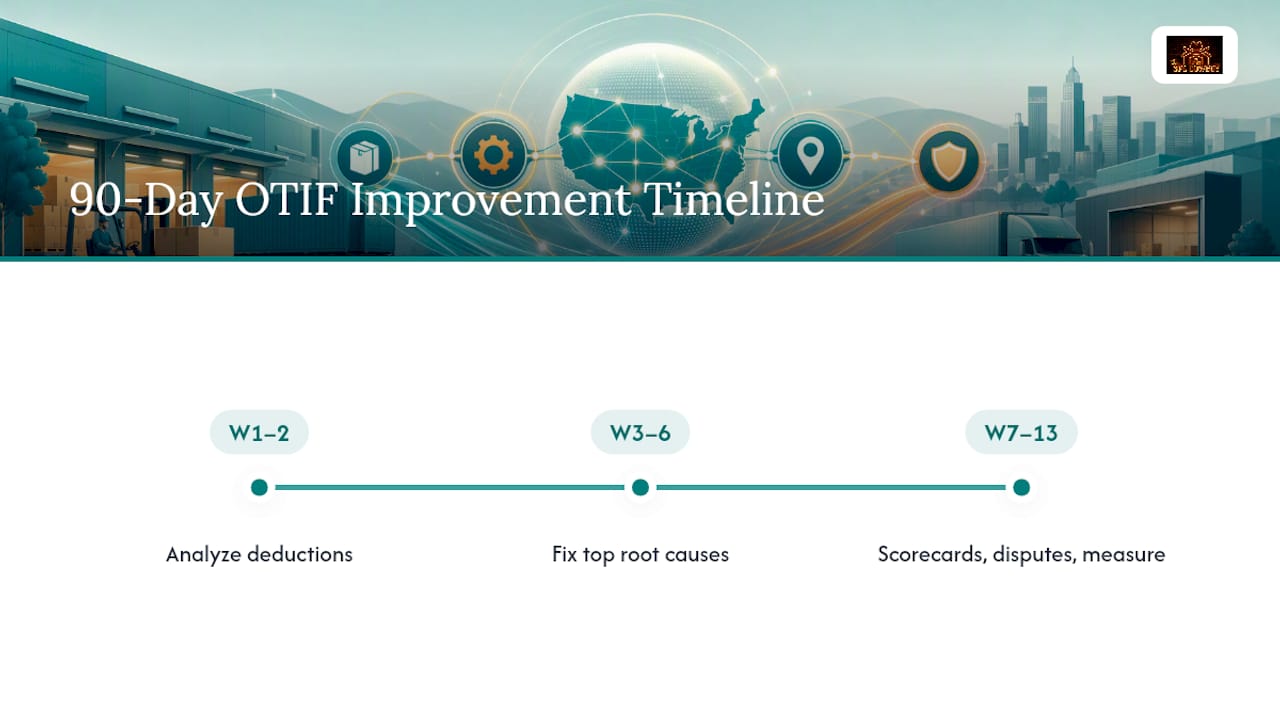
Weeks seven through ten: stand up the weekly scorecard review and start disputing every eligible chargeback within days of posting, not weeks. Weeks eleven through thirteen: measure movement. Teams that execute this sequence typically see their dispute win rate climb first, since documentation habits improve fast, followed by a slower but steadier drop in raw deduction volume as the ASN and confirmation fixes compound.
The pattern that separates a real turnaround from a temporary bounce is follow-through on governance. Teams that keep the weekly review running past the initial 90-day push hold their gains. Teams that treat it as a one-time cleanup usually see deductions creep back within two quarters, because the underlying habits, not just the initial fixes, are what OTIF actually rewards.
Practitioner Perspective: Quick Wins and Blind Spots
Across engagements involving Nike, Walmart, DHL, and Kellogg’s, including taking an inventory operation from 61% to 98%+ cycle count accuracy, the same three fixes surface repeatedly: lock PO confirmation to real inventory, automate ASNs, and review the scorecard weekly instead of monthly. The blind spot teams miss most is treating OTIF as a warehouse problem when it’s usually a sales-confirmation problem wearing a warehouse penalty. Bring in outside diligence once you’ve fixed the basics and the deductions still won’t budge.
— Michael
How 3PL Cowboy Cuts Through OTIF Penalty Chaos
An operator-led approach can offer an alternative to sales-driven vendor calls for fixing OTIF, focusing on diagnosis from people with direct operations experience. When ASN automation, PO confirmation discipline, and carrier accountability aren’t closing the gap on their own, the OTIF Improvement playbook walks through the same root-cause mapping used in this article, applied to your actual scorecard data. A typical engagement may start with a deduction audit, develop a prioritized fix list, and establish a governance structure to sustain improvements internally.

If the gap is bigger than a process fix, whether that means your current 3PL can’t keep pace with staging and pickup deadlines or your network needs a harder look, 3PL Selection & Diligence applies the same underwriting-grade scrutiny to that decision. Book a conversation to walk through your last 90 days of OTIF deductions and find out which fix actually moves your scorecard first.
Sources
- Standards for Suppliers (Walmart)
- Walmart OTIF Penalties: What CPG Suppliers Must Know (Emagia)
- Walmart OTIF performance metrics explained (Inymbus blog)