
A usable 3PL service level agreement needs copy-ready language for inbound receiving, outbound shipping, returns, inventory accuracy, and system uptime, each tied to a measurable threshold and a remedy. This article gives you those exact snippets, including a dock-to-stock example, a service credit formula, and the KPI benchmarks 3PL operators actually get held to, so you can drop working language straight into your next contract instead of starting from a blank page.
TL;DR:
- Ensuring KPIs like dock-to-stock processing time, inventory accuracy, and order accuracy have measurable thresholds and clear remedies prevents unenforceable SLAs.
- Running a pilot with actual transaction data and requiring detailed performance history filters out unrealistic performance expectations before signing.
- Regular transactional audits and continuous review during quarterly business reviews help prevent SLA drift and maintain enforceability.
- Including specific language on inbound readiness, system uptime, and returns processing times ensures clarity and accountability in operational performance.
- Building escalation procedures and termination rights into the SLA safeguards against persistent misses and enforces consequences before damage becomes unmanageable.
Table of Contents
- What Is a 3PL SLA, and How Is It Different From an MSA or SOW?
- Key SLA Components and the KPIs You Should Require
- Copy-Ready SLA Language You Can Adapt Today
- How to Measure and Report SLA Performance Without Fights
- Remedies, Escalation, and Termination Language That Actually Works
- Negotiating an SLA Before You Sign: What to Demand First
- Operator Checklist: Benchmarks Worth Demanding
- Why Most 3PL SLAs Fail Within a Year
- How 3plcowboy Helps You Write and Enforce SLAs That Hold
- Sources
- FAQ
What Is a 3PL SLA, and How Is It Different From an MSA or SOW?
A 3PL service level agreement is the exhibit inside your contract that defines what “good performance” means in numbers. It names the metric, the measurement window, the target, and what happens when the target gets missed. A logistics SLA typically lists scope, cadence, expected timing, and specific metrics such as dock-to-stock time, inventory accuracy, and on-time delivery, and it should drive quarterly business reviews rather than sit in a drawer.
The master service agreement (MSA) is the legal skeleton: liability caps, insurance, indemnification, termination for cause, governing law. The statement of work (SOW) describes the operational setup: warehouse location, staffing model, systems used, hours of operation. The SLA is narrower than both. It should contain only measurable performance commitments, not general descriptions of how the work gets done.
Mixing these up is the most common contract mistake logistics managers make. If your “SLA” reads like a narrative description of the 3PL’s process, you have no enforcement mechanism. Every KPI needs a number, a denominator, and a remedy, or it is not really a service level, just a hope.
Key SLA Components and the KPIs You Should Require
A working SLA exhibit covers seven core metrics, and each one needs a measurement rule attached, not just a target percentage sitting alone on a page. Vague thresholds are how good-sounding SLAs turn into unenforceable ones.
- Order accuracy: percentage of orders shipped with correct SKU, quantity, and destination, measured against total orders shipped in the period. Common benchmarks run above 99% for picking and packing accuracy, with higher-precision operations pushing toward 99.5%.
- On-time ship: orders shipped by the carrier cutoff on the day they’re eligible, as a percentage of eligible orders. Same-day processing rates for orders placed before cutoff commonly sit in the 95 to 98% range.
- Dock-to-stock time: hours or business days from inbound receipt to the inventory becoming sellable in the warehouse management system, typically measured per purchase order or ASN line.
- Inventory accuracy: percentage match between system-recorded quantity and physical cycle count, by SKU or location, usually sampled weekly or monthly.
- Fill rate: percentage of order lines shipped complete without backorder, measured against total order lines received.
- Returns processing time: business days from return receipt to disposition decision (restock, scrap, or return-to-vendor) being logged in the system.
- Damage rate: percentage of units damaged in the 3PL’s custody, measured against total units handled in the period.
Beyond these, your SLA exhibit needs operational clauses that aren’t KPIs but govern how metrics get measured fairly. Specify who provides labeling and advance shipping notices before goods arrive, since inbound readiness is a shared responsibility and a 3PL can’t hit dock-to-stock targets on poorly labeled freight. Also define special handling rules for hazmat, temperature-controlled, or high-value SKUs separately from your standard metrics.
Copy-Ready SLA Language You Can Adapt Today
These snippets are starting points, not finished legal text. Have counsel review them before signing, but use the structure and thresholds as a baseline for negotiation.
Inbound dock-to-stock:
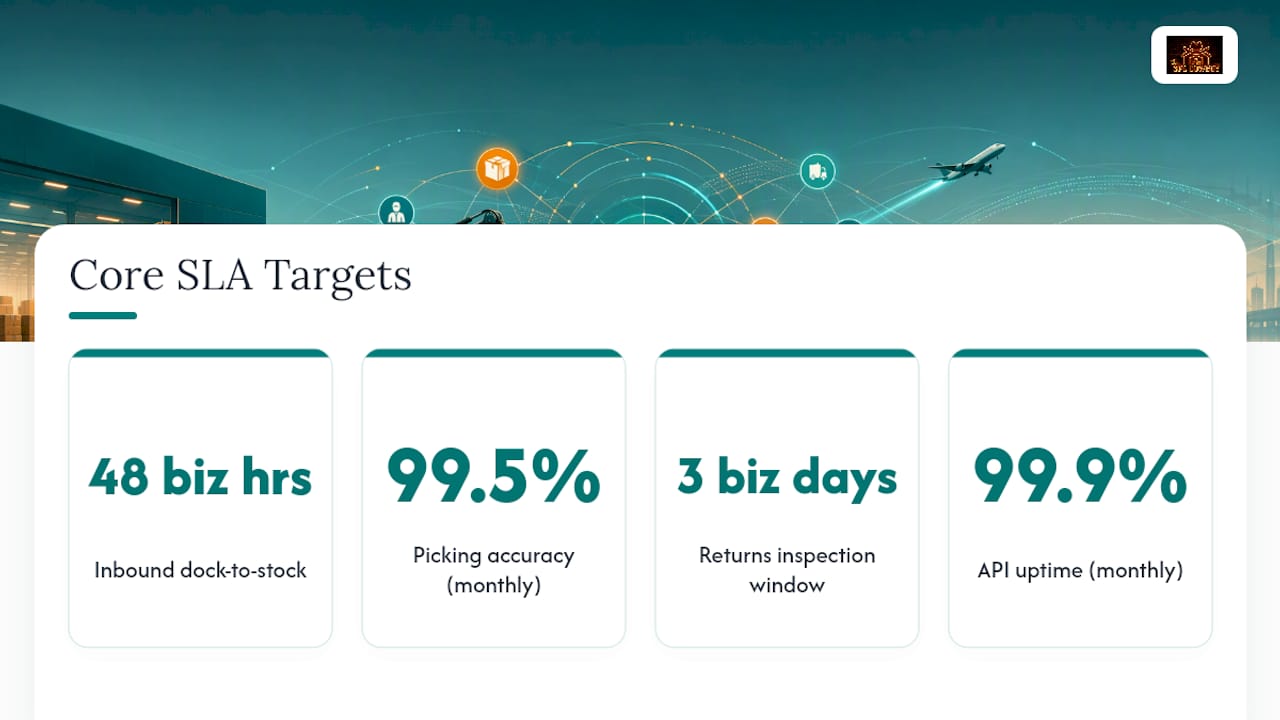
“Provider will process inbound receipts and make inventory available for sale within 48 business hours of dock receipt for standard SKUs, excluding shipments arriving without a valid ASN or with mislabeled cartons, measured per purchase order line.”
Outbound order cutoff and accuracy:
Picking accuracy will be measured at 99.5% or higher, calculated as (total order lines shipped correctly) divided by (total order lines shipped) per calendar month."
Returns processing:
“Returned units will be inspected and dispositioned (restock, scrap, or vendor return) within 3 business days of warehouse receipt. Restocked units will be reflected in available inventory within 24 hours of disposition.”
API and data integration uptime:
“Provider’s order management and inventory API will maintain 99.9% uptime measured monthly, excluding scheduled maintenance windows communicated 48 hours in advance. Inventory data synced via API will match physical inventory records within 99.5% accuracy.” Bespoke, higher-precision operations increasingly write 99.9% API uptime directly into the SLA instead of leaving system reliability undefined.
Service credit formula:
That cap language matters as much as the credit itself. Without it, one bad month across five KPIs could theoretically wipe out an entire invoice, which invites disputes instead of resolving them.
How to Measure and Report SLA Performance Without Fights
Every KPI needs a written counting rule, or you’ll spend your first QBR arguing about definitions instead of performance. Decide upfront what counts as an “error” (a wrong SKU, a late scan, a missed cutoff), what the denominator is (total orders, total lines, total units), and what sample window applies (rolling 30 days, calendar month, trailing quarter).
Reporting cadence should layer from daily to quarterly:
- Daily dashboards: real-time or near-real-time views of orders processed, exceptions flagged, and same-day ship status.
- Weekly exception reports: specific misses with root cause noted, not just aggregate percentages.
- Monthly scorecards: KPI-by-KPI performance against target, with trend lines showing the prior three to six months.
- Quarterly business reviews: the forum where trend performance and corrective action plans get formally reviewed and documented.
A good monthly scorecard includes the metric name, the target, the actual result, the variance, a root cause note for any miss, and the corrective action assigned with an owner and a date. Brands can lean on a structured scorecard template to keep this consistent month over month instead of reinventing the format every reporting cycle.
Remedies, Escalation, and Termination Language That Actually Works
Service credits only work as a fix when they’re paired with a mandatory root-cause response, not just a check written to make the miss go away. A well-built SLA ties every credit to a required corrective action plan, including direct cost recovery for expedited shipping or customer refunds caused by the 3PL’s error.
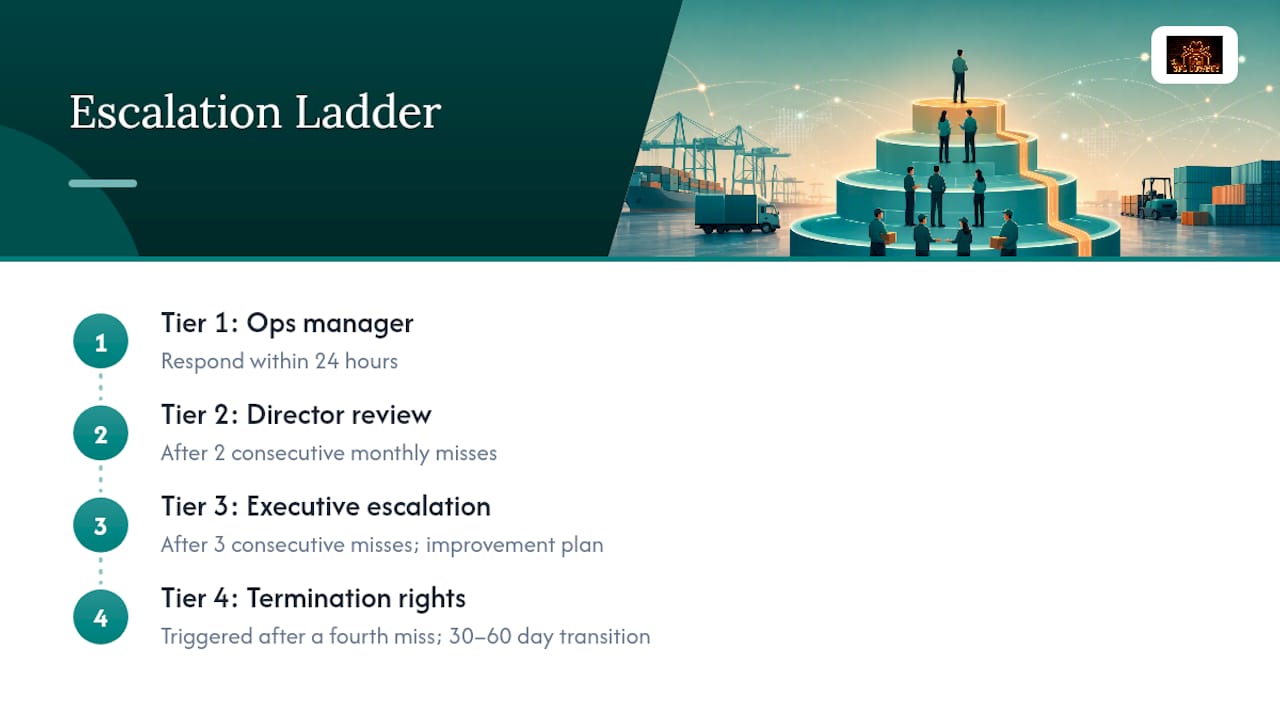
A reasonable escalation ladder looks like this: Tier 1, operations manager response within 24 hours of a flagged miss. Tier 2, director-level review after two consecutive monthly misses on the same KPI. Tier 3, executive escalation and a formal improvement plan after three consecutive misses, with termination rights triggered after a fourth.
Termination language needs teeth beyond “either party may terminate for cause.” Specify a data and inventory transition window (30 to 60 days is standard), require the 3PL to provide a full inventory reconciliation before transition, and lock in continued SLA enforcement during the wind-down period so performance doesn’t collapse the moment notice is given.
Negotiating an SLA Before You Sign: What to Demand First
Don’t negotiate SLA language in a vacuum. Demand evidence the numbers are achievable with your actual SKU mix before you agree to any threshold.
- Run a paid pilot with baseline measurement. Move a small volume slice, 20 to 50 orders a day is often enough, and measure real performance against proposed KPIs before scaling. Pilot programs at this scale surface measurement gaps that never show up in a sales deck.
- Require transaction-level operating history, not summary decks. Ask for actual pick, pack, and ship timestamps from a comparable client with similar SKU count and order profile.
- Ask for references running similar volume and complexity, not just their biggest logo.
- Watch for red flags that should stall signing: vague measurement methodology with no denominator defined, unlimited “excusable event” carve-outs, or no defined escalation cadence at all.
Serious negotiators treat the SLA as one piece of a coherent document set. A checklist of 27 critical provisions to negotiate in a 3PL contract stresses aligning the rate card, SOW, and SLA so financial remedies actually match real operating costs, not aspirational numbers a sales rep offered to close the deal.
Operator Checklist: Benchmarks Worth Demanding
Before you sign, require order accuracy at 99% minimum (99.5% for high-SKU-count or regulated goods), weekly cycle counts on A-items, and 99.9% API uptime if your systems integrate directly. Ask for a 30 to 90 day sample of transaction-level pick, pack, and timestamp data, plus cycle-count variance by SKU family, before you trust a summary scorecard.
Pro Tip: Request the raw ASN-versus-physical-receipt timestamps for your pilot period, not the 3PL’s summarized dock-to-stock number. The gap between the two tells you whether their reporting method is honest.
Why Most 3PL SLAs Fail Within a Year
SLAs rarely fail because the thresholds were wrong. They fail because nobody keeps auditing the transaction-level data after month three, and drift creeps in unnoticed until a customer complaint forces the issue. The fix that actually works is boring: recurring transactional audits, real rigor in QBRs, and an executive who will escalate before the fourth miss, not after. Treat the SLA as a living document you revisit, not a contract clause you file away.
— Michael
How 3plcowboy Helps You Write and Enforce SLAs That Hold
Most brands write SLA language once, at signing, and never touch it again until something breaks. 3plcowboy works differently: retained, operator-led diligence applied to the same numbers a 3PL’s sales team hands you on a call, before you’re locked into thresholds nobody stress-tested.

Through 3PL Selection & Diligence, 3plcowboy helps design the pilot, pull the transaction-level evidence, and draft SLA language that matches your real SKU mix and order profile rather than a generic template. Fulfillment Cost Benchmarking checks that your service credit formulas and rate card actually align, so remedies aren’t disconnected from what you’re paying. And Warehouse RFP Management builds the scorecard structure into the RFP itself, before you’re negotiating from a weaker position after signing.
If you’re heading into a 3PL contract renewal or a first-time selection, visit the services page to see which engagement fits your timeline.
Sources
Findings above draw on Ryder’s SLA breakdown, 3PLGuys’ SLA requirements guide, and FreightCenter’s SLA exhibit contents.
- What is a Service Level Agreement in Logistics | Ryder
- 3PL SLA Requirements: What Service Level Agreements Should Cover | 3PLGuys
FAQ
What Are Some Examples of 3PL Services Covered by an SLA?
3PL SLAs typically cover receiving and putaway, order picking and packing, shipping and carrier handoff, returns processing, inventory cycle counting, and system integration uptime.
What Is the Difference Between 1PL, 2PL, 3PL, 4PL, and 5PL Logistics?
A 1PL is the shipper handling its own logistics, a 2PL is an asset-based carrier like a trucking company, a 3PL manages warehousing and fulfillment on a client’s behalf, and a 4PL manages the entire supply chain including other 3PLs.
Is Amazon a 3PL or a 4PL?
Amazon’s fulfillment services function as a 3PL for most sellers, handling storage, picking, packing, and shipping, though its scale and platform integration lead some to describe parts of its logistics network in 4PL-like terms.
Where Can I Find a Sample 3PL SLA Template?
Several logistics providers and consulting firms publish sample SLA language covering dock-to-stock, order accuracy, and service credits; 3plcowboy’s 3PL performance metrics resource outlines a scorecard structure you can adapt.