
On-demand warehousing is a pay-for-use model that gives you storage and handling by the pallet, week, or month, without a multi-year lease. It fits companies with variable demand, seasonal peaks, or new markets to test, where committing to a fixed facility would tie up cash and flexibility you cannot spare.
TL;DR:
- Audit operator performance directly, including inbound process and inventory accuracy, as platform-level metrics may not reflect specific warehouse conditions.
- Require a trial period of several weeks before volume commitments, and set clear KPIs like pick accuracy and on-time delivery to ensure operational standards.
- Expect handling costs to include storage, handling fees, and possible platform fees, with potential hidden charges for receiving, insurance, and returns.
- Integration of inventory data can be inconsistent, so verify synchronization frequency, and ensure data security and compliance, especially for regulated products.
- Use flexible warehousing for predictable seasonal peaks or market testing, but avoid relying on it as a permanent substitute for a well-designed network.
Table of Contents
- What on-demand warehousing is and how the business models differ
- Core benefits and when flexible capacity actually pays off
- Where on-demand warehousing breaks down operationally
- Pricing structure, hidden costs, and onboarding timelines
- How to evaluate a provider and design a pilot
- Operator-grade checks that separate real capacity from a listing
- Compliance and security considerations before you commit
- What flexible capacity does for agility and scalability
- Case examples that show the model working, and where it strains
- When flexible capacity is strategic versus a stopgap
- How we help you choose and implement on-demand capacity
- FAQ
- Sources
What on-demand warehousing is and how the business models differ
On-demand warehousing connects three parties: the customer who needs space, the lender who owns or operates the warehouse, and often a platform that matches the two. Some platforms act purely as marketplaces, listing available space from independent operators. Others run as dedicated flexible-lease 3PLs that control their own network and guarantee service levels directly. A third variant works more like a lending model where the platform underwrites capacity across multiple sites and resells it in smaller units.
The contractual responsibility splits accordingly. In a marketplace model, the platform typically owns the booking and payment flow, but the lender owns execution: receiving, putaway, and order accuracy happen on their floor, under their labor standards. In a dedicated flexible 3PL, the operator carries both the capacity and the service-level accountability. This difference matters because on-demand warehousing provides capacity and commitment granularity, letting you rent by the pallet and by the week or month rather than negotiating a fixed-term lease. That granularity is the entire value proposition, but it also means you inherit whatever operational discipline the underlying lender brings to the job.
Core benefits and when flexible capacity actually pays off
The clearest use case is overflow: a demand spike, a promotional push, or a supplier delay that leaves you short on space for a few weeks. Seasonal businesses use the same mechanism in reverse, scaling storage up before a peak and releasing it right after. Market testing is another common application: adding a regional node to shorten delivery times before committing to a permanent lease there. Returns handling during peak season is a fourth, often underused, case.
The economic case rests on avoiding fixed cost. On-demand warehousing is an emerging B2B marketplace model built around pay-as-you-go access rather than long negotiations, which means you pay for capacity only while you use it. That can also shorten the distance between inventory and customer, since you can add a location in weeks rather than the months a standard lease and build-out would take. Flexible warehousing models reduce fixed lease commitments and improve scalability, according to industry coverage on flexible warehousing, which is precisely why they fit variable-demand businesses better than a traditional network footprint.
Where on-demand warehousing breaks down operationally
The flexibility that makes this model attractive also creates its biggest risk: inconsistent operator discipline. Academic research on these platforms flags a real concern here, noting a lack of consistent operational standards among lenders and recommending that customers audit operator performance directly rather than trusting platform-level metrics alone. A platform’s aggregated accuracy numbers can look fine while the specific warehouse handling your pallets runs well below that average.
Visibility gaps compound the problem. Many lenders operate their own WMS with limited integration into your systems, so inventory counts can lag reality by hours or days. Handling variability between lenders, meaning inconsistent receiving processes, labeling standards, or pick accuracy, is the second major failure mode.
Mitigate both with contractual and procedural steps before you sign:
- Require audit rights to inspect the specific facility, not just platform-reported averages.
- Negotiate a trial window of several weeks before committing to volume minimums.
- Set required KPIs in the contract, including inventory accuracy and cycle count frequency.
- Confirm integration expectations in writing, including how often inventory data syncs to your system.
Pricing structure, hidden costs, and onboarding timelines
Pricing generally breaks into three elements: storage, typically billed per pallet per day or per month; handling fees for receiving, picking, and packing; and, in marketplace models, a platform fee layered on top. A table of active on-demand platforms shows cost models vary by structure, with some charging a straight percentage fee and others running flat weekly or monthly rates. Minimums are common even in “on-demand” contracts, so read the fine print on volume floors.
Hidden costs show up outside the quoted rate card. Receiving chargebacks for non-compliant pallets, emergency replenishment fees when you need stock moved faster than standard SLA, insurance riders for your inventory while it sits in someone else’s building, and returns processing fees are the four that most often surprise first-time buyers.
Onboarding timelines vary with complexity. Trade coverage of early platform adoption notes that onboarding and ramp timelines vary by complexity, so a single-SKU overflow arrangement can go live in days while a full fulfillment integration with your order management system takes weeks. Build your timeline expectations around the complexity of your own setup, not the platform’s marketing claims.
How to evaluate a provider and design a pilot
Before signing anything, run a structured evaluation:
- Request WMS access or a live screenshot of the facility’s location map and current inventory for a sample SKU set.
- Confirm the labor model: employed staff versus temp agency, and typical tenure.
- Verify insurance coverage for your inventory specifically, not just general liability for the building.
- Ask for at least two references from customers with similar SKU profiles and volume.
- Request site photos or a virtual tour if an in-person visit is not practical.
Require these KPIs in writing before the pilot starts:
- Inventory accuracy percentage, measured by cycle count, not self-reported.
- Pick accuracy rate on outbound orders.
- On-time, in-full (OTIF) performance against your SLA.
- Actual onboarding timeline versus the one quoted.
Design the pilot with a defined scope: a single SKU category or a fixed pallet count, run over a 30 to 60 day measurement window. Practical vetting steps recommended by logistics trade articles include asking for sample KPIs and inbound process flows before you ever sign a volume commitment.
Operator-grade checks that separate real capacity from a listing
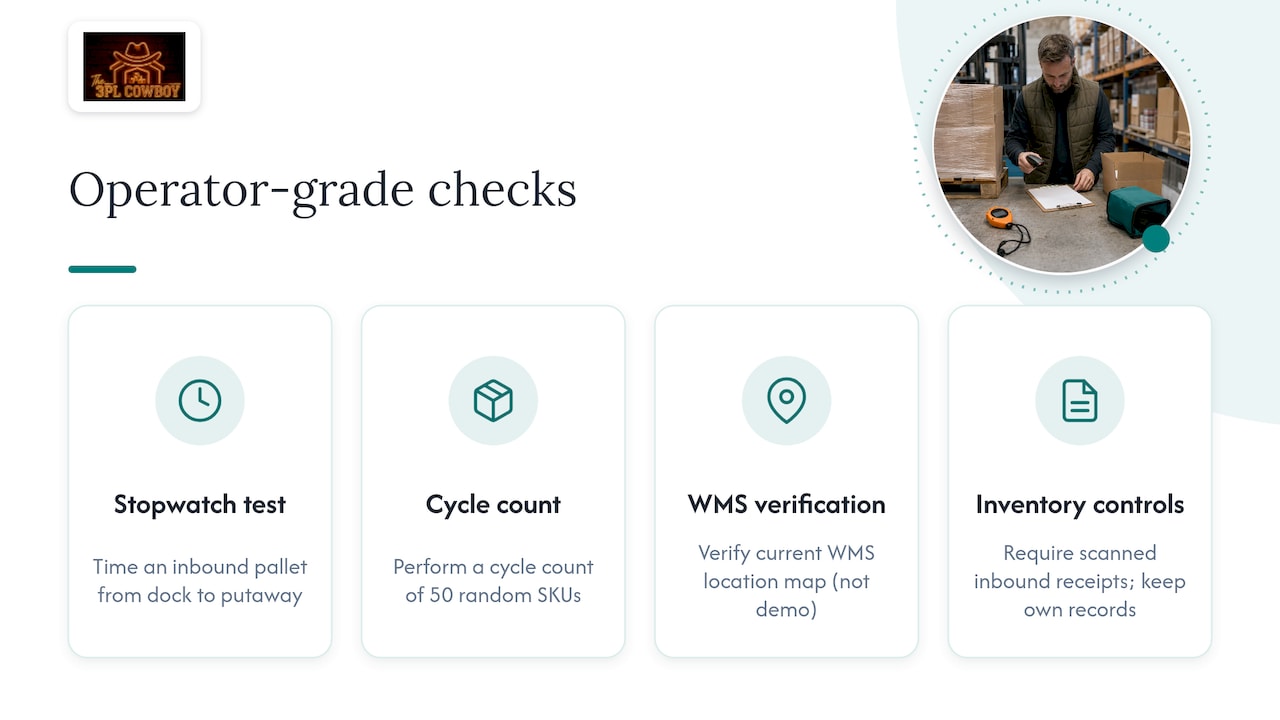
Three checks reveal more in an hour than a week of sales calls: a stopwatch test on an inbound pallet from dock to putaway, a sample cycle count of 50 SKUs pulled at random, and a current WMS screenshot showing the actual location map, not a demo environment. Push for scanned receipts on every inbound load and retain ownership of your own inventory records instead of relying solely on the lender’s system.
Pro Tip: Ask for a live cycle count during your site visit, not a report generated beforehand.
Small fixes often save more than switching providers entirely: a corrected pallet configuration, a shorter pick path for your top SKUs, or slotting rules specific to your short-term volume can cut handling costs without renegotiating the whole contract.
Compliance and security considerations before you commit
Storing inventory inside a facility you do not control introduces compliance questions you would not face in your own warehouse. Confirm that the lender’s insurance covers your inventory at full replacement value, not just the building’s general liability, and get that confirmation in writing rather than relying on a sales conversation.
Data security matters as much as physical security. If the lender’s WMS connects to your order management or ERP system, ask how access is provisioned, how credentials are revoked when the engagement ends, and whether your inventory and order data are segregated from other tenants sharing the same platform. A platform serving multiple customers out of the same facility needs clear controls preventing cross-contamination of inventory records.
Regulatory requirements depend on your product category. Food, beverage, and health and wellness products often carry specific storage condition and traceability requirements that a general-purpose flexible warehouse may not be built to meet. Confirm temperature control, pest management documentation, and chain-of-custody practices match what your category requires before committing volume.
Physical security audits are worth the time even for short-term arrangements. Ask about access control at the facility, whether cameras cover receiving and staging areas, and how the lender handles damaged or short-shipped inventory claims. None of this needs to be exhaustive for a 30-day overflow arrangement, but for anything running multiple months, treat the security review the same way you would for a facility you were leasing directly.
What flexible capacity does for agility and scalability
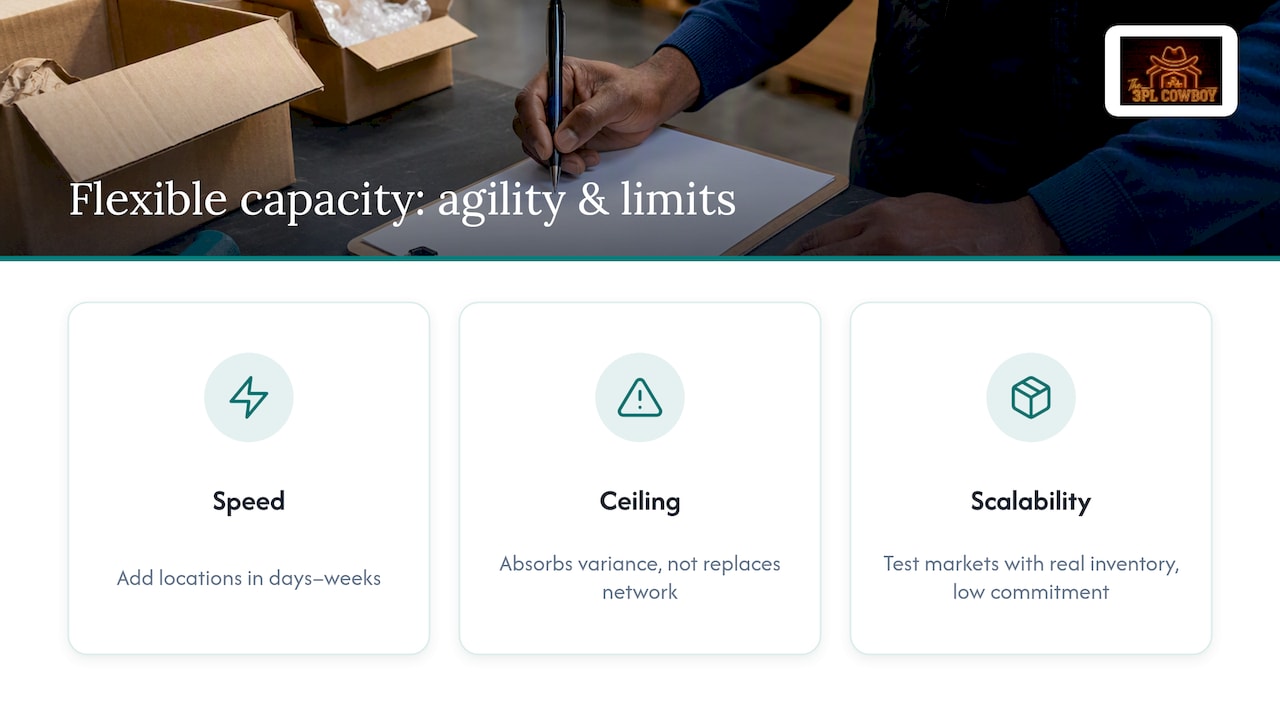
The core advantage of on-demand warehousing is speed. Adding a location the traditional way means a lease negotiation, a build-out, and a hiring ramp that can take months. A flexible arrangement can be live in days to a few weeks, which changes what a supply chain team can respond to in real time. A demand spike in one region, a supplier disruption, or a new marketplace launch becomes a capacity decision rather than a real estate project.
That agility has a ceiling. Flexible capacity is well suited to absorbing variance around a baseline network, not replacing that network. Scaling through many small, loosely coordinated flexible arrangements can create more complexity than it solves if each one runs on a different WMS with a different data cadence. The agility gain is real, but it is strongest when flexible capacity plugs into a network you already understand, rather than substituting for network design you have not done yet.
For companies entering new geographies or testing a market before building permanent infrastructure, the scalability benefit is more straightforward: you learn actual demand patterns with real inventory on the ground, at a fraction of the commitment a lease would require, and you can walk away if the market does not perform.
Case examples that show the model working, and where it strains
Trade coverage of early on-demand warehousing adoption describes the model as having real potential for buyers facing seasonal or overflow needs, but it consistently flags service-level and integration challenges that only show up after onboarding starts. That pattern holds across the category: the capacity is usually there, but the operational fit takes more diligence than the sales pitch suggests.
A seasonal apparel brand adding overflow space ahead of a peak period is the most common success pattern: a known SKU set, a defined window, and clear acceptance criteria going in. The arrangement works because the scope is narrow and the measurement period is short enough to catch problems before they compound.
The strain cases tend to share a feature: a customer treating a flexible arrangement as a permanent fix rather than a bridge. Running six months of steady-state fulfillment through a marketplace-listed lender without the audit rights, trial window, and KPI structure described earlier is where things go wrong. The platform-level case studies that exist are useful mainly as timeline benchmarks, not as proof that a given lender’s operation will match the pitch.
When flexible capacity is strategic versus a stopgap
Flexible capacity earns a seat in your planning cycle when it addresses a recurring, predictable pattern: a known seasonal peak, a standing overflow buffer, or a defined market test with an exit date. It becomes a liability when it is used to patch a network design problem you never solved, quietly becoming permanent infrastructure nobody budgeted or built KPIs for.
Ownership matters. Whoever owns your 3PL relationships should own the vetting and the KPI tracking for flexible capacity too, not a procurement team working off price alone.
— Michael
How we help you choose and implement on-demand capacity
We run 3PL Selection & Diligence engagements aligned with thorough audit standards: operator-level checks, not platform averages. When you need a formal process, our Warehouse RFP Management service structures the pilot, the KPIs, and the acceptance criteria before you sign anything.

We also run Fulfillment Cost Benchmarking to compare a flexible quote against your existing 3PL or lease economics, so you know the real number before you commit. See our full 3PL Selection & Diligence approach to get started.
FAQ
What are the four major types of warehousing?
Warehousing generally splits into private warehouses (owned by the company that uses them), public warehouses (leased space from a third party), contract warehouses (dedicated third-party operations under a longer agreement), and on-demand or flexible warehousing (pay-for-use capacity without a long-term lease). Each type trades fixed cost against control and flexibility differently.
Who are the top WMS providers?
WMS providers range from large enterprise platforms to warehouse-specific point solutions, and the right choice depends on your integration needs and transaction volume rather than brand recognition alone. When evaluating an on-demand warehousing partner, the more useful question is whether their WMS can sync inventory data to your systems on a schedule you can verify.
What is a good warehouse business to start?
This depends heavily on local market demand, available real estate, and capital access, so there is no single answer that holds across regions. For anyone evaluating warehousing as a buyer rather than an operator, focusing on operator discipline and audit rights matters more than the specific business model behind the space.
What are the 7 principles of warehousing?
Definitions vary across logistics texts, but common versions include principles like maximizing space utilization, minimizing handling and movement, ensuring inventory accuracy, maintaining safety, and designing for flow efficiency from receiving to shipping. Applied to on-demand warehousing, inventory accuracy and handling consistency are the two principles most likely to vary between lenders.
Sources
- Evaluating business service models for on-demand warehousing: a double perspective on suppliers and customers
- On-demand warehousing: main features and business models | NSF Public Access Repository
- What is Flexible Warehousing? Definition, Benefits, and What to Look For – Inbound Logistics
- On-demand Warehousing Ready to Be a Game Changer