
A routing guide is the rulebook that tells suppliers and carriers exactly how freight moves, from carrier priority down to labeling and ASN requirements. Designed well, it cuts chargebacks, keeps more freight under contract, and starves the spot market of load leakage. The core principle, backed by GS1 US/VICS standards and MIT SCM lane research, is lane-first: segment by volume and density, build rules-based tendering, and make it automation-ready before you ever touch a TMS button.
TL;DR:
- Proper lane segmentation prioritizes balanced and headhaul lanes, which exhibit at least an 8% higher carrier acceptance rate, over sparse or backhaul lanes.
- Automating tender response windows based on lane urgency reduces rejection rates and aligns carrier acceptance with shipment timelines, cutting tender-to-cover times.
- Regularly updating rates, reviewing rejection patterns, and maintaining version control prevent chargebacks caused by outdated guides and stakeholder discrepancies.
- Structuring RFPs around lane classification and using mini-bids instead of broad, all-lane approaches improves contract resilience against rejection-driven rate increases.
- A comprehensive routing guide should include clear carrier priorities, detailed lane definitions, service expectations, and documented exception procedures to ensure compliance and operational consistency.
Table of Contents
- What a Routing Guide Design Actually Contains
- Lane Segmentation and the Rules That Follow
- How to Design or Redesign a Routing Guide Step by Step
- RFP and Contracting Strategies That Hold Up Under Pressure
- Tendering Mechanics: Automation, Timers, and Escalation Logic
- Compliance, Training, and Governance That Prevent Chargebacks
- The KPIs That Tell You Whether the Guide Is Actually Working
- Common Failure Modes and How to Fix Them
- Operator Checklist: What a Guide Built to Hold Up Looks Like
- Should You Build This In-House or Bring in Retained Help?
- How 3PL Cowboy Helps You Execute the Design, Not Just Draw It
- Sources
- FAQ
What a Routing Guide Design Actually Contains
Most shippers think a routing guide is a spreadsheet of preferred carriers. It’s closer to a contract engine. Every routing guide worth using contains six functional pieces, and skipping any one of them is where compliance programs quietly fall apart.
- Carrier priority — the ranked sequence of who gets tendered first, second, third, by lane, not blanket across the network.
- Lane definitions — origin/destination pairs with enough granularity (3-digit ZIP or better) to actually mean something operationally.
- Contracted rates — the negotiated linehaul and fuel structure tied to each lane and carrier.
- Service level expectations — transit time, appointment windows, and delivery accuracy thresholds.
- Labeling and ASN rules — how freight gets identified and how the advance ship notice syncs with the retailer or DC system.
- Exception handling — what happens when the primary carrier can’t cover, and who’s authorized to make the call.
The reason this matters beyond paperwork: a routing guide is the connective tissue between procurement and execution. Procurement negotiates the rates and terms. Operations executes the tender. Finance reconciles the invoice against what the guide says should have happened. When those three don’t share the same document, version, and rule set, you get chargebacks, disputes, and finger pointing. Routing compliance frameworks describe this bluntly: non compliance with a retailer’s routing guide often triggers automated chargebacks the moment a shipment deviates from the documented instructions, regardless of intent.
GS1’s voluntary routing guide guidelines exist precisely because so many guides are built ad hoc, then patched with side emails and verbal exceptions that never make it into the master document. A guide built on that standard treats lane data as controlled master data, not a living Excel file three people are editing at once.
Lane Segmentation and the Rules That Follow
Not every lane behaves the same way, and pricing them or tendering them identically is the single most common design mistake. MIT’s supply chain research classifies lanes into four buckets, and the classification should drive almost every downstream decision you make.
- Balanced lanes — roughly equal freight flow in both directions, which gives carriers backhaul opportunities and keeps them loyal to the contract.
- Headhaul lanes — heavy flow one direction with less return freight, still attractive if volume is consistent.
- Backhaul lanes — the return-direction counterpart, often priced aggressively because carriers need the freight to reposition equipment.
- Sparse lanes — low, irregular volume that rarely justifies a dedicated contract carrier on its own.
Balanced and Headhaul lanes show at least an 8% higher primary carrier acceptance rate than Backhaul and Sparse lanes, according to MIT’s lane-classification research. That single data point should reshape how you allocate contracting effort. Balanced and Headhaul lanes deserve your best negotiated rates and tightest tender windows because carriers will actually show up. Sparse lanes need a different playbook entirely.
For Sparse and thin Backhaul lanes, don’t force a dedicated contract carrier structure. Aggregating by broader geography, a 3-digit ZIP radius instead of a point-to-point lane, increases carrier interest and lowers the transaction cost of bidding, based on DAT’s RFP guidance. A structured spot strategy, where you maintain a short list of vetted spot carriers with pre-negotiated terms rather than reinventing the wheel every time, usually beats trying to contract a lane that moves four loads a month.
Before you segment anything, pull together a data checklist:
- Trailing 12 to 24 months of load volume by lane, not just total network volume
- Seasonality patterns (peak surges, promotional spikes, holiday compression)
- Freight density and weight per load, which affects equipment type and carrier interest
- Current tender acceptance and rejection history by lane and carrier
- Existing contract rates versus recent spot market clearing prices
Pro Tip: Run your lane classification before your RFP, not after. Shippers who bid out a lane portfolio without knowing which lanes are Balanced versus Sparse end up overpaying on the lanes carriers love and under contracting the ones they need help with most.
How to Design or Redesign a Routing Guide Step by Step
Building a routing guide from scratch, or fixing one that’s leaking freight to the spot market, follows a sequence. Skip a step and you’ll find yourself rebuilding it in six months anyway.
-
Set objectives and KPIs before touching carrier data. Decide upfront what “working” looks like: a target first-tender acceptance rate, a percent-of-freight-under-contract goal, a maximum acceptable tender-to-cover time. Get procurement, operations, and finance aligned on these numbers in the same room, not in separate emails.
-
Assemble and clean lane-level data. Pull historical volume, seasonality, and current carrier performance by lane. This is tedious and unglamorous, and it’s also where most redesign projects die from lack of patience. Bad lane data produces a routing guide that looks organized but fails the moment you tender against it.
-
Calculate baseline KPIs. Before changing anything, measure where you stand today: current first-tender acceptance rate, current spot spend as a percentage of total freight spend, current tender-to-cover time by lane category. You need this baseline to prove the redesign worked.
-
Rank carriers per lane based on classification. Balanced and Headhaul lanes get your top contracted carriers first. Sparse lanes get a broader carrier pool or a structured spot list. Don’t rank the same three carriers first on every single lane just because they’re your biggest partners overall.
-
Set tender windows by urgency and lane type. A same-day appointment lane needs a shorter response window than a five-day-out scheduled lane. Document this explicitly instead of using one blanket window across the network.
-
Build escalation rules for when primary carriers decline. Define exactly how many carriers get tendered in sequence before a load escalates to a human planner or a spot desk. This is where routing-guide exhaustion either gets caught early or turns into a scramble.
-
Document every exception in the guide itself, not in someone’s inbox. If a retailer allows a different labeling standard for one DC, or a carrier gets special handling for a hazmat lane, write it into the master document with a version stamp.
-
Pilot on a narrow set of lanes before full rollout. Pick 10 to 20 high-volume lanes across different classifications. Run the new guide for two to four weeks. Watch first-tender acceptance, tender-to-cover time, and any chargeback disputes closely during this window.
-
Roll out network-wide with a communication plan for every supplier and carrier touched. A routing guide that changes silently is a routing guide that generates chargebacks in week one.
Pro Tip: During the pilot, resist the urge to tune more than one variable at a time. If you change tender windows and carrier ranking simultaneously, you won’t know which change actually moved the acceptance rate.
RFP and Contracting Strategies That Hold Up Under Pressure
A routing guide is only as reliable as the contracts underneath it, and the RFP process is where most of that reliability gets built or destroyed. Structure your lane portfolio into logical groupings, by region, by classification, by equipment type, and run mini-bids within those groupings rather than one massive all-lanes RFP that overwhelms carrier sales teams and produces shallow responses.
DAT’s RFP guidance recommends building lane-level histograms comparing carrier bid capacity against your required annual volume. This tells you immediately which lanes are over-subscribed with eager carriers and which ones need a different approach, like the geographic aggregation mentioned earlier for Sparse lanes.
The cost of chasing the lowest rate: Tender rejections carry a measurable price tag. Lanes with 1 to 10 rejections see average rate increases of roughly 13%, and lanes with more than 10 rejections can see rates climb around 26%, according to DAT’s analytics research. Award to the cheapest bidder on a lane that carrier has no intention of consistently servicing, and you’ll pay for it later in spot premiums.
That’s the trade-off every RFP evaluator has to internalize: price versus resiliency. Build contract terms that raise commitment, not just price:
- Minimum tender acceptance expectations written into the contract, with defined consequences for chronic underperformance
- Service level agreements covering on-time pickup and delivery, not just rate
- Volume commitments from your side in exchange for rate stability from theirs
- Clear language on how rate reviews or fuel surcharge adjustments get triggered
Favor a diversified award portfolio, mixing dedicated capacity, contracted carriers, and a structured spot bench, rather than betting the entire lane on a single low bidder. Running the numbers on expected tender rejection impact before you award, not after, is the difference between a routing guide that survives its first peak season and one that collapses by October.
Tendering Mechanics: Automation, Timers, and Escalation Logic
The routing guide only protects contracted rates if the tendering process actually enforces the ranking you built. That means automation, and it means understanding the technical rails underneath it.
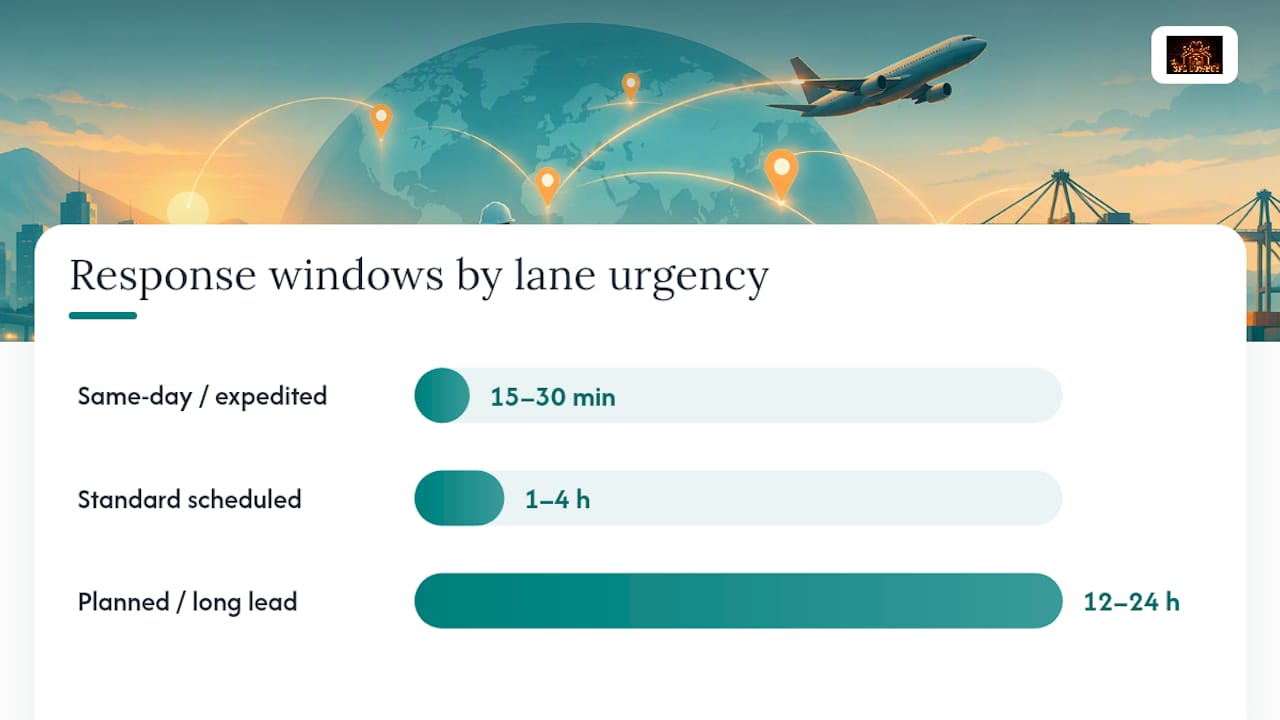
A standard automated tender lifecycle runs like this: the system matches an outbound load to its lane classification, tenders it to the top-ranked carrier via EDI 204 (or an API equivalent), starts a response timer, and cascades automatically to the next carrier in rank if the window lapses without acceptance. EDI 990 confirms acceptance or rejection back into the system, and every step gets logged for audit and invoice reconciliation later. Automated load-tendering guidance frames this cascade as the mechanism that actually enforces routing-guide discipline instead of leaving it to a planner’s memory.
Response windows need to match shipment urgency, not sit at one company-wide default. Tender response windows must be calibrated to how time-sensitive the load actually is, based on findings on automated tendering: too short a window and you cascade past carriers who would’ve accepted given a few more minutes, too long and you burn hours you don’t have on a time-critical appointment.
| Lane urgency | Typical response window | Trade-off if mistimed |
|---|---|---|
| Same-day / expedited | 15 to 30 minutes | Too short: skips willing carriers. Too long: misses appointment. |
| Standard scheduled (1 to 3 days out) | 1 to 4 hours | Too short: unnecessary cascading and carrier frustration. |
| Planned / long lead (4+ days out) | 12 to 24 hours | Too long: delays visibility into coverage risk. |
Key operational habits worth building into the process:
- Log every tender, response, and cascade event, not just final acceptance, for root-cause analysis later.
- Escalate to a human planner the moment a load exhausts its entire ranked carrier list without acceptance, a state known as routing-guide exhaustion.
- Review cascade logs weekly for patterns, if one lane exhausts its guide repeatedly, that’s a segmentation or rate problem, not a fluke.
- Keep API and EDI connections tested regularly; a silent integration failure looks identical to carrier non-response until someone digs into the logs.
Compliance, Training, and Governance That Prevent Chargebacks
Most chargebacks trace back to two root causes: an outdated standard operating procedure that nobody updated after the last guide revision, or a supplier who genuinely misread the routing instructions because they weren’t communicated clearly. Both are governance failures, not carrier failures.
Build an onboarding checklist for every new supplier and 3PL that touches the guide:
- Walk through the current guide version in a live session, not just an emailed PDF.
- Confirm labeling and ASN requirements with a test transaction before go-live.
- Document a single point of contact for routing questions on both sides.
- Establish a change-notification protocol so version updates get pushed out with enough lead time to implement.
Invoice validation should be tied directly to routing-guide categories. If a load moved under an approved exception code, the invoice needs to reference that exception, not create a dispute weeks later when finance can’t reconcile the rate against the guide’s stated terms. This is exactly the kind of controlled master data discipline GS1’s guidelines push for: version every change, categorize every exception, and make sure invoicing systems can actually see which version applied to which shipment.
Pro Tip: *Set a governance cadence and stick to it.
Firms handling parallel procurement decisions, equipment lifecycle management alongside carrier contracts, for instance, often find it worth coordinating governance calendars across both. A partner resource on IT equipment disposal is a useful reference point for procurement teams managing asset lifecycle alongside routing-guide refresh cycles.
The KPIs That Tell You Whether the Guide Is Actually Working
A routing guide without a monitoring dashboard is just a document you hope people follow. The KPI suite that matters, based on routing guide compliance frameworks, covers five core metrics:
- First-tender acceptance rate — the percentage of loads accepted by the top-ranked carrier without needing to cascade.
- Routing-guide depth — how many carriers deep, on average, a load has to cascade before finding coverage.
- Percent of freight moved under contract — versus spot, tracked by lane classification, not just network-wide.
- Tender-to-cover time — how long from initial tender to confirmed carrier acceptance.
- Rejection reason codes — capacity, rate, appointment conflict, equipment mismatch, tracked so patterns surface instead of getting lost in noise.
A weekly operations review should watch first-tender acceptance and tender-to-cover time closely, since those move fast and signal near-term coverage risk. A monthly procurement review should look at percent-under-contract trends and rejection reason patterns, since those inform whether a lane needs re-segmentation or a mini-bid.
Tender rejections carry a real cost, as noted earlier: lanes accumulating more than 10 rejections can see average rates climb roughly 26%, per DAT’s analytics guidance. That statistic alone justifies building automated alerts that flag any lane crossing a rejection threshold before it drifts fully into spot territory.
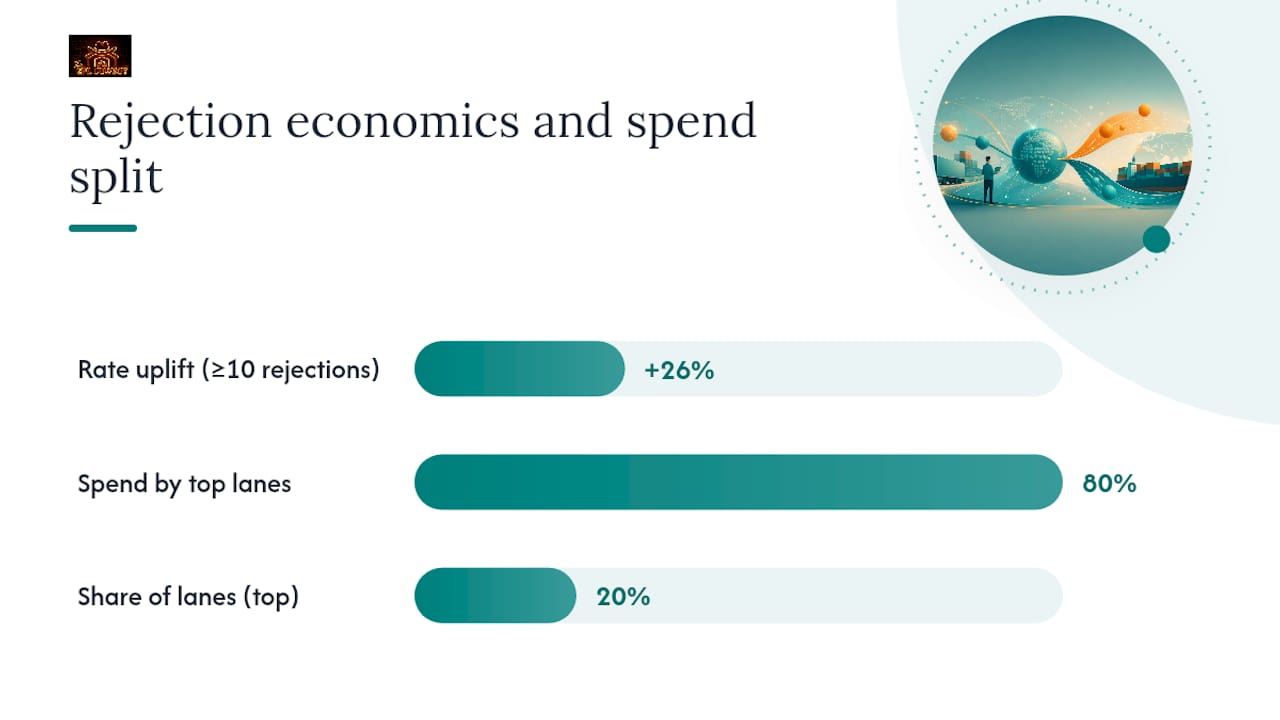
The 80/20 pattern shows up consistently here: roughly a fifth of your lanes, usually the highest-volume Balanced and Headhaul ones, generate most of your freight spend and deserve dedicated capacity conversations. The long tail of Sparse lanes is where structured spot and geographic aggregation earn their keep instead.
Common Failure Modes and How to Fix Them
Tender rejections and spot leakage top the list of practical failures, and the diagnosis usually points to one of two causes: rates that fell behind market, or carrier capacity that shifted away from the lane entirely. The fix is a targeted mini-bid on the affected lanes, not a network-wide rebuild.
Stale rates cause a slow bleed rather than a dramatic failure. Refresh contracted rates against current market benchmarks quarterly at minimum, more often on volatile lanes, using the kind of bid-versus-volume analysis DAT recommends for RFP evaluation.
Supplier exceptions and invoice disputes usually trace back to version control failures, someone executing against an outdated guide version because the update never reached them. Assign exception codes to every approved deviation and require that code on the corresponding invoice line.
A few clear triggers for corrective action:
- Rejection rate crosses 10 on a lane → run a mini-bid before the rate premium fully sets in.
- A lane shows rate drift beyond 10% to 15% from spot benchmarks → trigger a contract refresh.
- Routing-guide depth exceeds three or four carriers regularly on a lane → add carrier capacity or bundle the lane with adjacent geography.
- Repeated invoice disputes on one exception type → revisit whether that exception needs to become a permanent guide rule instead of a one-off.
Operator Checklist: What a Guide Built to Hold Up Looks Like
If your numbers sit well outside these ranges, that’s a segmentation or contracting problem, not a tendering software problem.
An onboarding and governance checklist worth running on every new lane or carrier addition:
- Confirm lane classification (Balanced, Headhaul, Backhaul, Sparse) before setting carrier rank.
- Version-stamp every guide update and push change notifications with lead time, not same-day.
- Tie every exception to a documented code visible to both operations and finance.
- Review cascade logs and rejection reason codes on a fixed weekly cadence, not ad hoc.
- Run a lane audit quarterly comparing contracted rates to current spot benchmarks.
Versioning and audit templates don’t need to be elaborate. A simple change log, date, lane affected, what changed, who approved it, prevents the single most common failure mode: someone executing against last quarter’s rules because nobody told them the guide moved.
Should You Build This In-House or Bring in Retained Help?
The honest answer depends on three thresholds most teams underestimate. First, TMS maturity: if your system can’t natively support tiered tendering with cascade logic, you’ll spend more time building workarounds than actually running the guide. Second, weekly load volume: below a certain threshold, the analytics investment doesn’t pay for itself, and a simpler manual process with quarterly reviews works fine. Third, procurement bandwidth: designing lane segmentation and running mini-bids properly takes real hours, and most procurement teams are already stretched across other categories.
Retained advisory tends to add the most measurable return in three specific spots: RFP design where lane portfolios need real segmentation before bidding, carrier diligence where you need an outside read on whether a bid is sustainable versus a loss-leader, and network segmentation where the classification work itself, Balanced versus Sparse, headhaul versus backhaul, requires data analysis most internal teams don’t have time to run properly. A pilot engagement scoped to a single lane portfolio, 30 to 60 days, with clear before-and-after KPI targets, is usually the lowest-risk way to test whether outside expertise actually moves your numbers before committing to a broader retainer.
— Michael
How 3PL Cowboy Helps You Execute the Design, Not Just Draw It
Most shippers can sketch a routing guide on a whiteboard. Fewer can pressure-test the carrier RFP, the contract terms, and the lane segmentation against what actually happens when tender volume spikes during peak. This operator-led advisory serves as an alternative to sales-driven matchmaking common in 3PL and carrier selection, applying underwriting-grade diligence to key decision points.

Relevant services for teams working through routing-guide design include Warehouse RFP Management for structuring lane portfolios and running mini-bids properly, 3PL Selection & Diligence for vetting whether a bid carrier can actually sustain the rate they quoted, and Parcel & Transportation Strategy for the broader carrier portfolio work that feeds into the guide itself. Engagements often begin with lane-level data review, proceed through segmentation and RFP structuring, and culminate in a documented guide accompanied by a governance cadence for ongoing management.
If your routing guide is leaking freight to spot or your last RFP left you wondering whether you awarded the right lanes to the right carriers, book a review of your services needs and get a straight read on where the design is breaking down.
Sources
The GS1 US/VICS routing guide guidelines remain the closest thing the industry has to a standard template for routing-guide components and versioning. MIT SCM’s market-based routing guide research backs the lane-classification approach with real acceptance-rate data. DAT’s RFP and analytics guide covers procurement mechanics and the tender-rejection cost math in depth. The FTA’s Best Practices Procurement Manual offers federal-grade procurement governance templates worth adapting even outside transit-specific contexts.
- A Market-Based Routing Guide Strategy for Truckload Transportation – MIT SCM
- Ultimate Guide to RFPs and Routing Guide Analytics – DAT
- Automate route load-tendering to preferred carriers (2026) – US Tech Automations
FAQ
What Is a Routing Guide?
A routing guide is the documented rulebook that tells suppliers and carriers how freight should move, including carrier priority by lane, contracted rates, service level expectations, and labeling or ASN requirements. Retailers and shippers use it to enforce consistent execution, and deviating from it often triggers a chargeback under standard supplier compliance programs.
What Are Routing Instructions?
Routing instructions are the specific, actionable directions within a routing guide, which carrier to use, what transit time to hit, how to label a shipment, and what to do if the primary carrier can’t cover the load. They exist to remove ambiguity from execution so freight moves the same way every time, regardless of who’s handling it that day.
What Belongs in an Effective Routing Guide Design?
An effective design includes carrier priority ranked by lane, clear lane definitions down to the ZIP or regional level, contracted rates, service level agreements, labeling and ASN rules, and documented exception handling. The GS1 US/VICS guidelines recommend treating all of it as version-controlled master data rather than a static document.
How Often Should a Routing Guide Be Updated?
Most lanes benefit from a rate and carrier review at least quarterly, with immediate updates whenever a contract changes or a lane shows rejection rates climbing past 10 tenders. Waiting for an annual RFP cycle to fix a struggling lane usually means absorbing months of spot-market premiums first.