
A fractional operations leader is a senior operations executive, often carrying the title of fractional COO, who works part-time or on a defined engagement to own operational outcomes rather than just advise on them. You typically need one when growth has outpaced your systems, deadlines slip, or you’re the one still approving every shipment and hire. Retainers commonly run $3,000 to $15,000 per month, depending on scope and industry.
TL;DR:
- A fractional operations leader owns the operating model and remains accountable for implementation, unlike consultants who only diagnose issues.
- Companies should consider hiring a fractional COO if deadlines are missed, margins shrink despite revenue growth, or new product lines increase complexity unexpectedly.
- Retainer fees range from $3,000 to $15,000 per month, depending on operation complexity, industry, and scope, with milestone contracts tying payment to measurable results.
- Successful hires require clear success metrics, relevant industry experience, and evidence of systems thinking during interviews; legal terms should specify scope, classification, and exit clauses.
- Engagements typically follow an audit, implementation, and scaling journey within 90 days, with early wins including inventory accuracy improvements and faster order fulfillment.
Table of Contents
- What a Fractional Operations Leader Actually Does
- When to Hire One: Signals You’re Past the DIY Stage
- Fractional COO vs. Operations Manager vs. Operations Consultant
- What Engagements and Pricing Actually Look Like
- How to Hire and Screen a Fractional Operations Leader
- The First 90 Days: What Progress Should Look Like
- Operator-Grade Proof: The 3PL Cowboy’s Track Record
- Contract and Legal Considerations for Fractional Engagements
- When Fractional Leadership Beats a Full-Time Hire
- How The 3PL Cowboy Helps With Fractional Operations Leadership
- Sources
What a Fractional Operations Leader Actually Does
A fractional operations leader owns the operating model, not just a slide deck about it. That distinction trips up a lot of first-time buyers who expect a consultant’s report and get, instead, someone who redesigns your fulfillment workflow and then stays to run it.
The role typically covers a defined set of domains:
- Operating model design: org structure, decision rights, and how work actually flows between departments
- Process architecture: fixing the systemic bottlenecks behind late shipments, duplicated work, or inventory errors
- KPI dashboards: building the handful of metrics that actually predict trouble before it hits the P&L
- Cross-functional execution: getting sales, fulfillment, and finance to operate off the same numbers instead of three different spreadsheets
The biggest difference between a fractional leader and a short-term diagnostic consultant is ownership. A consultant hands you a report and leaves. A fractional operations leader takes the recommendations, builds the systems, and answers for whether they work. Many engagements structure this around 10 to 20 hours per week, focused on architectural fixes rather than daily tactical fires. Some clients want boots on the ground weekly; others run the entire engagement remotely with a tight weekly cadence of calls and dashboard reviews. Neither is wrong. It depends on how distributed your team already is and how much of the work requires physical presence in a warehouse or plant.
When to Hire One: Signals You’re Past the DIY Stage
Certain patterns show up again and again in companies that finally bring in fractional operational leadership. Here’s what to watch for:
- The CEO is the bottleneck. If every operational decision, from a vendor contract to a staffing call, waits on the founder’s calendar, you’ve outgrown improvisation.
- Deadlines keep slipping, and nobody can say why. Missed ship dates and duplicated work across departments usually mean there’s no single owner of the process, not that people are lazy.
- You just raised money or landed a big contract. Post-funding scale and sudden headcount growth expose weak operating systems fast. What worked at 20 people breaks at 80.
- Margins are shrinking even as revenue climbs. That’s almost always an operations problem, not a pricing problem.
- You’re launching a new product line or channel. New complexity needs a structured operating plan before it needs more headcount.
Company size matters less than most people assume. Fractional operational leadership fits businesses roughly in the $2 million to $50 million revenue range most cleanly, though the trigger is really complexity, not revenue. A ten-person team running three fulfillment centers can need this more urgently than a forty-person team with one simple product line.
Fractional COO vs. Operations Manager vs. Operations Consultant
Buyers often default to whichever title sounds most familiar, and that’s how companies end up overpaying for the wrong role. The three options solve different problems, and mixing them up wastes months.
A fractional COO owns outcomes. This person sits at the leadership table, frequently takes direct reports, and is accountable if the fulfillment redesign doesn’t hit its numbers. Top practitioners draw a sharp line here: a fractional COO executes; a consultant diagnoses. An operations manager executes the plan someone else designed, running the daily mechanics of a warehouse, a shift schedule, or a vendor relationship. A consultant diagnoses a specific problem, delivers findings, and generally exits before implementation begins.
Here’s how that plays out in practice:
- A 15-person DTC brand hitting fulfillment chaos during a growth spike needs a fractional COO to redesign the operating model, then likely needs to hire a full-time ops manager to run it day-to-day once it’s stable.
- A company that suspects its 3PL pricing is off but doesn’t know why needs a focused consulting engagement or benchmarking review, not a six-month retainer.
- A business scaling from one warehouse to three often needs both simultaneously: a fractional COO setting network strategy and KPIs, and an operations manager executing the transition on the ground.
Pro Tip: If you’re not sure which one you need, ask yourself who will be accountable if the fix fails six months from now. If the honest answer is “nobody in particular,” you need the COO, not the consultant.
What Engagements and Pricing Actually Look Like
Fractional leadership comes in a few standard shapes, and each one changes how you should negotiate.
- Monthly retainer. The most common structure, typically running $3,000 to $15,000 per month based on experience level, scope, and how complex your operation is. Predictable for budgeting, but make sure deliverables are spelled out, not just hours.
- Block hours. You buy a set number of hours per month, often in the 10 to 20 hour range, and the leader allocates them across priorities. Good for companies that need flexibility more than a fixed weekly cadence.
- Outcome-based or milestone contracts. Payment ties to specific deliverables, like a completed network redesign or a target cycle count accuracy. Higher accountability, but requires both sides to agree on measurable definitions up front.
Price moves based on three things mainly: how complex your operation is (multi-site versus single warehouse), your industry (regulated goods and cold chain cost more to advise on than dry goods), and how many deliverables you’re asking for beyond the core strategy work. Structure milestone payments around specific KPIs, not vague check-ins, so both sides know exactly what “done” looks like at each stage.
How to Hire and Screen a Fractional Operations Leader
Hiring well here isn’t about finding the most polished résumé. It’s about finding someone whose pattern recognition matches your actual problem. Work through this before you post a single job listing.
- Define your 30/60/90 success metrics before you start outreach. What does “working” look like at day 30? Day 60? Day 90? If you can’t answer this, you’re not ready to hire yet.
- Check references for measurable outcomes, not vibes. Ask former clients what specifically improved, and by how much, not just whether they “liked working with” the candidate.
- Verify relevant industry experience. Operations leadership in food and beverage looks nothing like operations leadership in electronics or apparel. Ask about their track record in your specific vertical.
- Run the pattern-recognition test in the interview. Ask for two or three prior situations where they diagnosed a systemic bottleneck, and the specific steps they took to fix it, with before-and-after metrics. Vague answers here are a red flag.
- Test systems thinking, not just tactical fixes. Ask how they’d redesign a process versus how they’d patch it. You want someone who builds systems that scale, not band-aids.
- Put contract protections in writing. Include a defined trial period, clear deliverables tied to payment, and an exit clause that doesn’t punish either side for a bad fit discovered early.
Pro Tip: Ask candidates to walk through a time a “quick fix” actually made a problem worse six months later. Anyone who’s run real operations has a story like this. If they don’t, they haven’t been accountable for outcomes long enough.
Large networks that promise fast matching in days can be tempting, but speed of placement isn’t the same as fit. Buyer protection comes from clear deliverables and trial periods, not from how quickly someone gets on a call with you.
The First 90 Days: What Progress Should Look Like
Most credible fractional engagements follow some version of an audit, implement, and scale rhythm. The first 30 days go toward a deep-dive audit and a prioritized plan, often built around a structured entry process rather than guesswork. Days 31 through 60 focus on implementing the highest-leverage fixes identified in that audit. Days 61 through 90 are for measuring results and deciding what to scale.
Concrete early wins to watch for in that window include:
- Inventory or cycle count accuracy improving measurably against a documented baseline
- Reduced overtime costs from better shift and workflow planning
- Faster order-to-ship times after process redesign
- Clear, board-ready reporting that replaces anecdote with actual numbers
Report progress the same way you’d report any executive function: specific metrics, before and after, tied to the original 30/60/90 plan. If the fractional leader can’t show you a number that moved, something’s off with the engagement.
Operator-Grade Proof: The 3PL Cowboy’s Track Record
Michael Nooner founded The 3PL Cowboy after more than 17 years of hands-on operational leadership inside organizations like Nike, Walmart, DHL, FedEx, Kellogg’s, and Peloton. That’s the difference between advisory theory and someone who has actually run the floor.

The results speak for themselves. Documented case work includes taking a Nike inventory operation from 61% to over 98% cycle count accuracy across 450,000-plus SKUs, delivering more than $6 million in annual savings through a pallet-program redesign for Kroger, and leading an eight-month warehouse management system rollout across more than 60 Sysco sites.
Unlike a 3PL, a broker, or a matchmaking marketplace, The 3PL Cowboy has no warehouse to fill and no listings to move. It’s a retained advisory, which means the incentive structure is different: the fee comes from solving your problem correctly, not from steering you toward whichever partner pays the biggest referral.
Contract and Legal Considerations for Fractional Engagements
Fractional leadership contracts differ from a standard employment agreement or a typical consulting statement of work, and skipping the details here causes most of the friction that sours these engagements.
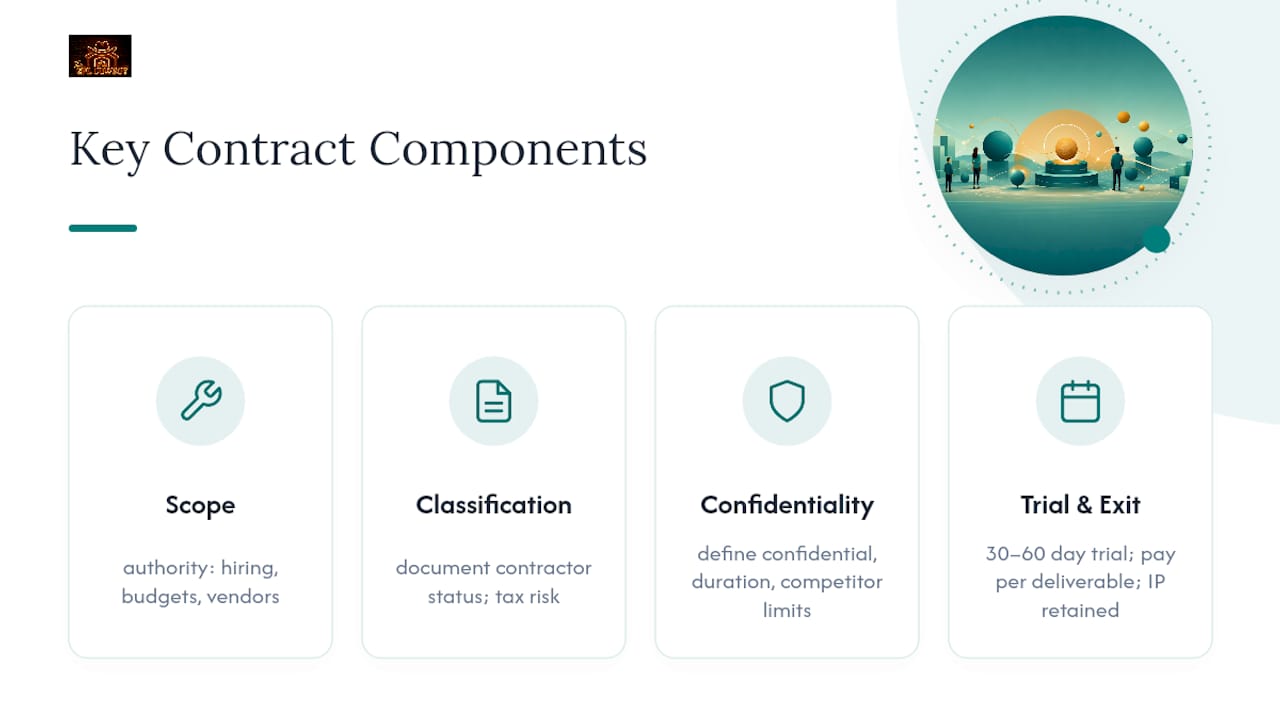
Start with scope language. A fractional operations leader agreement should specify exactly which decisions the person has authority over, whether that includes hiring and firing within their function, budget approval limits, and vendor negotiation authority. Vague scope language is the single most common source of disputes six months into an engagement.
Classification matters too. Most fractional executives operate as independent contractors, not employees, which affects tax withholding, benefits eligibility, and how termination works. Confirm this classification is documented correctly from the start, since misclassification carries real regulatory risk for the hiring company, not just the contractor.
Confidentiality and non-compete provisions need particular attention because a fractional leader often works with multiple companies simultaneously, sometimes in adjacent industries. Spell out what counts as confidential, how long that obligation lasts after the engagement ends, and whether the leader can work with a direct competitor during or immediately after your engagement.
Finally, build in a defined trial period and a clean exit clause. Both sides should be able to walk away within the first 30 to 60 days without a punitive penalty if the fit is wrong. Tie ongoing payment to specific deliverables rather than open-ended hours, and specify what happens to any systems, dashboards, or documentation the leader builds if the relationship ends. You want that intellectual property to stay with your company, not walk out the door.
When Fractional Leadership Beats a Full-Time Hire
Fractional leadership makes the most sense when you have a defined operational problem and a real deadline pressing on it, not when you’re vaguely unhappy with how things run. The fastest ROI comes from companies that already know something specific is broken, whether it’s fulfillment cost, inventory accuracy, or a network that hasn’t scaled with revenue.
Give the person real authority from day one. A fractional leader who’s kept at arm’s length as an outside advisor rarely moves as fast as one who’s actually on the org chart with direct reports. That’s not a nice-to-have structural preference; it’s the difference between advice and execution.
Convert to full-time when the operational rebuild is done and what’s left is steady-state management. At that point, you’re paying premium rates for a maintenance job, and a full-time operations manager will do it for less.
— Michael
How The 3PL Cowboy Helps With Fractional Operations Leadership
The 3PL Cowboy is the operator-led alternative to hiring a full-time COO before you know exactly what problem you’re solving. Instead of a six-figure salary commitment on a hunch, you get 17-plus years of hands-on operating experience applied directly to your fulfillment, inventory, or 3PL selection problem, at a fraction of the fixed cost.

Services include fractional COO and operations advisory, 3PL selection and diligence, fulfillment cost benchmarking, and distribution network design, all delivered through a retained engagement rather than a one-off report. Because the practice advises both brands and 3PL operators, it brings a rare, unfiltered view of how pricing and performance actually work on both sides of a contract, instead of the sales-driven pitch most companies get from a broker or a marketplace.
An introductory conversation typically starts with a straight assessment of where your operation stands today and whether a retained engagement, a benchmarking review, or a focused 3PL selection process fits your actual problem. Visit The 3PL Cowboy to schedule that first conversation and get a direct read on what’s actually broken in your operation.
Sources
For deeper detail on pricing models, see Pilot’s breakdown of fractional COO costs. For governance frameworks that connect operational and financial leadership, see Patricia Barrios’s work on executive collaboration.
- What Is a Fractional COO? — Pilot
- Fractional COO services — ScaleUpExec
- Fractional COO Services | Kamyar Shah