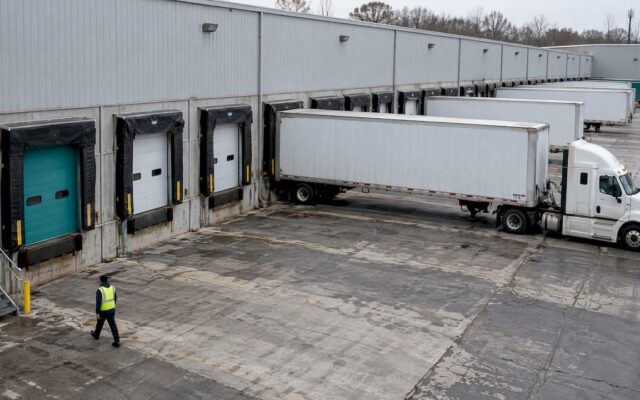
Assign one owner for returns, build a triage-first receiving zone, and rework your policy levers before you buy anything new. Those three moves consistently cut cost per return, shrink refund cycle time, and lift resale yield faster than any software purchase. Get ownership and triage right first, and most technology fixes become simpler and cheaper to justify.
TL;DR:
- Establishing clear ownership and a triage-first receiving zone can significantly reduce processing costs, cycle times, and improve resale yield without software investments.
- Mapping all five stages of returns, especially focusing on timely inspection and triage, reveals bottlenecks that cause high costs and inventory inaccuracies.
- Quick operational wins include assigning a dedicated returns owner, creating a triage area, and piloting automation like self-service portals within the first 60 days.
- Balancing policy adjustments, triage speed, and structured communication is more effective than relying solely on software or single-point fixes.
- Conducting thorough discovery audits and defining ROI thresholds before investing in platforms or outsourcing ensures improvements are based on actual operational needs.
Table of Contents
- Why returns management belongs on the P&L
- The five-stage returns process every operation should map
- Practical best practices: prioritized operational changes with typical ROI
- Prioritization framework and quick ROI checks
- Measurement: KPIs that show whether improvements are working
- Apply the 5Ps: an operator’s synthesis
- 30/60/90-day implementation checklist
- Operator perspective: measure before you buy software or outsource
- How The 3PL Cowboy helps you fix returns without the guesswork
- Sources
Why returns management belongs on the P&L
Returns aren’t a cost center you tolerate. They’re a line item most finance teams still underprice, and the gap between what returns actually cost and what gets reported is where margin quietly disappears.
Processing labor is the obvious drain: someone has to receive the box, inspect the item, decide what happens to it, and update inventory. But the bigger loss usually hides in disposition. An item that should have been restocked at full value gets liquidated, scrapped, or shipped to a secondary market at a fraction of its worth because nobody built a fast triage lane. Online return rates run in the high teens to low 30% range depending on category, according to Fortna’s returns research, which means for a lot of retailers, returns processing is a permanent, high-volume operation, not an exception queue.
The scale is real: Philips Consumer Electronics applied a coordinated returns strategy and reported $100 million in annual savings from returns-related costs. That’s not a rounding error. That’s an operations team treating returns as a system worth engineering.
Customer experience and inventory accuracy ride on the same process. A slow, opaque returns flow generates support tickets, chargebacks, and repeat-purchase hesitation. A messy disposition process throws off your inventory counts, which cascades into bad forecasting and phantom stockouts. Fix the process, and you’re solving three problems with one project.
The five-stage returns process every operation should map
Most returns problems trace back to one stage nobody’s actually mapped. Before you fix anything, walk the physical and digital path a return takes from the customer’s decision to your final resolution.
- Initiation and authorization. The customer requests a return, and your system issues an RMA (return merchandise authorization) or equivalent approval. Cross-channel returns (bought online, returned in store, or vice versa) need clear rules here, or you’ll spend weeks reconciling mismatched records.
- Shipping and routing. The item moves back to you, whether through a prepaid label, a carrier pickup, or a store drop-off. Route decisions made here (nearest facility vs. central hub) determine your transportation cost and how fast the item re-enters inventory.
- Receiving, inspection, and triage. The box arrives, gets opened, and someone decides what condition the item is in. This step should sort items into disposition categories on first touch: resellable as-new, resellable as open-box, refurbishable, liquidation, or scrap.
- Disposition and inventory reconciliation. The item moves to its assigned channel and your inventory system updates. This is where dedicated returns handling areas and WES/WMS integration pay off most, since Fortna documents that warehouse-level automation directly improves disposition yield.
- Customer resolution and communication. Refund, exchange, or store credit gets issued, and the customer gets a status update. This stage is where most avoidable complaints originate, usually because nobody told the customer what’s happening between steps two and four.
Map each stage against your actual operation and you’ll usually find the bottleneck sitting at stage three. Triage is where good intentions go to die if it’s not designed deliberately.
Practical best practices: prioritized operational changes with typical ROI
Not every fix deserves the same urgency. Some changes cost almost nothing and pay back in weeks. Others need budget approval and a pilot. Here’s how to sequence them by expected return on effort.
- Establish single ownership and cross-functional governance. Put one person accountable for returns performance across warehouse, customer service, and merchandising. Without this, every improvement stalls in departmental hand-offs.
- Build a triage-first receiving area. Physically separate returns receiving from regular inbound freight, and use barcode scanning instead of manual entry at first touch. ParcelLab’s research on low-tech process fixes found that the biggest savings often come from exactly this kind of change, not from new software.
- Launch a self-service return portal with automated labels and refunds. Letting customers generate their own return label and get an automatic refund status cuts customer service ticket volume and speeds the whole cycle.
- Tune your five policy levers deliberately. Monetary (who pays shipping), time (return window length), effort (how many steps to initiate), scope (what’s eligible), and exchange (refund vs. credit vs. swap) each push customer behavior differently. Test changes against specific cohorts rather than rolling out one policy for everyone, since a liberal policy that boosts conversion for one segment can quietly inflate avoidable returns in another.
- Apply risk-based friction selectively. Save manual review, photo evidence, or extended processing for patterns that actually look fraudulent. Signifyd’s return optimization research shows this protects legitimate customers from delay while still catching abuse, and instant refunds for low-risk returns increase the odds a customer buys from you again.
- Automate status communication for low-risk returns. A returning customer who sees real-time updates files fewer support tickets than one left guessing.
- Design value-recovery pathways before you need them. Refurbishment, resale through secondary channels, and returnless refunds (where it’s cheaper to let the customer keep a low-value item than pay to process it) all recover margin that a one-size-fits-all disposition process throws away.
- Feed structured return reasons back to product and merchandising teams. A return reason code that just says “other” tells you nothing. A taxonomy specific enough to flag “runs small” or “color mismatch to photo” gives your product team something to actually fix.
Pro Tip: Don’t buy a returns management platform until you’ve timed how long triage actually takes on your floor right now. Most teams find the fix is a redesigned workstation and a barcode scanner, not a six-figure software contract.
Balance matters here more than any single fix. Tightening policy without investing in triage speed just moves the bottleneck. Automating communication without fixing disposition accuracy just tells customers faster that something went wrong. The 5Ps framework exists because single-point fixes tend to leak margin somewhere else in the chain.
Prioritization framework and quick ROI checks
Before you commit budget to any returns fix, run a structured discovery pass. Ask each department the same question: “What is your biggest returns pain point, and what does it cost you?” ParcelLab’s playbook on structured discovery audits shows this single question, asked consistently across warehouse, CS, and finance, tends to surface the highest-ROI fixes faster than a generic process audit. One of the biggest obstacles teams hit here is a lack of a single source of truth across those departments, which makes true cost visibility harder than it should be.
The math itself is simple. Time how many seconds a barcode scan saves versus manual data entry per return, multiply by daily return volume, then multiply by your fully loaded labor rate. A five-second savings across 400 returns a day at $22 an hour works out to roughly $11,900 a year, before you count error reduction.
| Decision point | When to act | Typical signal |
|---|---|---|
| Automate a workflow | Manual step repeats at high volume with low variability | Seconds-per-return savings multiply cleanly across volume |
| Adjust policy | Return rate spikes in one category or channel | Cohort-specific data shows the driver, not a broad trend |
| Outsource to a 3PL | Volume exceeds internal capacity or geographic reach | Routing cost outweighs the cost of dedicated space |
| Build a dedicated returns facility | Return volume and SKU variety are both consistently high | Fortna notes dedicated facilities pay off once volume justifies the fixed cost |
If you’re weighing whether to build internal returns capacity or hand it to a 3PL, that decision deserves the same underwriting rigor you’d apply to any facility investment, not a gut call based on a sales conversation.
Measurement: KPIs that show whether improvements are working
You can’t improve what you’re not measuring consistently, and returns is one of the easiest processes to measure wrong. Track these five numbers monthly, broken out by SKU or category wherever volume supports it.
- Return rate, calculated as returned units divided by units sold, tracked by SKU and category since a blended company-wide number hides where the real problem sits.
- Cost per return, which should include labor, transportation, and packaging, not just processing labor alone.
- Disposition yield, the percentage of returned items that make it back to resellable inventory at full or near-full value.
- Cycle time to refund, measured from the moment the item is received to the moment the customer sees their money back.
- Customer-contact reduction, tracking how many support tickets a single return generates before and after a process change.
Watch the range, not just the average: because online return rates swing from the high teens to the low 30% range by category, per Fortna’s data, a flat company-wide target will always be wrong for at least half your catalog.
Set targets by category rather than company-wide, and build in a seasonal adjustment. A holiday-driven apparel spike in January returns isn’t a process failure. It’s a predictable pattern, and treating it as one lets you staff and forecast instead of reacting. Watch for move sizes that matter: a two-point drop in return rate on a high-volume SKU usually beats a ten-point drop on a slow mover.
Apply the 5Ps: an operator’s synthesis
The 5Ps framework (people, policies, processes, products, partners) works because it forces you to check every lever instead of falling in love with one fix. People means assigning real ownership and training staff on triage decisions, not just processing steps. Policies means tuning your five levers deliberately by customer cohort instead of applying one blanket rule. Processes means mapping the five-stage flow and fixing the actual bottleneck, usually triage. Products means feeding structured return-reason data back so merchandising can fix sizing, quality, or listing accuracy at the source. Partners means knowing when your own team should own returns handling and when a 3PL with dedicated returns infrastructure does it better and cheaper.
Coordinated, cross-functional fixes across all five levers are what separate a returns program that saves seven figures from one that shaves a few points off labor cost and stalls. The 5Ps framework research exists precisely because single-point fixes leak margin somewhere else in the chain.
Balanced intervention beats a single silver bullet every time. Tighten policy without fixing triage speed, and you’ve just moved the bottleneck downstream. This is exactly the kind of cross-functional diligence 3plcowboy applies when advising brands on whether to build internal returns capacity, renegotiate with an existing 3PL, or run a formal RFP for returns handling. Getting an outside operator’s read on where your 5Ps are actually weak tends to surface fixes your own team is too close to see.
30/60/90-day implementation checklist
Momentum matters more than perfection in the first quarter. Sequence your fixes so early wins fund the harder ones.
- Days 1 to 30: Assign a single returns owner, form a cross-functional governance group, fix the two or three obvious quick wins your discovery interviews surfaced, and build customer communication templates for refund status updates.
- Days 31 to 60: Stand up a physical triage-first receiving zone, build a basic KPI dashboard tracking return rate and cost per return, and pilot one targeted automation (self-service portal or barcode-driven intake) on a limited category.
- Days 61 to 90: Test a policy change on a specific cohort, evaluate whether a 3PL or dedicated returns facility makes sense for your volume, and scale your refurbishment or resale channel based on pilot data.
Each phase should produce a measurable number before you move to the next. If day 30 doesn’t show a cost-per-return improvement, don’t scale the pilot. Fix the pilot.
Operator perspective: measure before you buy software or outsource
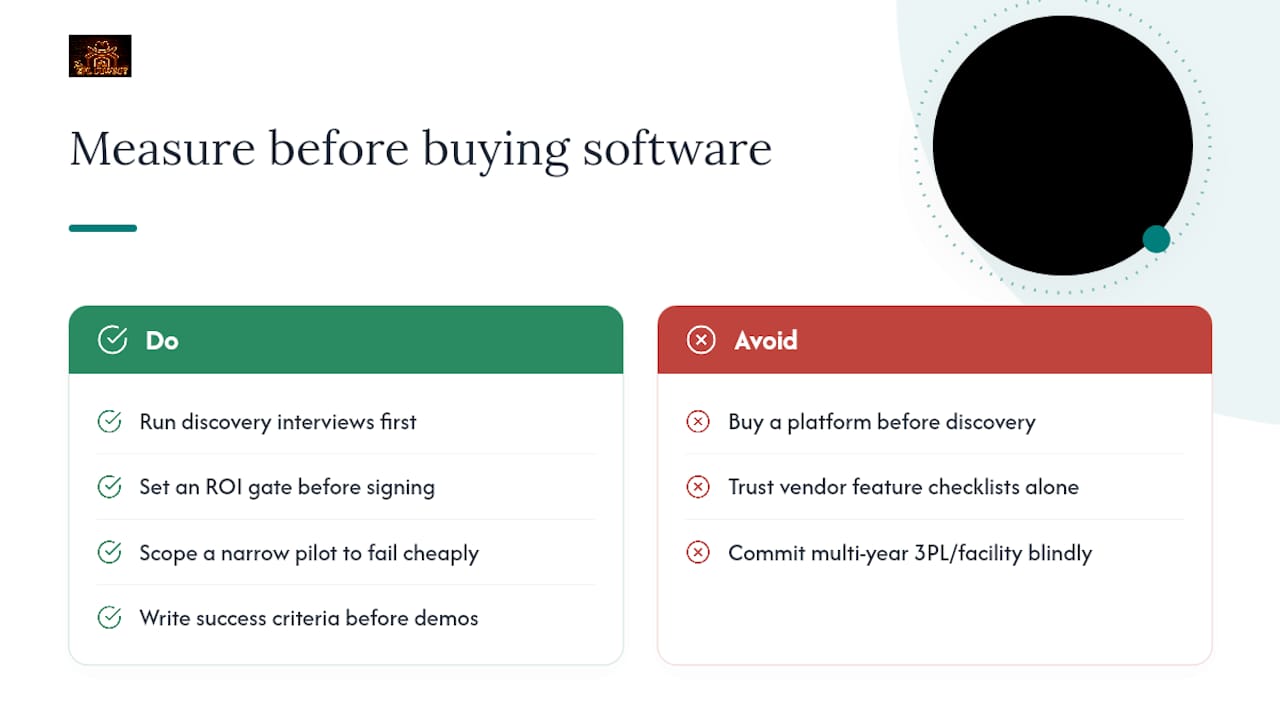
Most returns projects fail before a single dashboard gets built, because someone bought a platform before running discovery interviews. Feature checklists tell you what a vendor built. They tell you nothing about which of your five stages is actually broken.
Retained diligence earns its fee when the decision (build, buy, or outsource) carries real capital risk, like committing to a dedicated returns facility or a multi-year 3PL contract. Before signing anything, set an ROI gate, define a pilot scope narrow enough to fail cheaply, and write down success criteria before the vendor demo, not after.
— Michael
How The 3PL Cowboy helps you fix returns without the guesswork
3plcowboy is the alternative to a vendor sales call for returns process improvement: instead of a platform demo built to sell you software, you get underwriting-grade diligence built on 17-plus years of operating floors, not consulting theory.

If your team is trying to decide whether to fix returns internally, run an RFP for a dedicated returns partner, or benchmark your current cost per return against what’s actually achievable, that’s exactly the kind of engagement 3plcowboy runs for brands and 3PL operators. Services relevant to a returns project include 3PL selection and diligence, fulfillment cost benchmarking, and operations advisory, each built around the same discovery-first discipline covered above. The practice has taken operations from single-digit accuracy problems to industry-leading cycle count performance and delivered seven-figure annual savings through targeted redesigns, the kind of track record that comes from running floors, not just advising on them. If you’re weighing a returns overhaul against a software purchase, start with a conversation about your specific numbers before you sign anything.
Sources
The 5Ps of Returns Management white paper from UT’s Global Supply Chain Institute grounds the framework used throughout this piece, including the Philips case. ParcelLab’s returns optimization playbook covers the discovery audit method and seconds-per-return math. Signifyd’s guide to return optimization details risk-based friction, and Fortna’s returns processing research informs the warehouse-level and facility-decision guidance.