A supply chain control tower is a managed capability, not a piece of software: a team with the authority, process and decision rights to turn visibility into action. Done right, it resolves exceptions faster, produces measurable cost and service gains, and gives cross-functional leaders one governance hub for trade-off decisions. This guide walks through build versus buy, the operating model, rollout mechanics and the KPIs that prove the investment worked.
TL;DR:
- Building a control tower requires establishing clear decision rights and workflows linked to data alerts, not just deploying dashboards or software tools.
- The first use case should be high-value, measurable, and involve multiple functions, with quick wins typically achieved within one quarter.
- Success depends on a dedicated team with defined roles and authority, especially exception coordinators with escalation power and a governance model.
- A phased, use-case-driven rollout supported by low-code orchestration can deliver operational improvements in around 14 months without replacing legacy systems.
- The most common project failure occurs when organizations treat the control tower as a software purchase, neglecting operating model changes and decision authority.
Table of Contents
- What an operator-led control tower actually is
- When to build a control tower and how to pick the first use case
- The operating model: people, process, governance and bilingual talent
- Rollout and integration patterns that keep the project pragmatic
- In-house, outsource or hybrid: a rubric and the contract terms to demand
- Quick wins and the KPIs that prove the investment worked
- Practitioner proof: what real operating results look like
- Security and data privacy in control tower operations
- Case studies that show what a working control tower looks like
- Real-time analytics and visualization inside a control tower
- Technology architecture that supports the operating model
- Common pitfalls that stall or sink a control tower
- The take: build the team before you buy the tool
- How The 3PL Cowboy helps you build this the right way
- Sources
- FAQ
What an operator-led control tower actually is
A control tower is people, process and governance, supported by tools rather than defined by them. It works when a team has the authority to act on what the data shows: reroute a shipment, reprioritize a pick, escalate a vendor issue before it becomes a stockout.
Dashboards alone tend to fail for a specific reason: they surface problems without assigning anyone to fix them. Accenture frames the control tower as more than software, built through use-case-driven rollouts where early wins fund the next phase of work. Without decision rights attached to the alert, the team drowns in notifications nobody owns.
The payoff shows up when visibility gets tied to orchestrated action. AlixPartners and Accenture point to service and cost improvements when control towers convert alerts into resolved exceptions, with exception handling itself the fastest path to measurable ROI. That is the pattern worth building toward before anything else: a workflow, an owner, a resolution tracked
When to build a control tower and how to pick the first use case
Not every operation needs a control tower on day one. The signal is fragmentation: multiple systems, recurring exceptions, and manual handoffs between planning, warehouse and transportation teams that nobody owns end to end.
Run a quick assessment before committing capital:
- Do exceptions repeat weekly in the same lane, SKU category or node?
- Do handoffs between systems require a person to manually reconcile data?
- Does a single disruption cascade across multiple nodes without a clear owner?
- Is the data needed to act on the problem already captured somewhere, even imperfectly?
Pick the first use case using three filters: it has to carry measurable value, the data has to be reachable now, and it has to touch more than one function so the win builds cross-team credibility. A single exception-management sprint, scoped narrowly, often produces enough documented savings within one quarter to fund the second sprint. That is the self-funding model Accenture describes: use-case-led rollouts where early wins pay for what comes next, rather than a multi-year build funded up front.
Pro Tip: Start with the exception type that costs the most in expedited freight or missed SLAs, not the one that is easiest to instrument.
The operating model: people, process, governance and bilingual talent
The operating model is where most control towers actually live or die, not the technology layer underneath it. Four roles tend to recur across functioning operations:
- A network planner who owns the end-to-end view across nodes and carriers.
- An exception coordinator who resolves flagged issues within a defined SLA, not just logs them.
- A data steward who keeps the canonical data set trustworthy enough to act on.
- SLA owners in each function (warehouse, transportation, customer service) who commit to response times.
Decision rights matter as much as the roles themselves. KPMG’s operating-model guidance calls for documented decision rights and escalation paths so the control tower functions as an authoritative decision hub, with real trade-off authority including procurement levers, rather than a passive reporting layer. Someone has to be able to say yes to an expedited shipment or a reallocation without a three-day approval chain.
Talent is the differentiator practitioners keep coming back to. Locus’s practitioner insights describe the need for “bilingual” staff who combine hands-on operational experience with analytics fluency, because a dashboard without someone who can interpret and act on it becomes an alarm clock nobody answers. Align your S&OE cadence (daily and weekly exception review) with your S&OP cadence (monthly and quarterly planning) so the control tower feeds strategic decisions instead of running parallel to them.
Pro Tip: Give your exception coordinator explicit spending authority up to a defined dollar threshold; escalation delay is often the real cost, not the exception itself.
Rollout and integration patterns that keep the project pragmatic
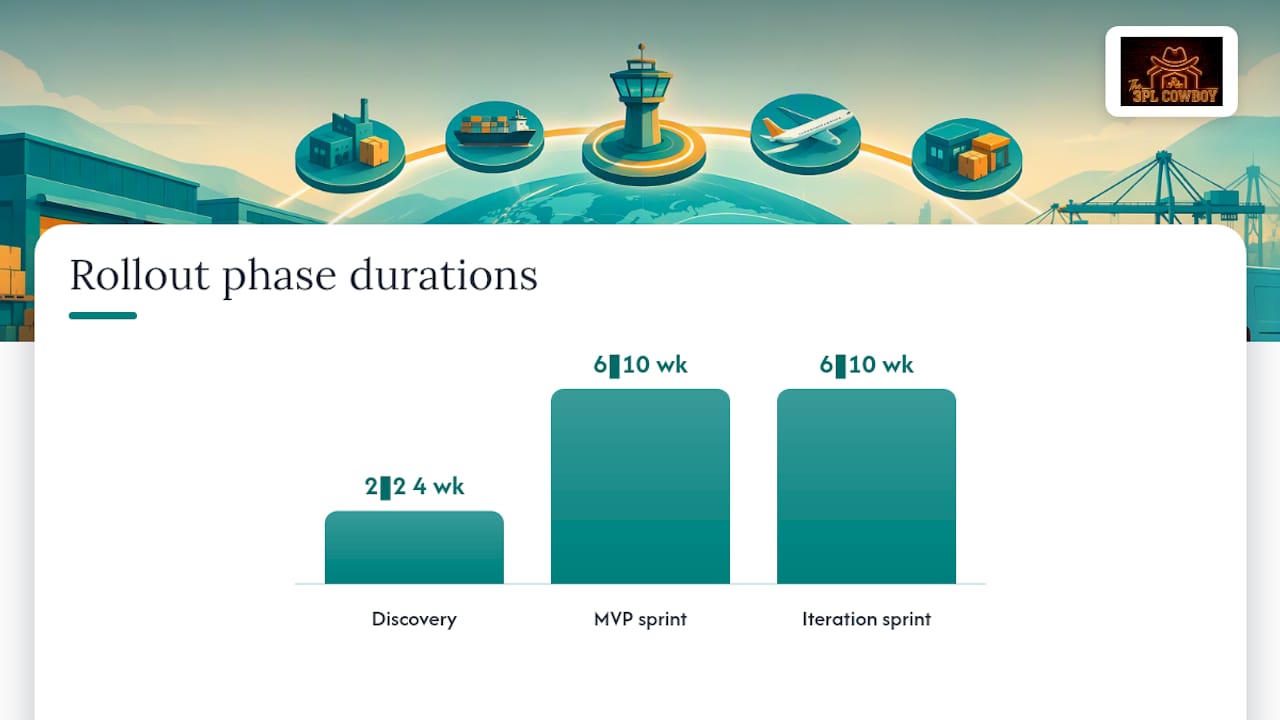
A phased, use-case-driven rollout beats a big-bang deployment for almost every team we have seen attempt this. Discovery runs two to four weeks and maps the highest-value use case plus the data actually available. The MVP sprint runs six to ten weeks and ships one working workflow, not a platform. Iteration sprints of similar length add the next use case once the first is proven and funding itself.
Integration does not require replacing legacy WMS or TMS systems. A 3PL case study on unifying warehouse systems shows a low-code orchestration layer placed above 12 separate WMS instances normalized data and orchestrated workflows across all of them, delivering major operational gains in roughly 14 months without a rip-and-replace. That same case points to the two components worth building first:
- An exception-handling workflow engine that routes flagged issues to an owner automatically.
- A unified order lifecycle view that gives every function the same status language.
- Client or internal self-service reporting that removes manual report requests from the coordinator’s day.
EDI and flat-file fallbacks stay in place for legacy trading partners who cannot support real-time APIs; the orchestration layer just needs to normalize what comes in, not force every partner onto the same protocol. For teams running their first structured pilot, a focused change-management approach built around one use case keeps scope from drifting into a platform project.
In-house, outsource or hybrid: a rubric and the contract terms to demand
The decision rarely comes down to preference; it comes down to complexity, scale, available talent and how fast you need value. A detailed insource versus outsource framework is worth running formally rather than deciding on instinct or a vendor’s pitch.
Use this rubric as a starting filter:
- Complexity and node count: more nodes and modes generally favor outsourcing execution.
- Talent availability: if bilingual operations-plus-analytics talent is scarce internally, outsourcing buys time.
- Speed to value: outsourced execution can often launch a pilot faster than an internal hire cycle.
- Capital posture: in-house build carries fixed headcount cost; outsourced models shift cost to variable.
A hybrid pattern shows up often in practice: strategic planning, KPI ownership and governance stay in-house, while execution-heavy exception monitoring and coordination get outsourced to a managed provider. Whichever model you choose, the contract needs specific clauses: named KPIs with defined measurement methods, audit rights over the data feeding those KPIs, a documented escalation path with response-time commitments, and formal change-control terms before scope expands. Brands weighing what to keep internal should treat those governance clauses as non-negotiable, not boilerplate.
Quick wins and the KPIs that prove the investment worked
The fastest visible wins tend to be exception automation, a unified order-status view, and self-service reporting that removes manual pulls from someone’s week. Track a small set of KPIs from day one rather than a long dashboard of vanity metrics:
- Average exception resolution time, measured from flag to close.
- Percentage of exceptions resolved without manual intervention.
- On-time-in-full (OTIF) rate for the specific lane or use case in the pilot.
- Reporting lag, the time between an event occurring and it showing up in a report.
One documented case shows a low-code orchestration layer unifying 12 warehouse systems delivered major operational improvements within roughly 14 months, a reminder that a first sprint’s timeline should be measured in months, not weeks, even when the win itself lands fast. Run the first formal business review at the 90-day mark, using the resolution-time and OTIF data to decide which use case earns the next sprint’s budget.
Practitioner proof: what real operating results look like
Michael Nooner built The 3PL Cowboy on 17 years of hands-on operating leadership, not advisory theory, running fulfillment operations for brands including Nike, Walmart, DHL, FedEx, Kellogg’s and Peloton. That background is the reason the operator-first framing runs through this guide rather than a software-first one.
A pallet-program redesign that delivered more than $6 million in annual savings for Kroger came from exception-driven process change, not a new dashboard. An eight-month WMS rollout across more than 60 Sysco sites shows what phased, use-case-driven implementation looks like at scale. Each result came from fixing decision rights and workflows first.
Security and data privacy in control tower operations
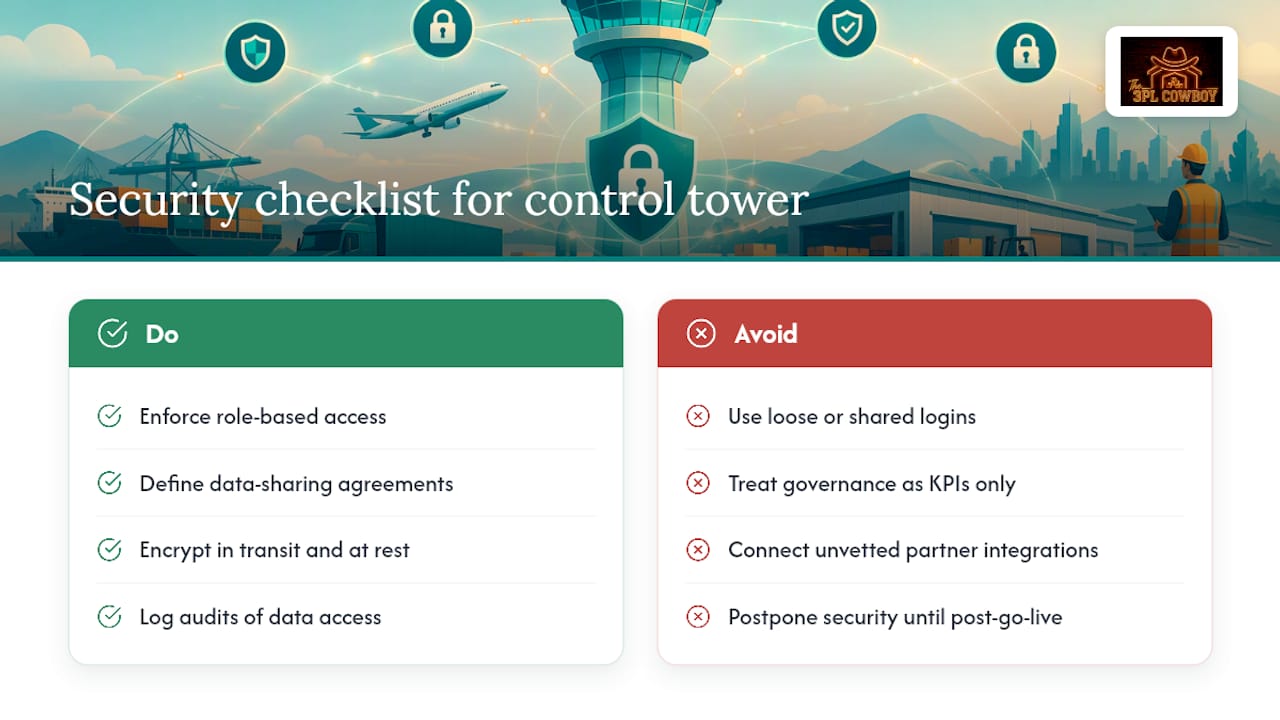
A control tower centralizes order, inventory and shipment data across every partner in the network, which makes it a concentrated target if access controls are loose. Role-based access matters more here than in most systems, because a network planner, an exception coordinator and an external 3PL partner all need different slices of the same data set, not the same login.
Data-sharing agreements with carriers, warehouse partners and any outsourced execution team should specify exactly what data crosses the boundary, how long it is retained, and who can export it. This matters more once execution is outsourced under a hybrid model, since the governance clauses discussed earlier need to cover data handling specifically, not just KPIs. Encryption in transit and at rest is table stakes for any system touching customer or shipment-level data, and audit logs on who accessed or changed exception records give you a paper trail when something goes wrong.
Supply chain networks are also a common entry point for broader cyber incidents, since a compromised partner integration can expose more than the partner’s own data. Guidance on preventing supply chain cyber vulnerabilities is worth reviewing alongside your control tower rollout, particularly before connecting new EDI or API integrations to partners you have not vetted before. Build the security review into the same discovery phase as the data-readiness assessment, not as an afterthought once the workflow engine is already live.
Case studies that show what a working control tower looks like
The clearest evidence for the operator-led model comes from operations that unified fragmented systems around a workflow rather than a dashboard. The 3PL case study on unifying 12 warehouse systems into one control layer shows the pattern in full: a low-code orchestration layer sat above the existing WMS and TMS instances, normalized the data flowing through them, and routed exceptions to owners, producing major operational gains within about 14 months without displacing any of the underlying systems.
That case is instructive because it did not start with a platform purchase. It started with the same sequence outlined earlier in this guide: pick the highest-value use case, prove it on the existing systems, then expand. The 12-system consolidation happened because the first workflow proved its value fast enough to justify connecting the next warehouse, and the next.
The Nike, Kroger and Sysco results described in the practitioner proof section above follow the same shape at a different scale: a specific, bounded problem (cycle count accuracy, pallet cost, a multi-site WMS rollout) solved through process and governance change first, with technology supporting the fix rather than defining it. The common thread across every credible example is sequencing: prove one use case, fund the next from its savings, expand deliberately.
Real-time analytics and visualization inside a control tower
Real-time visibility inside a control tower usually means an order-status feed, an exception queue and a small set of operational dashboards, not a sprawling business-intelligence build. The goal is a shared status language: everyone from the warehouse floor to the customer-service desk sees the same order state at the same time, which is what a unified order lifecycle view is built to provide.
Visualization tools matter less than what they are connected to. A dashboard that shows a late shipment but does not route that alert to an owner with authority to act produces what practitioners call dashboard fatigue. Locus’s practitioner insights describe exactly this failure mode: alerts pile up, nobody is assigned to them, and the team stops trusting the tower altogether. The fix is designing every visualization around a workflow trigger, so a red exception on a screen automatically creates a ticket with an owner and a deadline, not just a color change.
Keep the analytics layer scoped to the KPIs already defined for the active use case: exception resolution time, percentage automated, OTIF and reporting lag. Adding more metrics before the first use case is proven usually dilutes attention rather than adding insight. Once a use case is running cleanly, expand the visualization layer to the next node or workflow using the same discipline, rather than building a comprehensive view of the entire network up front.
Technology architecture that supports the operating model
The most pragmatic architecture pattern is a lightweight orchestration layer sitting above existing WMS, TMS and order-management systems, rather than replacing them. The 3PL warehouse-unification case demonstrates this directly: a low-code control layer normalized data from a dozen separate WMS instances and orchestrated workflows across them, avoiding a rip-and-replace while still delivering measurable gains within roughly 14 months.
That pattern rests on three pieces working together. A canonical event layer standardizes what an “order,” a “shipment” or an “exception” means across systems that each define those terms slightly differently. Low-code orchestration tools route events into workflows without requiring a custom integration for every system pair. EDI and flat-file fallbacks stay available for partners who cannot support modern APIs, so the architecture does not force a costly upgrade on every trading partner before the tower can go live.
AlixPartners’ guidance on practical digital reinforces the same posture from the data side: build around the imperfect data you already have, prioritize what a specific use case needs to make a decision, and iterate rather than waiting for a perfect, fully integrated data set before launching. That is the architectural mindset that keeps a control tower project from turning into a multi-year systems overhaul before it delivers a single resolved exception.
Common pitfalls that stall or sink a control tower
The most common failure mode is treating the control tower as a software purchase instead of an operating model change. A team buys a platform, wires up the data feeds and expects the dashboards to fix the underlying coordination problem, but nothing changes because nobody has the authority to act on what the screen shows.
A second pattern is weak governance: no documented decision rights, no escalation path, and KPIs that live in a report nobody reviews on a set cadence. KPMG’s operating-model guidance points to this directly, arguing that a control tower without real decision authority, including the power to make procurement trade-offs, becomes a reporting layer rather than a decision hub.
Other pitfalls recur often enough to name specifically:
- Scoping the first sprint too broadly, chasing every use case at once instead of proving one.
- Underinvesting in the exception coordinator role, so alerts pile up faster than anyone can resolve them.
- Ignoring data readiness until after the workflow engine is built, forcing a costly rework later.
- Skipping the security and access-control review until after partner integrations are already live.
Scaling past the first use case fails most often when the team never revisits the KPIs that justified the first sprint, so leadership loses confidence that the next one is worth funding. Treat every expansion the same way the first sprint was treated: a bounded, measurable bet, not an assumed continuation.
The take: build the team before you buy the tool
Skip the platform-first instinct. A control tower without decision rights is an alarm clock nobody answers, and one built on unclear governance just moves the coordination problem to a new screen. Build the operating model first; the tools should follow it, not the other way around.
— Michael
How The 3PL Cowboy helps you build this the right way
Most of the work described in this guide is operating-model work: deciding who owns what, which use case goes first, and whether execution stays internal or gets outsourced. That is exactly the diligence 3PL Selection & Diligence and 3PL Operations Advisory are built around, applied with the same underwriting-grade scrutiny whether you are choosing a partner or standing up an internal capability.

If your first move is a use-case pilot, Distribution Network Design and Warehouse RFP Management map directly to the rollout decisions covered above. See the full range of engagements on the services page and get a straight assessment of where your operation actually stands before committing budget.
Sources
- Benefits of Supply Chain Control Tower Solutions | Accenture
- Supply Chain Operating Model Roadmap for CSCOs | KPMG
- How a 3PL Unified 12 Warehouse Systems into One Control Tower
- Supply Chain Foundation: Building the Elusive Control Tower | AlixPartners
FAQ
What is a supply chain control tower, exactly?
A supply chain control tower is a managed capability built from people, process and governance, not a software product on its own. It works when a team has clear decision rights to act on exceptions, supported by tools that surface and route the issues, as Accenture’s framing of the concept makes clear.
How long does it take to implement a control tower?
Discovery typically runs two to four weeks, followed by a six to ten week MVP sprint focused on one use case. One documented example, a low-code orchestration layer unifying 12 warehouse systems, delivered major operational improvements within roughly 14 months, which gives a realistic sense of scale for a multi-system rollout rather than a single pilot.
Should we build a control tower in-house or outsource it?
The right answer depends on network complexity, available talent and how fast you need results, which is why a formal insource versus outsource analysis is worth running rather than guessing. Many operations land on a hybrid model, keeping strategic planning and KPI ownership internal while outsourcing execution-heavy exception monitoring.
What KPIs should we track first?
Start with exception resolution time, the percentage of exceptions resolved without manual intervention, on-time-in-full rate for the pilot lane, and reporting lag. These four give a clear read on whether the first use case is working before you expand to the next one.
What is the biggest reason control tower projects fail?
The most common failure is treating it as a software purchase rather than an operating model change, so dashboards go live without anyone holding clear authority to act on them. KPMG’s operating-model guidance points to the same root cause: no documented decision rights, so the tower ends up reporting problems instead of resolving them.