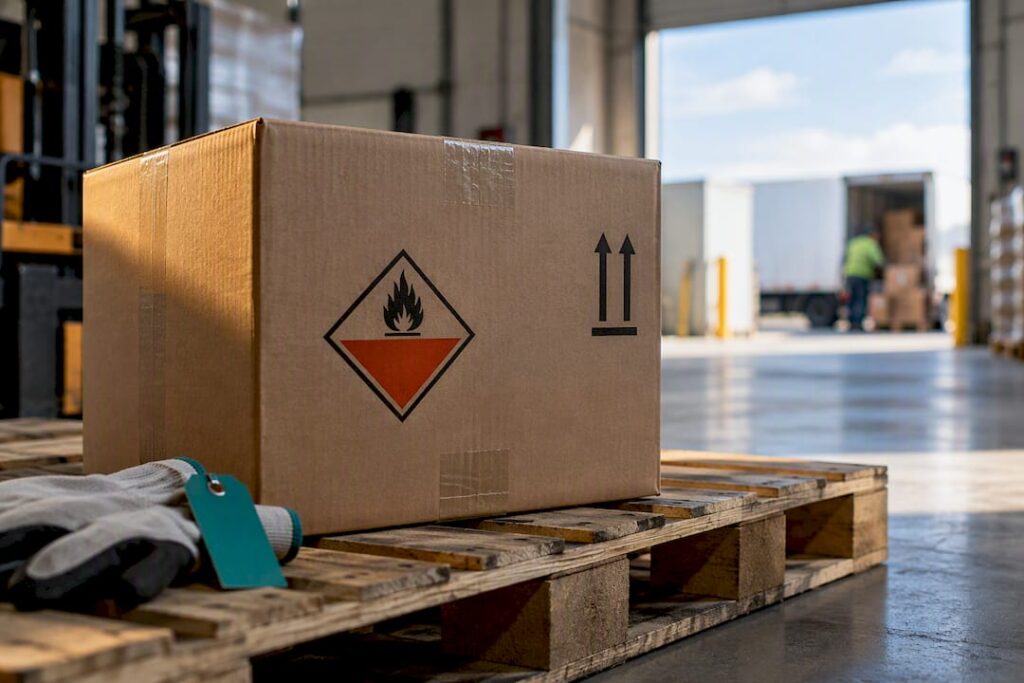
Hazmat shipping compliance under 49 CFR Parts 171-180 puts the shipper, not the carrier, on the hook for six things: classify the material correctly, package it in authorized containers, mark and label it, complete shipping papers with a signed certification, keep training and security programs current, and verify the carrier holds the right permits before freight ever leaves the dock. Before you tender a single shipment, confirm two things right now: that your business is registered with PHMSA if registration applies to you, and that you can reach an emergency-response contact within minutes if something goes wrong in transit.
TL;DR:
- Proper classification using the Hazardous Materials Table is essential, especially for blended products or aerosols, to avoid costly mislabeling and repacking.
- Packaging must match the classification, with specific requirements for DOT specification or UN-rated containers, and closure instructions must be followed precisely and documented.
- Correct marking, labeling, and placarding are critical, with separate rules for packages, vehicles, and freight containers, particularly for lithium batteries and other specialty categories.
- Shipping papers must follow strict sequences, and the signed certification confirms compliance at every step before shipment departure.
- Verify carrier permits and PHMSA registration before tendering hazardous shipments, and prepare with documented incident response procedures to handle emergencies effectively.
Table of Contents
- What Does Hazmat Shipping Compliance Actually Require?
- Classification First: Using the Hazardous Materials Table and UN/NA Numbers
- Packaging and Closure: DOT Spec, UN Performance, and Overpacks
- Marks, Labels, and Placards: What Goes Where
- Shipping Papers and the Shipper’s Certification
- Training and Security Plans: Who Needs What, and How Often
- Verifying Carrier Permits and PHMSA Registration Before You Tender
- What to Do When a Hazmat Incident Happens
- Building an Operator-Grade Compliance Program on the Floor
- Where Hazmat Compliance Actually Breaks Down
- How 3plcowboy Helps You Build an Audit-Ready Compliance Program
- Sources
- FAQ
What Does Hazmat Shipping Compliance Actually Require?
The Hazardous Materials Regulations, codified at 49 CFR Part 173, assign the shipper primary legal responsibility for getting a hazmat shipment right. That is not a technicality. If a carrier moves your freight improperly labeled or under the wrong classification, the enforcement action starts with you, the offeror of the shipment, not just the trucking company that hauled it.
Compliance breaks into a strict order, and the order matters more than most shippers realize. Classification comes first because every downstream decision, packaging type, label set, shipping paper language, quantity limit, depends on the entry you pull from the Hazardous Materials Table. Skip that sequence and you end up repacking pallets at the dock because someone guessed at a packing group instead of confirming it.
Michael Nooner of 3plcowboy has seen this play out across warehouse floors handling everything from Kellogg’s-scale CPG volume to smaller apparel and beauty operations shipping aerosol products for the first time. The pattern repeats: teams treat hazmat as a packing problem, when it is a classification problem that happens to end in a box.
Classification First: Using the Hazardous Materials Table and UN/NA Numbers
Every hazmat shipment starts with a single lookup: the Hazardous Materials Table at 49 CFR 172.101. That table assigns the proper shipping name, hazard class, UN or NA number, and packing group for a given material, and it drives everything else, packaging type, label requirements, and shipping-paper description, in a fixed sequence you cannot reorder.
Most shippers start with a Safety Data Sheet, and that is a reasonable first move. DOT’s own “Check the Box” guidance treats the SDS as a starting point for identifying hazard characteristics, not a final answer. An SDS tells you what a chemical does; it does not always tell you the exact packing group or whether a subsidiary hazard applies. Formulations change, pack sizes change, and an SDS written for OSHA workplace purposes does not automatically translate into a transport classification.
When the SDS leaves ambiguity, and it often does for blended products, aerosols, or anything near a hazard-class boundary, you have two paths: request manufacturer testing data that speaks directly to transport classification, or pursue a competent authority approval through PHMSA when the material does not clearly fit an existing table entry. Guessing at this stage is the single most expensive mistake in hazmat shipping compliance, because it invalidates the packaging choice, the labels, and the shipping papers all at once.
Build a five-point checklist before you commit a SKU to hazmat status:
- Cross-check the SDS hazard information against the Hazardous Materials Table entry for the material’s chemical identity.
- Confirm the assigned hazard class and division match the product’s actual composition, not a similar product’s history.
- Assign the correct packing group (I, II, or III) based on the degree of danger, not the loosest option that seems convenient.
- Check for subsidiary hazards, many materials carry more than one hazard class, and each one changes labeling.
- Verify mode restrictions separately for ground, air, and ocean, since a material fine for truck freight can be forbidden or restricted on a passenger aircraft.
Pro Tip: Never let a new SKU go live in your warehouse management system until someone with classification authority signs off on the Hazardous Materials Table lookup in writing. A verbal “it’s probably a Class 9” from a warehouse supervisor is how limited-quantity aerosols end up placarded wrong six months later.
Classification decisions age poorly if nobody revisits them. A reformulated cleaning product or a new pack size can shift a packing group without anyone in shipping noticing, which is exactly why the classification record needs a place to live outside someone’s memory.
Packaging and Closure: DOT Spec, UN Performance, and Overpacks
Hazmat packaging comes in two families, and mixing them up is a common, avoidable error. DOT specification packaging follows exact construction requirements spelled out in the regulations, while UN performance-oriented packaging is tested to a standard, marked with a UN certification code, and rated for specific packing groups. Part 173 governs which family applies to which material, and the packing group from your classification step determines what test level the packaging must survive.
Air shipments frequently demand stricter packaging than ground freight for the same material, since altitude and pressure changes introduce failure modes a truck never encounters. Ocean shipments carry their own overlay through the IMDG Code, which does not always mirror the ground rules exactly. Never assume packaging approved for one mode automatically clears another.
Closure instructions are where warehouses lose the thread. Manufacturers of UN-rated packaging issue specific closure instructions, torque values, gasket requirements, the number of turns on a cap, and those instructions have to be followed exactly and retained on file. This is not paperwork for its own sake. A packaging test certification is only valid when the package is closed exactly the way it was tested, and inspectors can and do ask to see the retained closure instructions during an audit.

Statistic Callout: PHMSA’s own recordkeeping structure under Part 173 requires shippers to retain manufacturer packaging certification and closure documentation, since a package closed even slightly differently than tested no longer carries the protection the UN rating implies.
Set up pack-station controls that catch failures before the truck leaves:
- Confirm the correct packaging spec is pulled for the SKU’s assigned packing group before the box is built.
- Verify closure instructions are posted at the pack station, not filed in a binder three departments away.
- Inspect every overpack for visible inner-package markings; when they are not visible through the overpack, the overpack itself needs representative markings and the word “OVERPACK.”
- Check gross weight and dimensions against the limited-quantity or excepted-quantity thresholds for that material before defaulting to full hazmat packaging.
- Log the packaging lot or certification code used on each shipment for traceability.
Overpack inspection deserves its own line item on a checklist, not a mental note. It is a routine failure point precisely because it looks like the packaging step is already finished by the time someone reaches for a shrink wrap or a master carton.
Marks, Labels, and Placards: What Goes Where
A package marking and a hazard label are not the same requirement, and confusing them is how compliant-looking cartons still fail an audit. Under Part 172, every hazmat package needs the proper shipping name and UN or NA identification number marked directly on the package, in the format and size specified for that material’s quantity. The hazard class label, the diamond-shaped placard familiar from tanker trucks, is a separate requirement layered on top of the marking, and both have to be visible and durable enough to survive normal handling.
Placarding is a different question entirely, applying at the vehicle or freight-container level rather than the individual package. A truck carrying enough hazmat by weight or class needs placards on the exterior of the vehicle, and that threshold depends on hazard class and total quantity, not on whether the individual cartons inside are labeled. A fully labeled pallet does not guarantee the truck hauling it is correctly placarded; that decision belongs to whoever is loading the conveyance, and shippers moving full truckloads of hazmat need to confirm placarding happens, not assume the carrier handles it automatically.
Run through this sequence for every outbound hazmat shipment:
- Confirm the proper shipping name and ID number are marked on the package in the correct format for the material and quantity.
- Apply the correct primary hazard class label, and any subsidiary hazard labels the classification requires.
- For liquids in certain orientations, apply orientation arrows on two opposite sides of the package, since inverted liquid hazmat is a recurring cause of leaks in transit.
- Check special label categories separately, lithium battery marks and infectious substance labels follow distinct rules under Part 172 and are easy to miss if your team only trained on general hazard classes.
- Verify label and marking visibility through any overpack or unit-load configuration before it leaves the dock.
- Confirm placarding responsibility for the conveyance is assigned and documented, whether that falls to your team or the carrier’s.
Lithium battery shipments in particular carry packaging and labeling nuances that trip up teams shipping electronics or battery-powered products for the first time; carrier-specific guidance like BuyBackBear’s guide to shipping lithium batteries and devices is a useful field reference for that narrower slice of hazmat.
Shipping Papers and the Shipper’s Certification
The shipping paper is the legal record of what you told the carrier you were handing them, and it has to follow an exact sequence, not just contain the right information somewhere on the page. Under 172.204 and the surrounding sections, the basic description must appear in this order: UN or NA identification number, proper shipping name, hazard class or division, and packing group, followed by any required additional entries like quantity and packaging type.
The shipper’s certification is the sentence that turns a shipping paper into a legal attestation. The standard language certifies that the material is properly classified, described, packaged, marked, labeled, and in proper condition for transport according to the applicable regulations. Whoever signs that certification is putting their name on every step that came before it, which is exactly why classification and packaging sign-off need to happen before someone signs a shipping paper, not after.
Air shipments carry an extra wrinkle: many air waybills require duplicate shipper’s certifications, one for the shipper’s file and one that travels with the shipment, and air carriers often layer their own operator variations on top of the base federal requirement. If your operation ships hazmat by air even occasionally, confirm the specific carrier’s air-variation requirements rather than assuming your ground shipping-paper template covers it.
- Basic description in the mandated sequence: ID number, proper shipping name, hazard class, packing group.
- Total quantity and unit of measure for the hazmat portion of the shipment.
- Emergency-response information, either directly on the paper or referenced to an accessible emergency-response guide.
- The signed shipper’s certification statement, dated and attributable to a specific person.
- Any special permit or approval numbers referenced by the classification.
Pro Tip: Build a single auditable shipment packet for every hazmat load, shipping paper, classification record, packaging certification, and carrier acceptance confirmation, filed together under one shipment reference. When PHMSA or an insurer asks for documentation after an incident, the difference between finding everything in one folder and reconstructing it from four departments is the difference between a clean audit and a bad week.
Training and Security Plans: Who Needs What, and How Often
Part 172 Subpart I requires hazmat employees to complete training before they perform hazmat functions unsupervised, with recurrent training required at least every three years. The regulation is function-specific by design: a picker who selects hazmat SKUs, a packer who closes UN-rated containers, a shipping clerk who signs certifications, and a driver who loads placarded trailers all touch hazmat differently, and PHMSA’s training framework expects content tailored to each function rather than one generic hazmat video for the whole warehouse.
Security plans are a separate, mandatory document for shippers and carriers handling certain quantities and classes of hazardous materials, and they are not interchangeable between facilities. A plan built around personnel security, access control, and en-route security has to reflect the actual site, its staging areas, its access points, its shift patterns, because a security plan copied from a sister facility routinely misses the exact vulnerabilities specific to that building’s layout and routing.
Treat training and security compliance as an operational build, not a binder:
- Map every warehouse role that touches hazmat to a specific training module, not a shared general-awareness course.
- Store training completion records with dates and content summaries, since “we trained everyone” without records is functionally the same as not training at all during an audit.
- Include personnel security screening, unauthorized-access controls, and en-route security measures in the written plan, matched to your actual facility.
- Review and update the security plan at least annually, and immediately after any change in facility layout, shift structure, or hazmat volume.
- Fold security-plan awareness into new-hire onboarding for any role with hazmat contact, rather than treating it as a separate annual event.
Verifying Carrier Permits and PHMSA Registration Before You Tender
PHMSA’s current registration cycle runs from July 1, 2026 through June 30, 2027, and businesses that meet the registration thresholds, based on hazmat volume, classes shipped, and other criteria, need to confirm their status in PHMSA’s registration system before that window opens or before starting any activity that requires registration. Registration fees vary by category, so check your specific registrant classification rather than assuming a flat fee applies.
PHMSA registration and FMCSA’s Hazardous Materials Safety Permit are two different requirements that get conflated constantly. PHMSA registration applies to shippers and certain carriers based on hazmat activity generally. The FMCSA Hazardous Materials Safety Permit is a narrower requirement triggered by specific high-consequence materials and quantities, radioactive materials, certain explosives, large quantities of specific hazard classes, and it applies to motor carriers, not shippers directly.
Before tendering freight, work through this sequence every time a new carrier or lane enters the picture:
- Confirm your own business’s PHMSA registration status is current for the active cycle, not assumed from last year’s filing.
- For high-consequence shipments, verify the carrier holds an active HMSP rather than inferring compliance from a valid USDOT number alone, since a USDOT number confirms general motor carrier authority, not hazmat permit status.
- Document carrier acceptance of the shipment, including any carrier-specific hazardous-materials agreement they require signed before pickup.
- Build these checks into your tendering standard operating procedure so a new hire booking freight cannot skip the verification step under deadline pressure.
Shippers who move hazmat freight regularly should treat carrier verification as a standing part of transportation strategy, not a one-time vetting exercise, particularly as lanes and carrier mixes shift with peak volume or new distribution markets. That is the kind of structural gap a parcel and transportation strategy review tends to surface fast.
What to Do When a Hazmat Incident Happens
The first minutes after a hazmat incident, a leak, a spill, a damaged package discovered mid-transit, determine whether the paperwork that follows is straightforward or a liability problem. Stabilize the situation and get emergency responders engaged first; nothing about compliance documentation matters if someone is at risk. Once the scene is safe, get your emergency-response contact engaged, document the scene with photos and notes on what was observed, and preserve the shipment packet, shipping papers, classification records, packaging certifications, intact rather than letting it get filed away or discarded.
PHMSA’s incident reporting rules under 171.15 require immediate telephone reporting for incidents meeting certain severity thresholds, death, serious injury, significant property damage, or evacuation, and a detailed written report within 30 days for incidents that meet the broader reporting criteria even without an immediate call-in requirement. Knowing which threshold you have crossed matters, and when it is ambiguous, the safer path is reporting rather than assuming an incident falls below the line.
Pro Tip: Keep a one-page incident response card at every dock and pack station listing the emergency-response phone number, the immediate-reporting threshold criteria, and who internally owns the 30-day written report. In the chaos of an actual incident, nobody remembers the regulation citation; they need the phone number and the next step in front of them.
Preserve these records for every hazmat shipment, not just the ones that go wrong, since you will not know which shipment needs them until after the fact:
- The SDS and classification decision record for the material involved.
- The packaging instruction and manufacturer closure documentation used.
- The complete shipping papers, including the signed certification.
- Training records for every employee who handled the shipment.
- Carrier acceptance documentation and any hazardous-materials agreement.
- Photos, telematics data, and a written incident log if an incident occurred.
Building an Operator-Grade Compliance Program on the Floor
Regulations tell you what is required. They do not tell you how to build a warehouse floor that actually complies on the thousandth shipment the same way it did on the first. That gap is where most hazmat compliance programs quietly fail, not at the policy level, but at the pack station six months after the policy was written.
Start with the product master. Every hazmat SKU needs a dedicated record separate from the SDS text, holding the UN or NA number, proper shipping name, class and division, packing group, assigned packaging instruction, limited-quantity status, mode restrictions, an emergency-response contact number, any approval or special permit references, and a last-reviewed date. Keeping this separate from the SDS matters because SDS documents change on the manufacturer’s schedule, not yours, and a silent formulation change can drift your transport classification without anyone updating the shipping side.
At the pack station, build in six checks as standard procedure, not tribal knowledge:
- Confirm classification against the product master before pulling packaging.
- Verify manufacturer closure instructions are present and followed exactly.
- Check overpack visibility and apply representative markings when inner labels are obscured.
- Pair the correct shipping paper to the physical shipment before it leaves the station.
- Confirm carrier acceptance and any required hazardous-materials agreement.
- Require a signed pack checklist for every hazmat shipment, tying a name to each completed step.
The contract layer matters just as much as the floor layer, especially in brand-to-3PL relationships. Operating agreements should explicitly assign who owns classification decisions, who approves packaging, who prepares and signs shipping papers, who owns training records, and who is responsible for incident reporting. Ambiguity here is not a paperwork gap; it is the reason two parties each assume the other one handled the certification.
| Compliance function | Typically owned by |
|---|---|
| Classification decision | Brand (with 3PL input on packaging fit) |
| Packaging approval | 3PL, verified against brand’s classification |
| Shipping paper preparation | 3PL operations |
| Training program | 3PL, documented for brand audit access |
| Incident reporting | Whoever has custody at time of incident |
| Record retention | Joint, defined in operating agreement |
Where Hazmat Compliance Actually Breaks Down
Most hazmat compliance failures I’ve seen trace back to a handful of repeat offenders, and none of them are exotic. Misclassification tops the list, usually because someone trusted an SDS as a final answer instead of a starting point, and the fix is simple: require signed classification sign-off before any hazmat SKU goes live. Hidden overpacks come next, cartons palletized without checking whether inner markings are still visible, and the fix is making overpack inspection its own checklist line, not an assumed step inside “packaging is done.”
Inadequate function-based training causes a specific kind of failure: a picker trained on general hazmat awareness but never on the specific handling quirks of aerosols or lithium cells makes different mistakes than an untrained picker would, because they think they know what they are doing. And the most dangerous assumption of all is believing a carrier’s acceptance of a shipment somehow retroactively fixes a shipper’s classification or packaging error. It does not. Carrier acceptance is not a compliance audit.
The fix that actually holds up across a growing SKU count is structural: lock classification into the product master, require documented signoff before activation, and treat that record as the single source of truth every downstream team pulls from. Programs built on operator discipline, drawn from running inventory operations at Nike-scale accuracy and cost-saving redesigns at Kroger-scale volume, hold up under audit precisely because they do not rely on anyone remembering the rule correctly under deadline pressure.
— Michael
How 3plcowboy Helps You Build an Audit-Ready Compliance Program
Hazmat compliance rarely fails because a company does not know the regulations exist. It fails because classification ownership, packaging sign-off, and training records live in different systems and nobody owns the seams between them. That kind of structural gap operator-led advisory work is built to close, not by writing a policy binder, but by fixing the contract language, the pack-station controls, and the carrier-tendering rules that let compliance drift in the first place.

If you are evaluating a 3PL partner for hazmat-capable fulfillment, 3PL Selection & Diligence puts underwriting-grade scrutiny on a candidate’s actual packaging and training capabilities before you sign, not after a failed audit reveals the gap. If your existing operation needs pack-station remediation or clearer SOPs, 3PL Operations Advisory and Parcel & Transportation Strategy address the carrier-verification and tendering-rule gaps this guide walks through. Every engagement is built on 17-plus years of direct operating leadership, not theoretical frameworks. Visit the full services list and book a consult to get your hazmat program audit-ready before your next PHMSA registration cycle.
Sources
Skip the secondhand summaries when the actual rule is one click away. Start with 49 CFR Part 173 for packaging and general shipper requirements, and 49 CFR Part 172 for the Hazardous Materials Table, marking, labeling, and training rules. For registration timing and fees, check PHMSA’s registration information directly rather than a third-party summary.
For carrier permit questions, FMCSA’s Hazardous Materials Safety Permit Program page clarifies who needs one. New shippers should start with DOT’s Check the Box getting-started guidance, and everyone handling hazmat freight should bookmark PHMSA’s incident reporting page before an incident happens, not after.
- 49 CFR Part 173 – Shippers—General Requirements for Shipments and Packagings
- 49 CFR Part 172 – Hazardous Materials Table, Special Provisions, Hazardous Materials Communications, Emergency Response Information, Training Requirements, and Security Plans
- PHMSA registration information
FAQ
What Are the Shipping Requirements for Hazmat Items?
Hazmat items must be classified using the Hazardous Materials Table, packaged in authorized DOT or UN-rated containers, marked and labeled per Part 172, and accompanied by shipping papers with a signed shipper’s certification. The shipper also needs current employee training, an applicable security plan, and verified carrier permits before the shipment moves.
Do Hazmat Items Need to Be Shipped in a Box?
Not necessarily a box specifically, but hazmat items must go into authorized packaging rated for the material’s hazard class and packing group under 49 CFR Part 173. That can mean a DOT specification drum, a UN performance-tested carton, or another certified container, and the packaging choice depends entirely on the classification result, not on convenience.
Who Regulates Hazmat Shipping?
The Pipeline and Hazardous Materials Safety Administration (PHMSA) writes and enforces the core Hazardous Materials Regulations at 49 CFR Parts 171-180. The Federal Motor Carrier Safety Administration (FMCSA) regulates motor carrier permits, including the Hazardous Materials Safety Permit for high-consequence shipments, while modal agencies add air- and ocean-specific rules on top.
How Many Pounds of Hazmat Can I Carry Without a Hazmat Endorsement?
Endorsement thresholds depend on the specific hazard class and whether placarding quantities are reached, not a single universal weight figure, so drivers and shippers need to check the applicable class-specific threshold in the Hazardous Materials Table rather than relying on a rule of thumb. When in doubt, treat the shipment as regulated and verify the exact threshold for that material’s hazard class before assuming a small-quantity exception applies.
Does 3plcowboy Help With Hazmat Compliance Directly?
3plcowboy does not file classifications or hold PHMSA registration on a client’s behalf. The advisory work focuses on fixing the operational and contractual gaps, carrier verification, pack-station controls, and 3PL selection criteria, that cause compliance programs to fail, which you can explore through the services page.