Engineered labor standards are element-level, defensible time expectations built from measured work, not guesswork or gut-feel benchmarks. They let you plan headcount, coach performance, and control labor cost with far fewer surprises. The signals that separate a real program from a spreadsheet full of round numbers are OLE, predetermined motion time systems, and labor efficiency variance, all of which get their own treatment below.
TL;DR:
- Most standards decay over time when layout, SKU mix, or equipment change without re-timing, which can lead to inaccurate staffing and costing.
- Building an effective engineering standard requires breaking tasks into elements, collecting data with appropriate methods, and validating before full implementation.
- Using a hybrid approach—combining time studies, predetermined motion time systems, and work sampling—provides more accurate and maintainable labor standards.
- Maintaining a standard involves ongoing governance, revalidation triggers, and ownership to prevent drift and ensure standards reflect current conditions.
- Key KPIs like labor efficiency variance, direct labor efficiency, and overall labor effectiveness help diagnose whether standards are functioning and highlight areas for improvement.
Table of Contents
- What Are Engineered Labor Standards and Why “Engineered” Matters
- Core Methods for Building Labor Efficiency Metrics
- How Does the ELS Maturity Model Work?
- How Do You Build and Roll Out Engineered Labor Standards?
- Which KPIs Actually Prove ELS Are Working?
- Common Pitfalls That Wreck an ELS Program
- Implementation Checklist: Owners, Data, and Cadence
- What Actually Happens When You Roll These Out
- How 3plcowboy Helps You Build Standards That Actually Hold
- Sources
- FAQ
What Are Engineered Labor Standards and Why “Engineered” Matters
An engineered labor standard (ELS) breaks a task into its component motions, times each one against a defined method, and adds allowances for fatigue, personal needs, and delay. The result is a standard tied to a specific method, not a historical average of however people happened to do the job last quarter. That distinction is the whole point of the word “engineered.”
Compare a units-per-hour (UPH) target to an actual ELS. A UPH target of 120 units per hour might come from last month’s average output, blending fast pickers, slow pickers, bad slotting days, and a broken cart wheel into one number. An engineered standard for the same job would define the pick method step by step: travel distance per pick, reach and grasp time, scan time, place time, and a documented allowance percentage for rest and unavoidable delay. Change the layout or the cart, and you know exactly which element to re-time.
That granularity is what makes an ELS auditable. When a worker disputes a standard, you can walk through the elements with them and show your work, the same way an accountant walks through a variance report. A UPH number invites arguments because nobody can point to where it came from. An element-based standard invites questions you can actually answer, which is a very different kind of conversation to have on the floor.
Core Methods for Building Labor Efficiency Metrics
Three methods dominate how operations build labor standards, and each has a place depending on task volume, task variability, and how fast you need results.
Time and motion study puts a trained analyst with a stopwatch (or video) on the floor to time a worker performing a task through multiple cycles. Done well, it captures the real method, not an idealized one, and it works best on high-volume, repetitive tasks where enough cycles can be observed to get a statistically sound average. The catch: it requires a qualified observer, a big enough sample to smooth out variation, and a worker performing at a “normal” pace, not sandbagging or sprinting for the clock.
Predetermined motion time systems (PMTS), including Methods Time Measurement (MTM) and MOST, assign fixed time values to basic motions like reach, grasp, move, and position, based on decades of industrial engineering research rather than a stopwatch on your specific floor. You build a standard by sequencing the motions a task requires and summing their predetermined times. PMTS shines when you’re designing a new process before it exists, or when you need a standard nobody can accuse of being timed on a good day or a bad one.
Work sampling and standard data systems estimate labor utilization through random observations across a shift rather than continuous timing, and they scale well across large, varied operations. Their weakness shows up at the task level: they’re good for utilization percentages, weak for setting a precise standard on any single task.
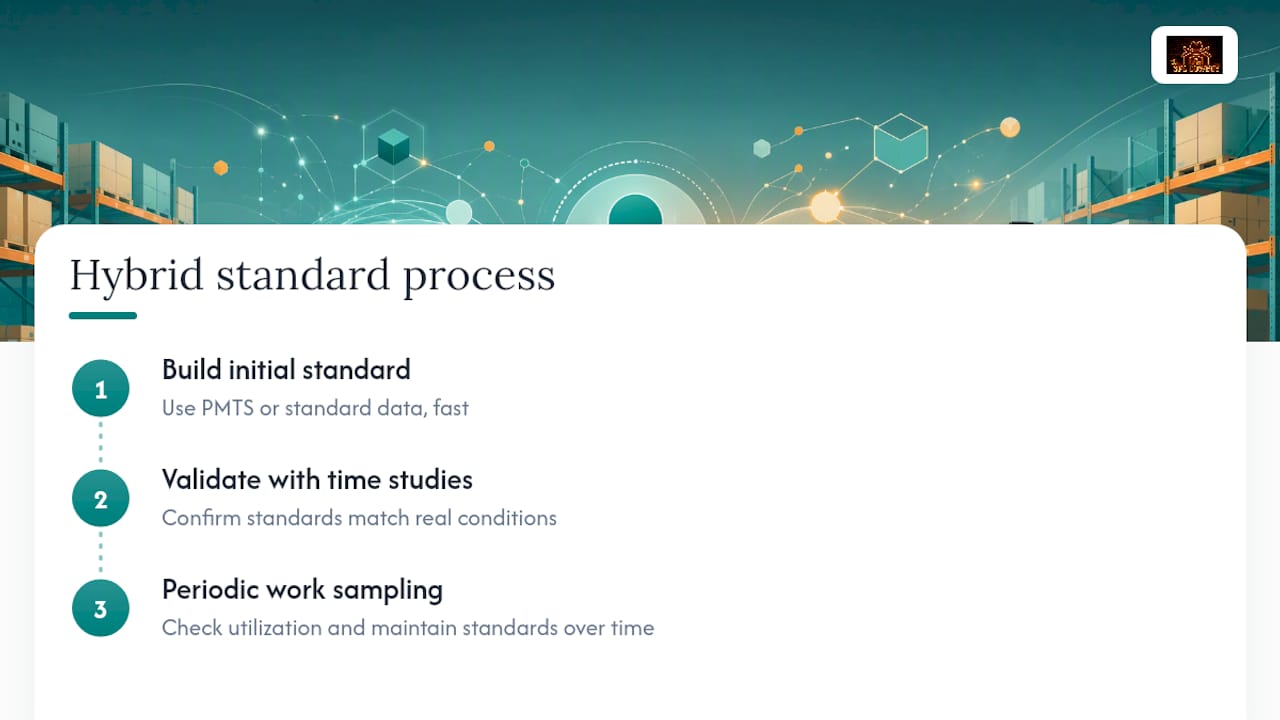
Most mature programs land on a hybrid approach: PMTS or standard data to build the initial standard fast, time studies to validate it against real conditions, and periodic work sampling to check overall utilization. This blend is generally more accurate than any single method and far easier to maintain as tasks evolve.
How Does the ELS Maturity Model Work?
Engineered labor standards aren’t a one-time project. They move through maturity stages, and where your operation sits determines whether standards actually drive decisions or just sit in a binder nobody opens after the launch meeting.
Historical baseline is the starting point most warehouses never leave: standards based on past averages, no method documentation, no real defensibility. Engineered standards mark the first real jump, with element-level times built from time studies or PMTS and tied to a defined method. Governed standards add ownership and change control: someone owns revalidation, standards get updated when layout or SKU mix shifts, and there’s a documented process for challenges. Real-time validation is the top tier, where a warehouse management system or labor management system compares actual performance against the standard continuously, flagging drift the same shift it happens instead of in a report three weeks later.
The operational difference between tiers is stark. A historical-baseline operation plans headcount off last quarter’s trend and finds out it was wrong when the trucks are already late. A real-time validation operation sees a standard drifting out of tolerance mid-shift and can retrain, reassign, or re-slot before the variance compounds. The Future WFM Operating Standard frames this shift as moving workforce management toward continuous variance harvesting and probabilistic forecasting rather than static, backward-looking plans. That’s the direction the best-run distribution centers are already heading, whether or not they call it a “maturity model.”
How Do You Build and Roll Out Engineered Labor Standards?
Building a program that survives contact with a real warehouse floor takes more discipline than most teams expect going in. Here’s the order that actually works.
- Stabilize the method first. Standardizing a broken or inconsistent process just engineers the mess into a permanent number. Fix layout, slotting, and workflow issues before you time anything.
- Define scope and break tasks into elements. Pick the processes worth engineering, usually the highest-volume or highest-labor-cost tasks, and decompose each into its component motions.
- Collect baseline data with the right method for the task. Use time studies for high-repetition work, PMTS for new or low-frequency tasks, and make sure your sample size is large enough to smooth out normal variation.
- Pilot in a controlled area before going wide. Run the standard against real throughput and quality outcomes on one shift or one zone, and compare the predicted time to what actually happens under normal working conditions.
- Validate and adjust before full rollout. Reconcile any gap between predicted and observed performance, and confirm the standard holds up across different workers, not just your fastest one.
- Roll out with governance built in from day one. Assign an owner, set a revalidation cadence, and define the triggers (layout change, new SKU, new equipment) that force a standard to be re-timed.
Pro Tip: Pilot your first standard in the zone with the most SKU or layout stability you have, not the busiest one. You want a clean signal on whether the method works before you introduce the noise of a high-variability process.
Standards also need to respect real working conditions, not just theoretical throughput. The Fair Labor Association’s compliance benchmarks are a useful check that your allowances for rest, hours, and humane scheduling hold up alongside your productivity math, not against it.
Which KPIs Actually Prove ELS Are Working?
Three metrics do most of the heavy lifting once standards are in place, and each answers a slightly different question.
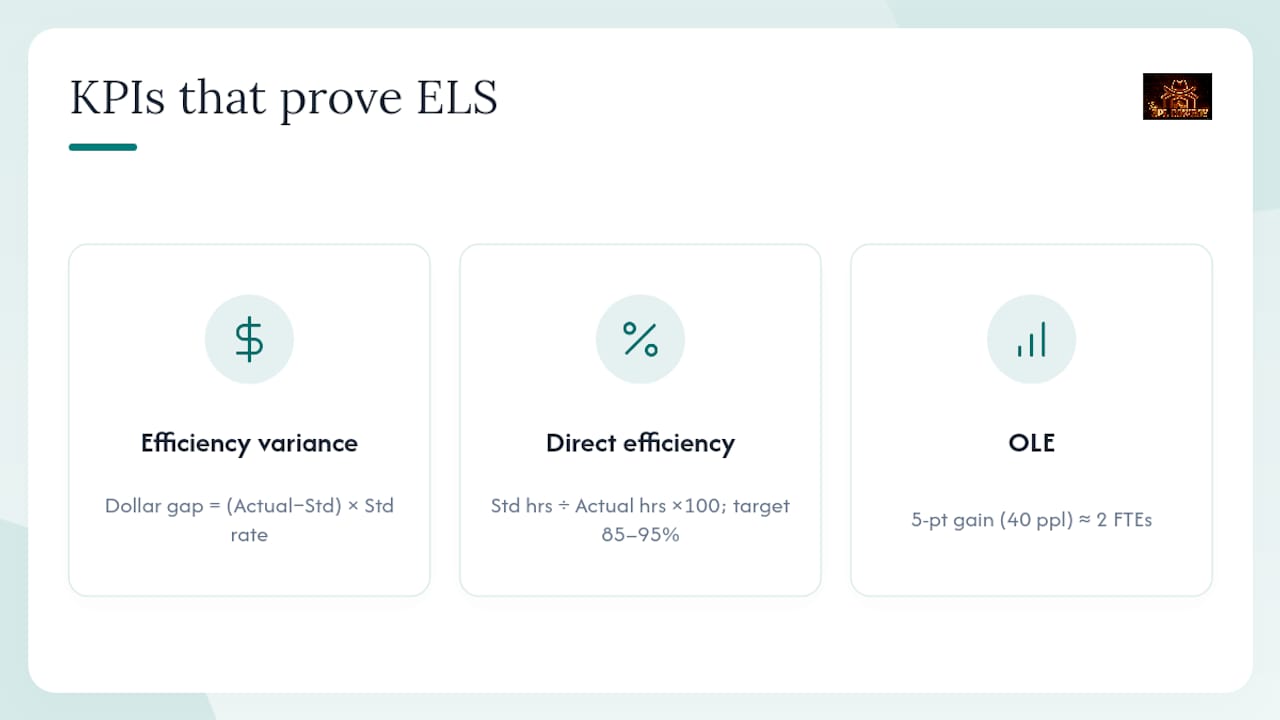
Labor efficiency variance is calculated as (Actual hours minus Standard hours) multiplied by Standard rate, and it tells you in dollar terms whether actual labor exceeded engineered expectations on a given task or shift. It’s most useful on repetitive operations where the standard applies cleanly across many cycles; it gets noisy fast on infrequent or highly variable work.
Direct labor efficiency is commonly figured as (Standard labor hours divided by Actual labor hours used) times 100, and target ranges of 85 to 95 percent are a reasonable practical benchmark for a healthy operation. Anything consistently well below that range points to either a bad standard, a training gap, or a process problem worth investigating before you touch headcount.
The 85 to 95 percent band isn’t a pass/fail line. It’s a guide for where a well-run, engineered process typically lands. A number outside it is a diagnostic starting point, not an automatic verdict on the workforce.
Overall labor effectiveness (OLE) rounds out the picture by combining availability, performance, and quality into one composite view, which keeps you from chasing speed at the expense of accuracy. To turn any of this into a dollar figure, multiply the efficiency gap by your loaded labor rate and hours worked. A five-point efficiency improvement across a 40-person shift can translate into roughly two fewer FTEs needed to hit the same throughput, which is the kind of number that gets a standards program funded past year one. Fulfillment cost benchmarking is the natural next step for converting these variance numbers into a real cost comparison against peer operations.
Common Pitfalls That Wreck an ELS Program
Most ELS programs don’t fail at launch. They fail eighteen months later, quietly, when nobody’s watching.
- Standards decay happens when layout, SKU mix, or equipment changes but the standard doesn’t get re-timed, so it slowly stops matching reality; fix it with scheduled revalidation triggers, not an annual calendar reminder.
- Gaming and unfair pressure creep in when a single speed metric gets over-weighted; pairing throughput data with OLE’s quality and availability components and pairing both with real coaching keeps workers from cutting corners to hit a number.
- Ignoring travel and variability is the single biggest reason UPH targets mislead: a picker’s actual time is dominated by walking, not picking, and a standard that doesn’t model travel distance per zone will be wrong for every zone except the one it was timed in.
- Governance failures show up as no clear owner, no change-control process, and no audit trail, which turns every disputed standard into a shouting match instead of a documented review.
Implementation Checklist: Owners, Data, and Cadence
A program only survives if someone owns it past the pilot phase. Build the governance structure at the same time you build the standard, not after.
- Assign RACI ownership: industrial engineering typically owns the standard’s technical accuracy, operations owns day-to-day application, workforce management owns scheduling integration, and a data or analytics function owns the reporting pipeline.
- Wire up your data feeds: pull from the WMS for actual pick and pack times, the WFM system for scheduled versus worked hours, time-study capture tools for the original baseline, and any floor telemetry (scanners, voice, RFID) for real-time tracking.
- Define your change triggers explicitly: layout changes, new SKU categories, routing changes, and new equipment or technology should each automatically flag a standard for review, in writing, not by memory.
- Build the reporting and coaching loop around variance thresholds: set a tolerance band, escalate anything outside it to a supervisor conversation within the same week, not the following month’s business review.
ISO’s guidance on work allocation offers a useful reference point for documenting these frameworks in a way that holds up to audit, and it pairs well with the 3PL Operational Excellence playbook if you’re building this out as part of a broader operations overhaul.
What Actually Happens When You Roll These Out
Most vendors will sell you a labor standards project as a software implementation. It isn’t. It’s a change management project that happens to produce a spreadsheet of times at the end, and the software is the easy part.
The hard part is what happens in month four, when the layout changes and nobody remembers to re-time the affected tasks, or when a supervisor starts using the standard as a blunt instrument instead of a coaching tool. I’ve seen inventory accuracy programs and pallet redesigns live or die on exactly that kind of follow-through, not on the initial engineering. A 61 percent to 98-plus percent cycle count accuracy swing, or a multi-million-dollar pallet program redesign, doesn’t happen because someone built a good time study. It happens because someone kept the governance running long after the launch excitement wore off.
If you’re evaluating outside help, ask any vendor or consultant one question: what’s their revalidation cadence, and who owns it after they leave? If they don’t have a crisp answer, you’re buying a report, not a program.
— Michael
How 3plcowboy Helps You Build Standards That Actually Hold
Building an ELS program in-house works when you have the industrial engineering bandwidth and the governance discipline to keep it alive past year one. Most operations don’t, and that’s usually the moment a labor standards project either stalls out or gets outsourced to a vendor selling software instead of a method. We run this differently: no warehouse to fill, no listings to move, just operator-grade diligence applied to key supply chain decisions based on deep industry experience.

A typical engagement covers pilot design, RFP development if you’re benchmarking a third-party operator against your own standards, and a governance playbook that names owners and revalidation triggers before the first standard goes live. If you’re deciding whether to build this in-house or bring in outside eyes, our 3PL selection and diligence work and broader advisory services are built around exactly this kind of decision. Reach out and we’ll walk through what a pilot would look like on your floor.
Sources
- What is the formula for calculating efficiency? — AccountingTools
- Direct Labor Efficiency – KPI Definition, Formula, & Benchmarks | KPI Depot
- Overall labor effectiveness — Wikipedia
- Future WFM Operating Standard — WFM Labs
FAQ
What Are Some Examples of Engineering Standards?
Engineering standards used in labor settings include time-and-motion study protocols, PMTS frameworks like MTM and MOST, and standard data systems built from historical elemental times. In a warehouse, an example would be a documented pick standard that specifies travel distance, scan time, and place time per unit, with an allowance percentage added for fatigue and delay.
Where Can I Find Engineering Standards for Labor?
Element time libraries come from PMTS providers, internal time studies, or industry-specific standard data systems built by industrial engineering teams over time. Reference frameworks like ISO’s work allocation standards and the Future WFM Operating Standard offer structural guidance, though the actual time values need to be built or validated against your own operation.
What Are the Basic Components of a Labor Standard?
A basic engineered labor standard has four parts: a defined method for performing the task, elemental time values for each motion or step, an allowance for fatigue and personal needs, and a travel or variability model that accounts for distance and process differences. Skipping the travel model is the most common shortcut, and it’s the reason many UPH-based targets miss the mark.
What Are Engineered Labor Standards, Exactly?
Engineered labor standards are time expectations built from measured or predetermined motion data rather than historical averages, tied to a specific, documented method. They’re used to plan staffing, set fair performance expectations, and track labor efficiency variance against actual results.
How Do I Know If My Current Standards Need Rebuilding?
If your direct labor efficiency consistently falls outside the 85 to 95 percent range, or nobody can explain where a standard’s number came from, it’s a strong sign the standard is decayed or was never properly engineered. A quick diagnostic review, often done as part of a fulfillment cost benchmarking engagement, usually surfaces which tasks need re-timing first.